
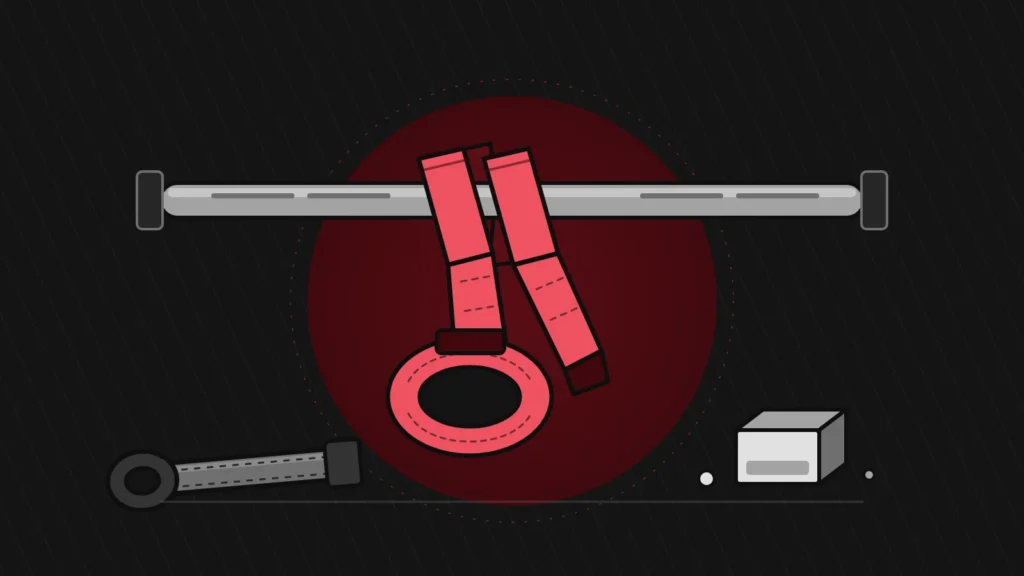
Lifting straps are strips of fabric that loop around your wrist and wrap the bar, so the load travels through your wrist instead of your fingers. On a heavy deadlift, that works, and the research backs it. On a weighted pull-up, it is far less obvious, and that is the part most buying guides leave out. Our stance at SWAT TEAM: chalk first, straps last.
What lifting straps actually do
The mechanism is pure friction. As long as your fingers hold the bar, your grip is a link in the chain, and that link fatigues before your back does. A strap builds a friction loop between your wrist and the bar, so your finger flexors no longer have to generate crushing force. They just keep the hand pinned.
The deadlift data is clear. Jukic and colleagues, writing in Physiology & Behavior in 2021, put sixteen trained men through 4 sets of 4 reps at 80% of their max. With straps, mean and peak bar velocity were higher, grip strength loss between sets was smaller, and rated exertion was lower. Trahey and colleagues, in the Journal of Strength and Conditioning Research in 2023, ran ten trained women through 3 sets to failure at 80%: straps produced significantly more total reps and less grip strength loss, with no change in bar velocity.
One finding deserves your attention before you spend a dime. The 2026 review by Martins and colleagues in the International Journal of Sports Physiology and Performance concludes that straps raise maximal strength and the feeling of security on the bar, but that they do not increase recruitment of the target muscles, contrary to what you hear in most gyms. Straps let you absorb more total work. They do not make any single rep more productive.
Lifting straps vs chalk for pull-ups
Here the numbers cut against the sales pitch. A 2021 study in Sports Biomechanics tested twelve trained men on the lat pull-down, with and without straps. One-rep max came out the same either way: 213 lb (96.5 kg) with straps, 213 lb (96.6 kg) without. No difference in reps at 70% of max, and no difference in latissimus dorsi activation either. The 2026 review reaches the same place: across pulling and back exercises, no consistent effect has been observed.
The reason is simple. On a vertical pull, the bar is not rolling out of your fingers the way a 500 lb deadlift bar does, and the absolute loads are lower. Your grip usually is not the limiter on a pull-up. Your back quits first.
Then there is the rule book, which settles the question if you plan to compete. The technical rules of the World Pull-up Federation forbid gloves, wrist straps and hand taping, and allow only the magnesium powder supplied by the organizer. Train in straps and you will meet your real grip for the first time on meet day. Start with good chalk instead, then treat your grip as a strength quality with dedicated hanging work.
The three types of lifting straps
Three formats cover almost everything, and they are not interchangeable.
| Type | Security | Quick release | Best used for |
|---|---|---|---|
| Closed loop | Lowest, one wrap only | Yes, instant | Snatch, clean, any Olympic lift where you must ditch the bar |
| Lasso | Good to very good depending on wraps | Moderate | The versatile pick: rows, pull-downs, working-set deadlifts |
| Figure 8 | Highest, closed circuit around wrist and bar | No | Max deadlifts, heavy pulls, never overhead |
Hook straps are a fourth option. Security is excellent and there is nothing to wrap, but the hook dictates your wrist angle and wears poorly against thick bars. For general use, the lasso still gives you the best mix of versatility and safety.
On materials: cotton soaks up sweat and stays pliable, nylon does not stretch and lasts longer, leather molds to the wrist but slips while it is new. Common sizing runs around 24 in (60 cm) long and 1.5 in (38 mm) wide. Longer straps give you more wraps and more friction, shorter straps get on and off faster.
How to use lifting straps correctly
Setting up a lasso is the step everyone botches. Wrapped the wrong way, the strap unrolls under load and the set is gone.
- Thread the loose tail through the sewn loop to form a ring, then slide your hand through it.
- Seat the ring on your wrist bone, not in your palm, and let the tail run in line with your thumb.
- Set your hand on the bar and wrap the tail around it in the opposite direction to your fingers. That opposition is what creates the friction.
- Take one to three wraps depending on strap length, never laying one wrap on top of another.
- Pull out the slack by rolling your hand and the bar toward you, like twisting a motorcycle throttle, until it bites.
- Close your fingers over the top. The strap should take the tension before your grip does, otherwise it is doing nothing.
Rehearse it ten times on an empty bar before you use it on a heavy set. Thirty seconds fumbling with a strap between sets is thirty seconds of recovery you gave away.
Where straps belong in a streetlifting plan
The rule we coach: the main movement always happens bare handed. Your heavy weighted pull-ups, dips and muscle-ups get your real grip, because that is the grip you bring to a platform and the one you want improving. For loading progression, see the guide on adding weight to pull-ups, and the full plans in the weighted pull-up program, the weighted dip program and the weighted muscle-up program.
Straps come in afterward, on accessory volume where grip is not the point of the session:
- The heavy barbell row, where the bar slips and you want to load the back without cutting the set short.
- Deadlifts above 85% of max, where your hands fail before your hips do.
- Machine pull-downs late in a session, once your forearms are already cooked from the main work.
Keep them off hangs, heavy carries, close grips and anything you are doing specifically to build your hands. Hiding the weak link guarantees it stays weak.
About the fear you have heard most: no, no long-term study has shown that using straps weakens your grip. The 2026 review files that idea squarely under hypothesis, not established fact. The real case against living in straps is not that they damage your hands, it is that they replace the time you would have spent training them.
Action plan and mistakes to avoid
A framework you can apply at your next session:
- Test before you buy. Take a set of weighted pull-ups to failure and note what gives out, your back or your fingers. If it is your back, you do not need straps.
- Chalk first. A dry grip solves most slipping, and it is legal in competition.
- One format to start. Standard length cotton lassos will cover everything you do.
- Bare hands on the main lift, straps on accessories. Never the reverse.
- No figure 8s or hooks overhead. If there is any chance you need to drop the bar, use a closed loop.
- Do not cinch the ring into your palm. That is the number one cause of straps unrolling and wrists getting chewed up.
- Keep one strap-free session a week on your accessory pulls so your hands keep taking volume.
If you conclude that your grip really is the ceiling on your weighted pull-ups, the answer is not a purchase. Train it: loaded dead hangs, top-position holds, thick bar work. Check which liquid chalk you are using before you look any further, and revisit how to add weight to pull-ups so your load jumps stay sane.

mathieu
Street workout athlete since 2019, I discovered streetlifting in 2023. Today I share my passion for the sport through streetliftings.com.