
Programme Muscle Up : Passé au niveau supérieur
Le muscle up est bien plus qu’un simple exercice de musculation. C’est une démonstration de force, de coordination et de maîtrise corporelle. Si vous cherchez à rendre votre entraînement au niveau supérieur, le muscle up est un mouvement qui mérite toute votre attention.
Programme Muscle Up débutant
Ce programme est conçu pour progresser graduellement vers le muscle-up. N’oublie pas de t’étirer après chaque séance, et ajuste l’intensité en fonction de ta propre condition physique et de ta progression. Répète le jusqu’à maîtriser le mouvement complétement et te sentir à l’aise sur celui-ci :
Ton programme muscle up en 3 semaines
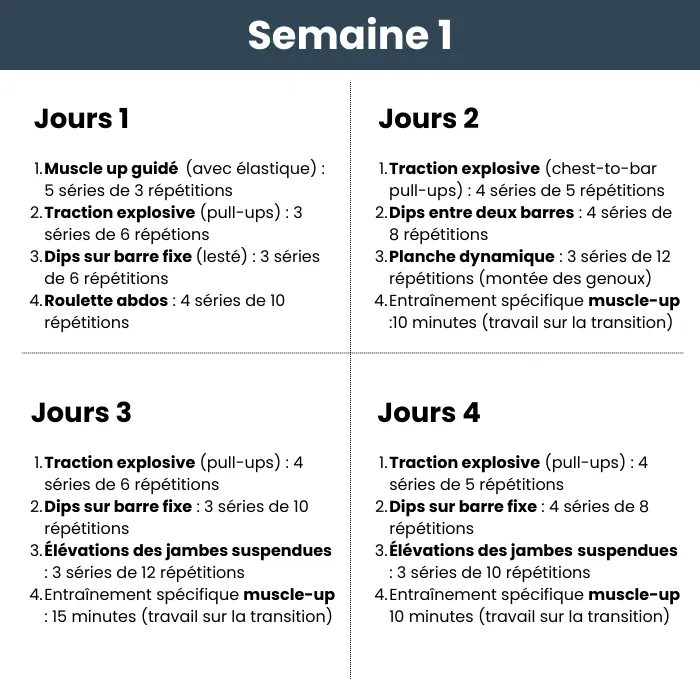
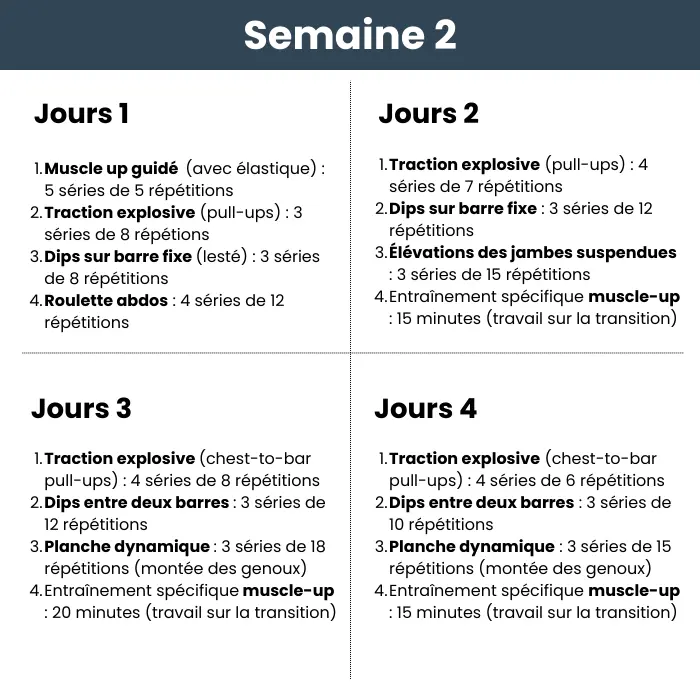
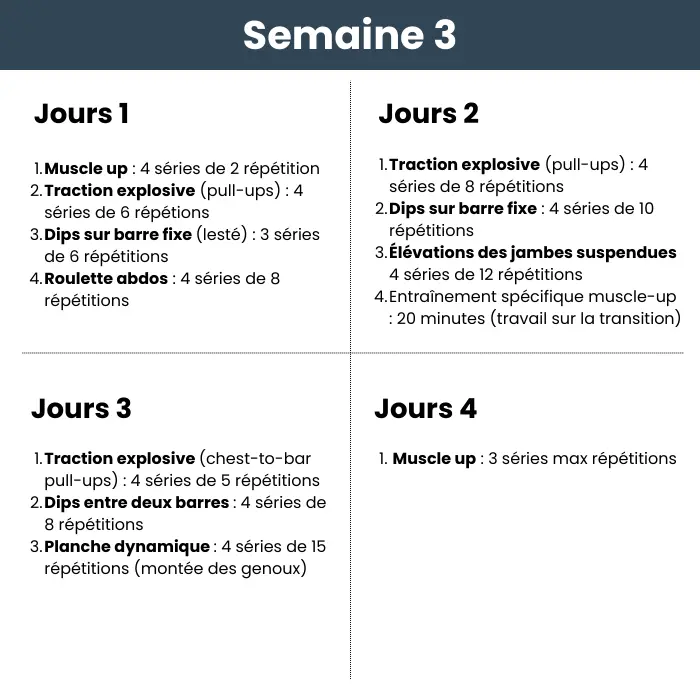

Comment faire chaque mouvement du programme :
Muscle up guidé (avec élastique) :
- Comment : Commence par accrocher un élastique à la bar de traction. Met les deux pieds dedans puis met toi en position suspendue, bras étendus. Lance ton muscle up en t’aidant de la résistance de l’élastique.
- Conseils : Augmente ou diminue la résistance de ton élastique en fonction de ton niveau. Garde ton gainage pendant le mouvement.
Traction Explosive (Pull-Ups) :
- Comment : Commence en position suspendue, bras étendus. Descends en position basse, puis tire-toi vers le haut de manière explosive.
- Conseils : Garde une posture neutre, abaisse les épaules en descendant, puis tire avec force. Utilise l’élan des jambes si nécessaire.
Traction Explosive (Chest-to-Bar Pull-Ups) :
- Comment : Comme le pull-up explosif, mais vise à amener la poitrine au niveau de la barre.
- Conseils : Accentue l’extension des coudes en bas pour maximiser la hauteur de la poitrine. Engage les muscles du dos.
Dips sur Barre Fixe :
- Comment : Place-toi entre deux barres parallèles, bras étendus. Descends jusqu’à ce que les coudes soient à 90 degrés, puis remonte.
- Conseils : Évite de pencher le buste en arrière, maintiens une trajectoire verticale. Serre les omoplates en descendant.
Dips entre Deux Barres :
- Comment : Utilise deux barres parallèles pour les dips. Descends jusqu’à 90 degrés, puis remonte.
- Conseils : Garde les coudes près du corps, le buste droit. Sers les triceps en remontant.
Planche Dynamique :
- Comment : En position de planche, effectue une montée alternée des genoux vers la poitrine.
- Conseils : Stabilise le tronc en engageant les abdominaux. Maintiens une ligne droite du corps.
Élévations des Jambes Suspendues :
- Comment : Pendu à une barre, élève les jambes devant toi en gardant les genoux tendus.
- Conseils : Contrôle le mouvement avec les muscles abdominaux. Descends lentement pour maximiser l’efficacité.
Entraînement Spécifique Muscle-Up :
- Comment : Utilise des élastiques pour assister la transition du pull-up au dip.
- Conseils : Focalise-toi sur la coordination entre le mouvement de traction et la transition. Réduis progressivement l’assistance des élastiques.
Qu'est-ce qu'un muscle-up ?

Le muscle-up est un exercice physique de haute intensité qui combine à la fois une traction et une poussée, se réalisant généralement sur une barre de traction ou des anneaux de gymnastique.
Cet exercice exige une maîtrise technique et une force exceptionnelle, car il consiste à passer de la position de traction, où vous êtes suspendu par les bras, à une position de dips, où vous êtes complètement au-dessus du niveau des barres ou des anneaux. En d’autres termes, vous effectuez une traction jusqu’à ce que votre poitrine dépasse la barre, puis vous continuez à pousser pour finir en position haute, les bras tendus
C’est un mouvement sophistiqué qui exige une coordination et une puissance musculaire considérables, souvent utilisé par les athlètes et les passionnés de fitness pour tester et améliorer leur force fonctionnelle et leur explosivité.
Pourquoi faire des muscle-up ?
Incorporer des muscle-up dans votre routine d’entraînement offre de nombreux bénéfices pour le développement physique et les performances sportives.
Tout d’abord, cet exercice constitue un défi ultime pour la force du haut du corps, sollicitant simultanément les muscles du dos, des épaules, des bras et du tronc. Il permet d’améliorer la puissance fonctionnelle, car il exige une transition fluide entre deux mouvements complexes : la traction et le dips.
Le mouvement favorise également une meilleure connexion esprit-muscle, contribuant ainsi à une meilleure coordination et une plus grande efficacité dans les mouvements polyarticulaire.
Comment Réaliser un Muscle Up

Préparation : Assurez-vous d’avoir une bonne force de base, notamment en maîtrisant les tractions et les dips.
Position de Départ : Suspendez-vous à une barre fixe en position de traction, les paumes des mains tournées vers l’extérieur.
Traction : Tirez-vous vers le haut de manière explosive, en cherchant à amener votre poitrine au niveau de la barre.
Transition : Lorsque vous atteignez le sommet de la traction, inclinez légèrement le haut de votre corps vers l’avant pour faciliter la transition.
Élévation : En continuant le mouvement, poussez-vous vers le haut en position de dips, verrouillez les coudes et stabilisez votre corps.
Descente Contrôlée : Inversez le mouvement de manière contrôlée pour redescendre à la position de départ.
Les avantages des muscle-up
Les muscle-up offrent des avantages significatifs pour le développement physique global.
En améliorant la force du haut du corps, ils favorisent une hypertrophie musculaire efficace et une meilleure définition des bras, des épaules et du dos.
Leur nature explosive et complexe améliore la puissance fonctionnelle, la vitesse et la coordination.
Les muscle-up renforcent la stabilité des articulations, en particulier des épaules, ce qui peut réduire le risque de blessures.
Pour les athlètes et les passionnés de fitness et street workout, cet exercice est un véritable indicateur de force et de technique, offrant une satisfaction personnelle et une motivation accrue à atteindre de nouveaux objectifs d’entraînement.
FAQ du programme muscle up
Q : Puis-je suivre ce programme si je suis débutant en musculation ?
R : Oui, le programme est conçu pour s’adapter à différents niveaux de fitness. Assurez-vous de suivre les étapes progressivement.
Q : Combien de fois par semaine dois-je effectuer le programme ?
R : Trois à quatre séances par semaine sont recommandées, mais ajustez en fonction de votre emploi du temps et de votre récupération.
Q : Est-ce que je peux faire des muscle ups si je n’ai pas de barre de traction à la maison ?
R : Absolument. Si vous n’avez pas de barre de traction, vous pouvez utiliser des anneaux de gymnastique suspendus à une poutre solide ou à un cadre de porte adapté. Les anneaux offrent une alternative efficace pour développer la force nécessaire au muscle up.
Q : Dois-je continuer le programme une fois que j’ai réussi mon premier muscle up ?
R : Oui, il est recommandé de continuer le programme même après avoir réussi votre premier muscle up. Cela contribuera à renforcer votre performance, à perfectionner votre technique et à prévenir toute perte de compétences. Vous pouvez également ajuster le programme pour inclure des variations plus avancées du muscle up ou d’autres objectifs de fitness.