
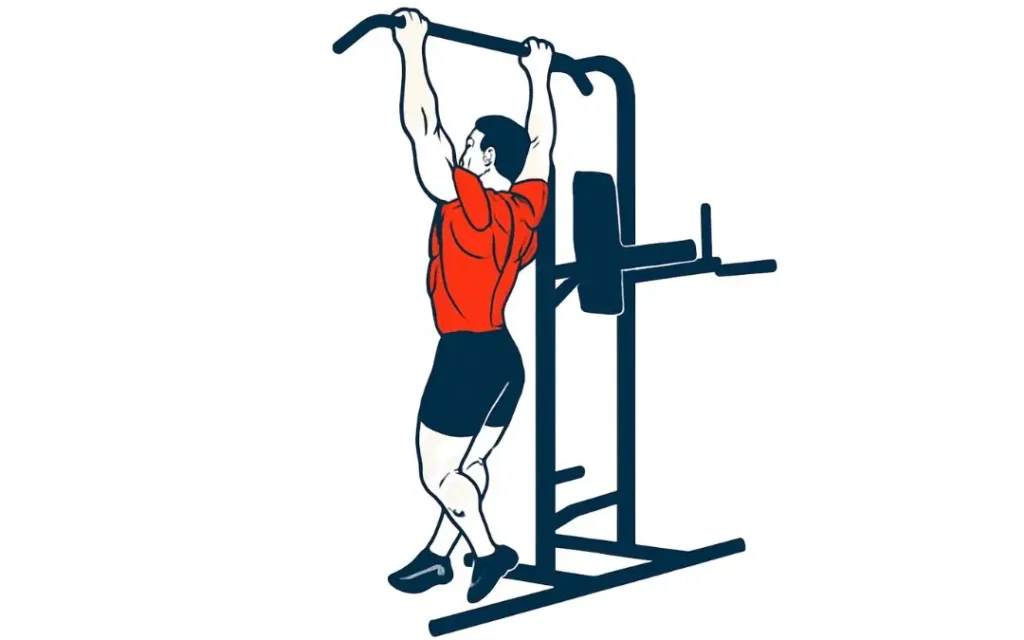
Pull-ups are a cornerstone exercise for any strength-training program. Among the many variations – including the weighted pull-up program – the neutral grip pull-up stands out for its versatility and joint comfort. Whether you are a beginner or an experienced athlete, this exercise offers an excellent way to build your back and arms while avoiding excessive joint stress.
How to do neutral grip pull-ups
Mastering the neutral grip pull-up is essential to getting the most out of it. It all starts with proper positioning and disciplined execution. Here are the detailed steps for performing this exercise like a pro.
Positioning on the neutral grip pull-up bar
-
Choose a bar with parallel handles: The defining feature of neutral grip pull-ups is hand orientation. Your palms must face each other.
-
Place your hands at shoulder width: A grip that is too wide or too narrow can limit range of motion or create tension.
-
Hang from the bar: Retract your shoulders and engage your shoulder blades to prepare your back for the effort.
-
Keep your body aligned: Brace your core and squeeze your glutes to stabilize your posture and avoid swinging.
Executing the movement
-
Pull yourself up: Focus on your lats and biceps to raise yourself until your chin clears the bar.
-
Control the descent: Lower yourself slowly until your arms are almost fully extended. This maximizes muscle engagement and prevents injury.
-
Breathe correctly: Inhale on the way down and exhale during the pulling phase.
Good technique is essential to avoid injuries and optimize results.
Program or coaching?
Find your ideal format
Answer 4 questions and receive a personalized recommendation based on your level and goals.
Tailored result
Free
Muscles targeted
The neutral grip pull-up engages many muscles – similar to a barbell row – making it a complete exercise. Here are the main muscles worked:
-
Latissimus dorsi: The primary muscles engaged, responsible for back width.
-
Biceps: The arms play an essential role during the pulling phase.
-
Trapezius and rhomboids: These stabilize your shoulder blades.
-
Teres major and teres minor: These secondary muscles complement the back work.
-
Core: Active bracing keeps the body stable throughout the movement.
Benefits of neutral grip pull-ups
The neutral grip pull-up offers several advantages that make it ideal for athletes of all levels:
-
Joint comfort: The neutral grip reduces pressure on the shoulders and elbows, lowering injury risk.
-
Accessibility: It is often perceived as easier than the pronated-grip version, making it a good option for beginners.
-
Versatility: This exercise targets multiple muscle groups while being adaptable to different intensity levels.
-
Progression: Ideal for advancing toward more complex variations like the overhand (pronated) pull-up.
Neutral grip pull-up variations
Pronated-grip pull-up (overhand)
The overhand pull-up is a classic and demanding variation. In this version, palms face forward, which increases lat involvement and also recruits the forearms, building grip strength. Although harder, it develops functional strength and an ideal range of motion for a V-shaped back.
To perform an overhand pull-up, keep your body stable to avoid swinging. A controlled ascent and a slow descent maximize muscle engagement. If this variation is too difficult, using a resistance band or an assisted machine can be a good way to progress.
Supinated-grip pull-up (chin-up)
The chin-up differs in hand orientation: palms face toward you. This grip shift transfers more of the effort to the biceps while still strongly activating the lats. This variation is ideal for working both arms and back simultaneously, offering excellent muscle balance.
To optimize the chin-up, use a grip slightly narrower than shoulder width. Focus on contracting the biceps on the way up and maintain a controlled descent. This movement can also be a good choice for beginners, as it is often perceived as more accessible.
Australian pull-up (inverted row)
The Australian pull-up is an excellent alternative for beginners or those who want to vary their training. Performed with a low bar, the body is inclined, which reduces the load. It strengthens the back muscles while improving posture and core stability.
To perform this variation, position a bar at hip height and lie beneath it. Your feet stay on the floor or elevated, and your body must form a straight line. Pull yourself toward the bar by squeezing your shoulder blades, then lower yourself slowly. The Australian pull-up is also ideal for high-rep sets or as a warm-up before more demanding pull-up variations.
Common mistakes to avoid
When doing neutral grip pull-ups, certain mistakes are common and can hurt your performance or lead to injury:
-
Skipping the warm-up: A proper warm-up prepares your joints and muscles for the effort ahead.
-
Using momentum: Kipping reduces the exercise’s effectiveness and can stress your shoulders.
-
Neglecting core bracing: Lack of stability compromises body alignment and increases injury risk.
-
Dropping too fast: An uncontrolled descent limits muscle engagement and raises injury risk.
Coach’s conclusion
Neutral grip pull-ups are an excellent exercise for strengthening your back, arms, and core while protecting your joints. By adopting impeccable technique and varying your exercises, you will optimize your results. Integrate them into your weekly routine for a powerful and well-balanced back.
Remember: consistency and perfect execution are the keys to success. So grab that bar and push past your limits!