
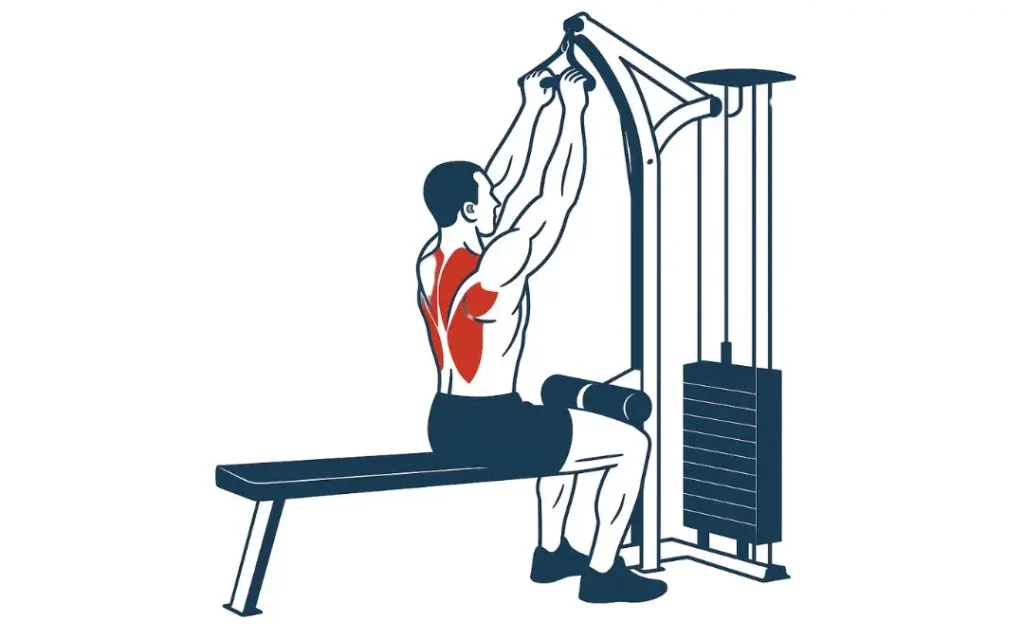
The close-grip lat pulldown is a must-have exercise in strength training to build a wide, dense, and powerful back. It primarily targets the upper back muscles while also engaging the arms and shoulders. Whether you are a beginner or an experienced lifter, performing this movement correctly is essential to reap all its benefits and avoid injuries. Here is everything you need to know to master this exercise.
How to Do the Close-Grip Lat Pulldown
The close-grip lat pulldown is typically performed on a high-pulley machine using a V-bar or triangle handle, allowing a neutral grip. It is an excellent alternative to the wide-grip lat pulldown or pull-ups.
Setup
Before you start, make sure your machine is properly set up:
-
Adjust the seat height so your arms are slightly extended when you grab the handle.
-
Place your knees under the pads to properly stabilize your body throughout the movement.
-
Choose a V-bar or triangle handle that allows a close neutral grip (palms facing each other).
Adopt a tall, upright posture, slightly leaned back, chest up, and core engaged.
Execution of the Close-Grip Lat Pulldown
-
Grip the V-handle with both hands, arms fully extended.
-
Pull the handle toward the upper chest, bringing your elbows close to your sides.
-
Squeeze your shoulder blades firmly together at the end of the movement.
-
Lower the weight slowly back up, controlling the eccentric phase, until your arms are almost fully extended.
-
Repeat for 8 to 15 reps depending on your goal (strength, hypertrophy, or endurance).
Program or coaching?
Find your ideal format
Answer 4 questions and receive a personalized recommendation based on your level and goals.
Tailored result
Free
Muscles Worked
The close-grip lat pulldown primarily targets:
-
The latissimus dorsi, the main back muscle
-
The lower and mid trapezius
-
The rhomboids (muscles between the shoulder blades)
-
The biceps (as a synergist)
-
The brachialis and brachioradialis
Advantages of the Close Grip Over the Wide Grip
-
Less shoulder stress: The neutral grip allows a better joint position, ideal for people with shoulder pain.
-
Greater range of motion: The movement often allows a fuller range of pull, promoting better muscle recruitment.
-
Better lat focus: The close grip enables a better stretch and stronger contraction of the latissimus dorsi.
-
Increased stability: The narrow arm position provides more control and stability, especially for beginners.
-
Versatility: It can easily be integrated into any back training program.
Tips to Keep Progressing
Here are some tips to optimize your results on the close-grip lat pulldown:
-
Vary the tempo: Try a 2-1-3 tempo (2 sec pull, 1 sec contraction, 3 sec return) for better muscle recruitment.
-
Add volume progressively: Gradually increase load or reps to stimulate hypertrophy.
-
Work in supersets: Pair it with rows or pull-ups for a complete back workout.
-
Focus on the contraction: Visualize your shoulder blades coming together with each pull.
-
Use straps if needed: If your grip gives out before your lats, straps can help maintain proper muscular effort.
Common Mistakes to Avoid to Stay Injury-Free
Even though the movement seems simple, bad technical habits can limit your progress or cause injuries. Here are the most common ones:
-
Rounding the back: Poor posture reduces the effectiveness of the exercise and increases the risk of lower back injury.
-
Pulling with arms only: Think about engaging your back from the very start of the movement – initiate the pull with your shoulder blades.
-
Overloading the machine: Too much weight will push you to cheat with momentum, at the expense of muscle recruitment.
-
Shrugging the shoulders: This reduces lat engagement and overloads the upper trapezius.
-
Lack of control: Do not let the weight snap back up – maintain a slow and controlled eccentric phase.
Coach’s Conclusion
The close-grip lat pulldown is an essential strength training exercise to sculpt a strong and aesthetic back. Accessible, safe, and effective, it offers an excellent alternative to the wide grip, especially for those who want to more precisely target the latissimus dorsi. By maintaining good technique, avoiding classic mistakes, and intelligently integrating this exercise into your program, you will maximize your gains while minimizing risk. Let’s go, and always remember – quality of movement before quantity!