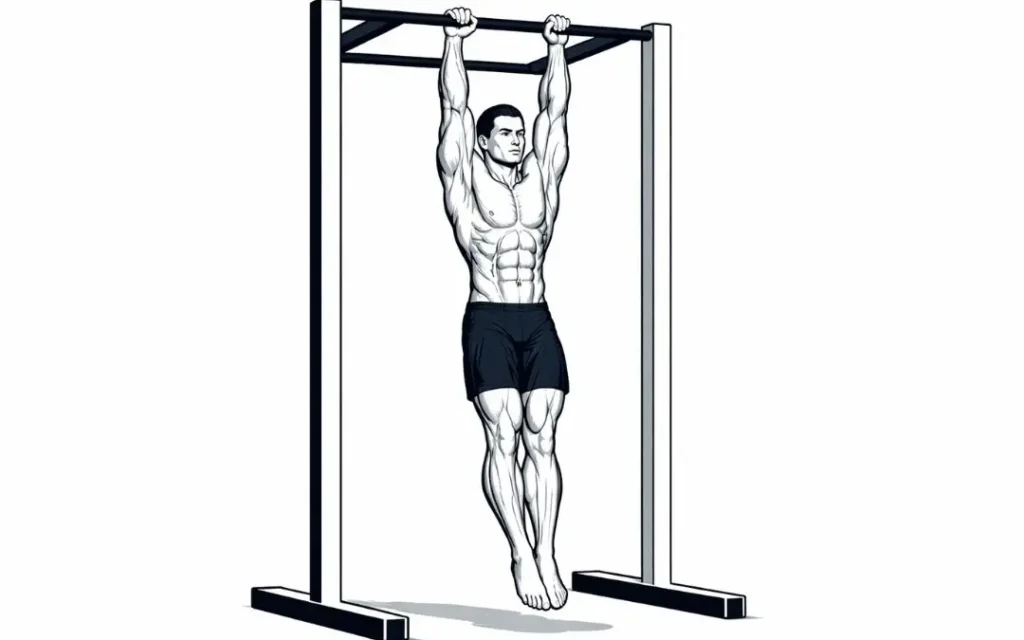
The dead hang, or passive hang, is an exercise as simple as it is effective – valued in streetlifting, strength training, and even climbing. It consists of hanging from a bar with straight arms and no movement. Do not be fooled by its apparent simplicity: despite looking easy, it is an excellent tool for building strength, preventing injuries, and improving grip. Here is everything you need to know to execute this movement correctly, get the most out of it, and progress quickly.
How to Perform the Dead Hang
The dead hang is accessible to everyone, but it requires good technique to avoid common mistakes and unnecessary pain.
-
Starting position: Grab a fixed bar with a pronated grip (palms facing forward), hands shoulder-width apart or slightly wider.
-
Passive hang: Let your body stretch naturally. Arms must remain completely straight, with shoulders slightly elevated (no active engagement).
-
Feet off the ground: Your feet must not touch the floor. Bend your knees slightly if needed.
-
Breathing: Inhale deeply and control your breathing throughout the hang.
Recommended duration for beginners:
Start with 10 to 20 seconds, then progress gradually. The goal is to reach 30 to 60 seconds for noticeable effects – especially in streetlifting, where grip is a decisive performance factor.
Program or coaching?
Find your ideal format
Answer 4 questions and get a personalized recommendation based on your level and goals.
Tailored result
Free
Muscles Worked
Even though the dead hang appears passive, several muscle groups are engaged:
-
Forearms: The finger flexors work intensely to maintain grip on the bar.
-
Shoulders: Stabilizing muscles (particularly the mid and lower trapezius) are activated to maintain posture.
-
Back: Even without pulling, the lats are slightly engaged to stabilize the upper body.
-
Core: To avoid swinging, the abdominal muscles must stay contracted.
It is therefore an excellent complementary exercise in a streetlifting routine, particularly for improving grip strength, which is often the limiting factor in weighted pull-ups.
Benefits of the Dead Hang in Streetlifting
In a discipline like streetlifting, where weighted pull-ups and weighted muscle ups are essential, the dead hang offers several advantages, making it a must-have in any solid streetlifting program:
-
Grip improvement: It is one of the most effective exercises for strengthening your grip.
-
Injury prevention: It promotes shoulder decompression and improves joint mobility, reducing shoulder and elbow pain.
-
Forearm strengthening: Strong forearms mean more safety and performance on the bar.
-
Better isometric endurance: Useful for holding the top position of a movement or during a controlled descent phase.
Tips to Progress and Build a Better Grip
Progressing in the dead hang requires consistency, but also a few technical adjustments and complementary exercises:
Vary your grip
-
Wide pronated grip: To target the lats more.
-
Supinated grip: Engages the biceps more.
-
Pinch grip: Gripping a board or flat support for finger-specific work (ideal for climbers and advanced streetlifting athletes).
Progressively increase duration
Use an interval approach: do 3 to 5 sets of 20 seconds with 30 seconds of rest. Increase the duration week by week.
Use equipment if needed
-
Liquid chalk: To prevent slipping.
-
Resistance bands: To reduce your bodyweight and help you hang longer when you are just starting out.
Add complementary exercises
-
Farmer’s walk: Walk with heavy loads to strengthen your grip.
-
Plate pinches: Hold weight plates between your fingers.
-
Reverse curls: Strengthen the forearm extensors.
Coach’s Conclusion
The dead hang is far more than a simple recovery exercise. It is a genuine progression tool in streetlifting that will help you build a solid grip, protect your shoulders, and strengthen your forearms. Easy to implement, requiring no complex equipment, it fits perfectly into any program – whether you are a beginner or an advanced athlete. So hang on… literally!