
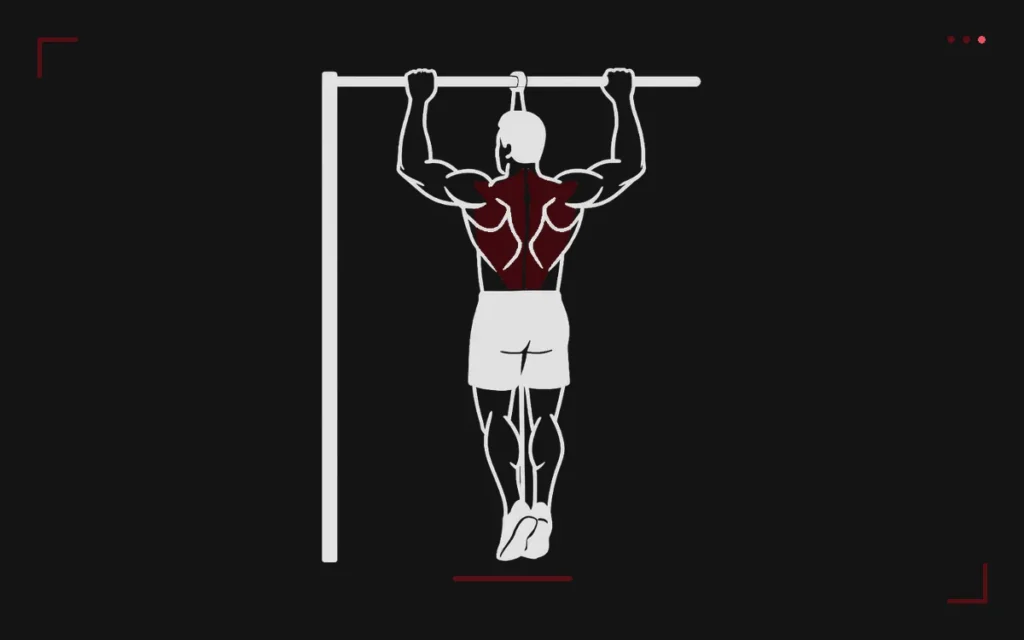
Resistance band pull-ups are the ideal tool for learning to master this iconic strength movement. Thanks to a resistance band, your bodyweight is partially offset, letting you perform the movement more easily while working on technique and the muscles involved. It is a perfect solution for beginners who want to achieve their first pull-ups, and also a stepping stone toward more advanced goals such as weighted pull-ups in streetlifting.
Assisted pull-ups with a resistance band – a tool for beginners and those looking to progress
The band-assisted pull-up is often the first learning stage for anyone who wants to build strength and control. By supporting part of your bodyweight, the band lets you repeat the movement more easily, correct your posture, and familiarise yourself with the mechanics of the pull-up.
In streetlifting, this stage is non-negotiable: before loading the bar with added weight, you must master strict bodyweight pull-ups. The band therefore offers a progressive path, taking you from being a beginner who cannot complete a single pull-up all the way to performing weighted pull-ups.
Program or coaching?
Find your ideal format
Answer 4 questions and get a personalised recommendation based on your level and goals.
Tailored result
Free
Why do band-assisted pull-ups?
The main benefit lies in the targeted assistance the band provides. The more the band is stretched, the more help it gives at the hardest point of the movement: the pulling phase. This lets you:
- repeat the full movement without getting stuck,
- build muscle memory and coordination,
- improve your confidence and consistency,
- progress steadily toward strict pull-ups.
Which muscles do pull-ups work?
Resistance band pull-ups engage the same muscles as standard pull-ups:
- Latissimus dorsi: the primary drivers of the movement.
- Trapezius and rhomboids: scapular stabilisers and upper-back support.
- Biceps and forearms: contribute to elbow flexion.
- Rear deltoids: stabilise the position and sustain the effort.
- Core and abs: keep the body straight and prevent swinging.
What is the maximum weight a pull-up band can support?
The resistance capacity of a band depends on its thickness, length, and manufacturer. In general, pull-up bands provide between 5 and 80 kg of assistance.
- Thin bands (5 to 15 kg): for experienced athletes who need minimal help.
- Medium bands (15 to 35 kg): for beginners who can already do a few reps.
- Heavy bands (35 to 80 kg): for complete beginners or people returning from injury.
How to choose a resistance band for pull-ups?
Resistance level
Your choice should match your current level. Too much assistance can slow progress; too little can block your technique.
Material
The best bands are made of natural latex or rubber, offering elasticity and durability. Fabric or mesh models may be more comfortable but less progressive.
Length
A 2 m band is often ideal for a standard pull-up bar, as it provides a good tension point without interfering with the movement.
Price
Expect to spend between 10 and 30 euros depending on the brand and resistance level. Buying a full set is often more cost-effective for adjusting your progression.
See our complete guide to choosing a resistance band for training.
How to attach a resistance band to your pull-up bar correctly?
The attachment must be secure so the band does not slip during the exercise. The simplest method:
- Loop the band around the pull-up bar.
- Thread one end through the loop.
- Pull until the band is tight and firm.
More information: How to secure a resistance band
Technique for doing resistance band pull-ups
Starting position
- Attach the band securely.
- Place one foot (or one knee) in the loop.
- Grip the bar in pronation (palms facing away) at shoulder width.
Executing the band-assisted pull-up
- Inhale at the bottom with arms extended and shoulders depressed.
- Pull yourself up by contracting your back until your chin clears the bar.
- Exhale at the top, then lower yourself slowly and control the negative phase.
Key points for well-executed assisted pull-ups
- Keep your body straight without swinging.
- Control the descent – do not drop.
- Make sure the band stays firmly attached and does not rub against your joints.
Sample resistance band pull-up training plan to build progress
Here is a simple session example for a beginner:
- Warm-up: 5 minutes of shoulder mobility + 2 sets of scapular pull-ups.
- Band-assisted pull-ups: 4 sets of 8 to 12 reps.
- Negative pull-ups (without band): 3 sets of 5 reps, slow descent (4-5 sec).
- Band rows: 3 sets of 12 to 15 reps.
- Plank hold: 3 sets of 30-45 sec.
When can I do pull-ups without a band?
You can remove the band when you are able to complete 8 to 10 assisted reps with perfect control and are starting to manage a few reps without help.
The transition is gradual: alternate sets with and without the band until you no longer need assistance.
BONUS – 3 tips to progress toward weighted pull-ups
- Include negative pull-ups: slow lowering without a band to strengthen the eccentric phase.
- Vary your grip (pronation, supination, neutral) to develop the full back.
- Move on to weighted pull-ups: once you master 12 to 15 strict pull-ups, add a weight (attached to a dip belt) to keep building strength and prepare for streetlifting competitions.
Coach’s conclusion
Resistance band pull-ups are an essential learning tool for stepping up to strict pull-ups and then weighted pull-ups. They help you acquire proper technique and strengthen the muscles of the back and arms, while progressing safely without risk of injury. Used correctly, they become a launchpad toward pure strength.
So invest in a good band, stay disciplined with your technique, and before long, unassisted – and even weighted – pull-ups will become your new playground.
Start Here
- Streetlifting Program
- Weighted Muscle Up Program
- Weighted Pull-Up Program
- Weighted Dip Program
- Squat Program

mathieu
Street workout athlete since 2019, I discovered streetlifting in 2023. Today I share my passion for the sport through streetliftings.com.