
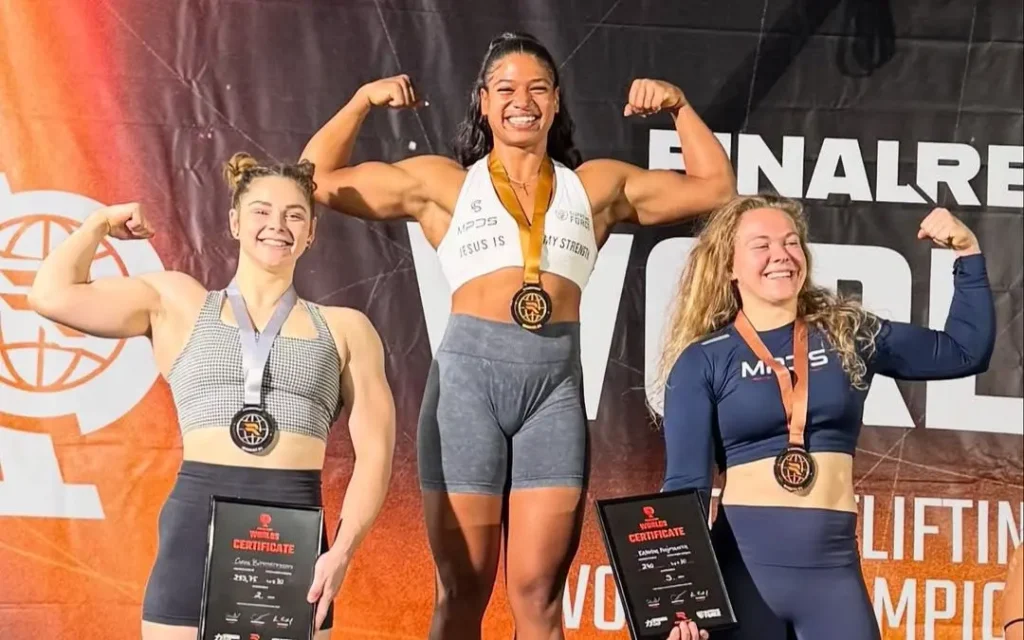
The third edition of the Streetlifting World Championships took place on October 4 and 5, 2025 in Halle, a German city near Leipzig. For the third consecutive time, the organization Final Rep orchestrated the event with particular care, in a new host city but still in Germany.
80 athletes, qualified through official Final Rep competitions around the world, competed throughout the weekend in an electrifying atmosphere, each with a single goal: to claim the 2025 world champion title in their category.
What is streetlifting?
Streetlifting is a fast-growing strength discipline, born out of street workout, consisting of performing weighted movements in a structured competition format. The four official events are:
-
The weighted muscle up,
-
The weighted pull-up,
-
The weighted dips,
-
And the squat
Each athlete has three attempts per movement to achieve their best lift, with strict execution standards to meet.
Program or coaching?
Find your ideal format
Answer 4 questions and receive a personalized recommendation based on your level and goals.
Tailored result
Free
An intense competition in the arena
From early morning, some athletes had to show up for the official weigh-in, sometimes as early as 6:30 a.m. Then came the show at the SWH.Arena, transformed for the occasion into a true gladiatorial theatre. The infrastructure received unanimous praise: three warm-up stations identical to those on the main platform, smooth logistics, and a well-separated but equally immersive athlete/spectator area.
Over two days, 12 categories, both men and women, took to the stage one after another. The intensity, the physical and mental preparation, and the pressure of elite competition produced spectacular head-to-head battles.
Judging under fire
Contested severity
The first point of friction over the weekend: judging. Deemed too strict, even inconsistent at times, it sparked debate. Many « no rep » decisions (rejected attempts) were contested by athletes. While some were justified (failure to follow commands, use of bounce, insufficient depth), others left room for doubt – particularly on weighted dips and squats.
As one official put it:
« Athletes must convince the judges they are rep. Not just reach depth, but exaggerate it. »
Shoulders touching the station at dips, hamstrings grazing the floor at squats: that is the level of implicit demand.
Johan Sanon’s injury
Among the notable incidents, French athlete Johan Sanon, the -73 kg world champion, suffered a pectoral tear. An accident that reignites the debate around excessive depth requirements, potentially responsible for mechanical overload.
Top contenders under pressure
High-profile athletes such as Benjamin Ibanez (Chile) and Gwendal Scott Roy Simon (Belgium) opened too high and were caught out by the standards. Ludo Adamantium, a well-known figure in the sport, summed up the situation during a live stream:
« It’s because you don’t train to standards all year long. »
Excessively strict demands, or athletes who are borderline on their standards year-round? The debate rages in the streetlifting community.
« Mistakes are human »: Jan Knoest speaks out
In a video that went viral, Dutch athlete Jan Knoest spoke out in a measured yet striking way:
« Judges are human and can make mistakes – that is part of sport. But this weekend, the mistakes were devastating. »
He specifically pointed to one judge responsible for numerous controversial decisions, more than 30 of which were overturned after VAR intervention. Knoest emphasizes this is not a personal attack, but an observation: the system needs to be rethought.
Favored athletes?
Another controversy from the weekend: the case of Gokcan Aydin, in the -87 kg category. Weighed above the limit at the first weigh-in, he should have been disqualified. But following an organizational delay in launching the sessions, an exceptional re-weigh was offered to him. Result: the German validated a weight after a rapid cut, competed… and reached the podium (3rd place), at the expense of French athlete Kevin Gogo, who finished fourth.
A decision that raises questions:
Where is the fairness for athletes who were on time and on weight from the very first weigh-in?
Final Rep: a step up
Despite the criticism, the progress made by Final Rep as an organization deserves acknowledgment. The international qualifiers allowed for worldwide representation, with athletes from India, the United States, Brazil, and across Europe.
The equipment was top-of-the-line, the platform on par with the best competitions. The live broadcast, high quality, allowed thousands of viewers to follow the performances in real time. On site, a well-designed spectator area delivered a great experience, despite the length of the days.
What’s next for Final Rep: going international
The day after the Worlds, Final Rep convened an exceptional committee bringing together judges, athletes, sponsors and media. The goal: to shape the future of global streetlifting.
What was announced:
-
Three continental championships starting in 2026: Europe, Asia, and the Americas.
-
Implementation of an anonymous judging system through digitalization, to eliminate personal bias.
-
Worldwide standardization of « rep » criteria, backed by reference videos.
-
Creation of an international judging corps, better trained, better supervised, and evaluated at each competition.
Conclusion
The 2025 World Championships will prove to be a turning point for streetlifting. Caught between heightened demands, controversial judging, and a genuine will to improve, Final Rep is walking a tightrope. But the organization also demonstrates its capacity to question itself, to listen to its community, and to drive the discipline toward a more structured, fairer, and ever more spectacular global stage.
Find the 2025 streetlifting world championship results.