
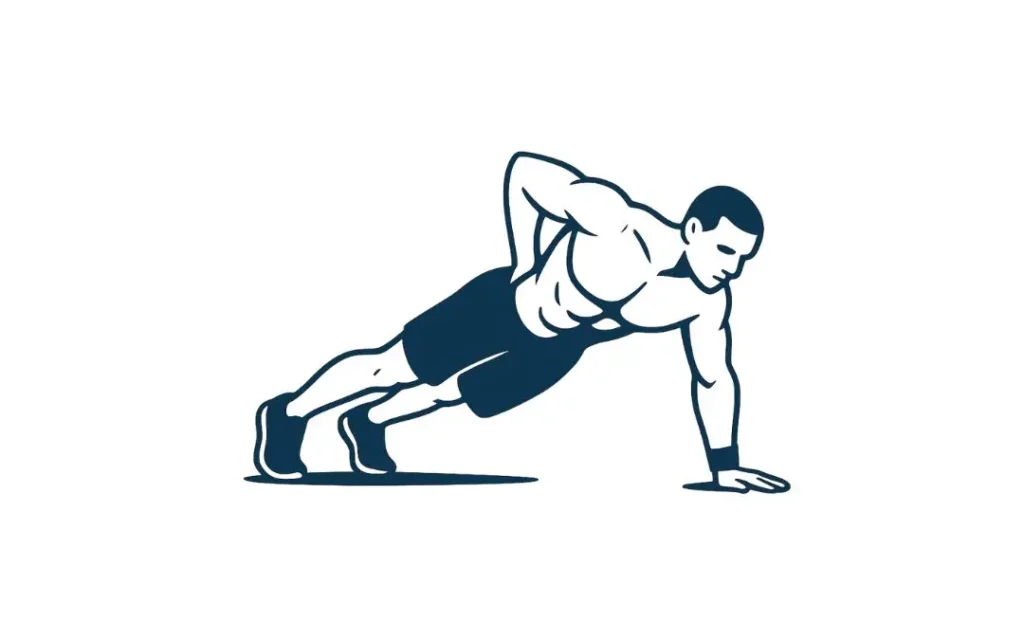
The one-arm push-up is one of the most impressive and effective exercises for developing upper-body strength, stability, and balance – and it will help you progress in your weighted muscle up and weighted dips. It is a coveted milestone for many athletes and gym-goers because it demonstrates advanced body control and considerable power. However, before you can perform a one-arm push-up, you need to follow a well-structured progression and adopt solid technique to avoid injury.
Start Here
- Streetlifting Program
- Weighted Muscle Up Program
- Weighted Pull-Up Program
- Weighted Dip Program
- Squat Program
Steps to Do a One-Arm Push-Up

The one-arm push-up demands far more than raw strength. It requires precise body control, excellent stability, and optimal muscular coordination. Here are the steps to master this movement:
1. Build a solid foundation with standard push-ups
Before attempting a one-arm push-up, you must first have perfect command of standard push-ups. You should be able to perform at least 20 to 30 reps with excellent technique. This ensures you have the necessary strength in your chest, shoulders, triceps, and – crucially – your core, which is essential for stabilizing your body during the one-arm push-up.
2. Train your core stability
The core plays a key role in the one-arm push-up. Without solid abdominal stability, you risk losing balance and engaging unwanted muscles during the movement. To strengthen your core, include exercises such as planks, side planks, and mountain climbers in your routine. These movements will help you stabilize your body while recruiting the key muscles needed to execute a one-arm push-up.
3. Start with offset push-ups
Once comfortable with standard push-ups, begin working with offset push-ups. These involve placing one hand elevated (on a block or platform) and the other on the ground. The greater the height difference, the more load is shifted onto the lower arm. This gradually conditions you to support increasing amounts of weight on a single arm.
4. Incorporate archer push-ups
Archer push-ups are an excellent transition toward the one-arm push-up. They involve placing your hands wider than shoulder-width, bending one arm while keeping the other fully extended to the side. The straight arm provides minimal assistance, leaving the bent arm to bear the majority of the load. This prepares you mentally and physically to handle the demands of a one-arm push-up.
5. Try assisted one-arm push-ups
If full one-arm push-ups are still too difficult, you can try assisted push-ups. Use a resistance band under your chest or place your non-working hand on a support such as a ball to reduce the load and stabilize the movement.
6. Progress to the one-arm push-up
After mastering the previous progressions, you can finally attempt one-arm push-ups. Widen your foot stance for better balance, place your working hand directly under your active shoulder, and ensure your core is fully engaged to maintain alignment. Lower yourself slowly, keeping your body rigid and straight, then press back up with control.
Program or coaching?
Find your ideal format
Answer 4 questions and receive a personalized recommendation based on your level and goals.
Tailored result
Free
How to Perform a One-Arm Push-Up
- Starting position: Spread your feet wider than you would for standard push-ups to better stabilize your body. Place your working hand directly under your active shoulder.
- Full-body tension: Brace your abs and glutes to maintain a rigid alignment from head to toe.
- Controlled descent: Lower yourself slowly by bending the elbow of your working arm, taking care not to rotate your torso excessively.
- Press back up: Drive hard to return to the top while keeping your body perfectly aligned.
How to Train for the One-Arm Push-Up

Achieving a one-arm push-up is not purely a question of brute strength. A well-designed training program is essential for building the power, muscular endurance, and balance required. You can also work complementary movements beforehand, such as archer push-ups. Here is how to organize your sessions to maximize your chances of success:
1. Strengthen the primary muscles
The muscles most heavily recruited during one-arm push-ups are the chest, the triceps, and the deltoids (shoulders). To strengthen these muscles, include exercises such as the bench press, dips, and pull-ups for the shoulders and triceps. Vary the types of push-up in your training (diamond push-ups, pike push-ups) to develop your entire upper body.
2. Work on unilateral strength
One of the greatest challenges of the one-arm push-up is pressing your entire bodyweight with a single arm. To get there, it is useful to train unilateral strength – exercises where only one side of the body works at a time. For example, single-arm dumbbell presses allow you to concentrate the effort on one arm while also building core stability.
3. Stability and balance training
Balance is paramount in the one-arm push-up. You can improve your stability through proprioception exercises such as single-leg squats, BOSU exercises (half-sphere balance trainers), or by training on unstable surfaces like Swiss balls. These develop the stabilizer muscles that will help you maintain a straight position throughout the movement.
4. Progressive overload
Do not rush into one-arm push-ups. It is essential to follow a slow and consistent progression to avoid injury. Start with sets of standard push-ups, move to offset push-ups, then to archer push-ups. Only advance to the next stage when you can perform at least 10 clean reps at your current level.
5. Programming and recovery
To work toward the one-arm push-up, it is recommended to train this skill 2 to 3 times per week. But do not overlook recovery – it is equally important. Schedule rest days to allow your muscles to rebuild and to avoid joint overload. Active recovery, such as stretching and massage, can also speed up muscle recovery and reduce soreness.
Is the One-Arm Push-Up Dangerous?
One-arm push-ups, while effective for upper-body development, carry certain risks if performed with poor technique – risks you could sidestep with a chest press instead. Let’s take a closer look at the potential dangers and how to avoid them.
1. Shoulder injury risk
The shoulder is one of the joints most heavily loaded during a one-arm push-up. If your technique is not perfect, you risk overloading this joint, which can lead to pain or injuries such as tendinitis. To prevent this, make sure to warm up your shoulders thoroughly before the exercise and always maintain correct posture.
2. Lower back strain
Another common source of injury is the lower back, especially if you are unable to maintain solid core stability. If your abs are not sufficiently engaged, your hips may sag, placing excessive pressure on your spine. It is therefore crucial to strengthen your core before attempting one-arm push-ups and to monitor your body alignment carefully throughout each rep.
3. Balance and stabilization
Balance is a key factor in this exercise. Poor weight distribution can lead to falls or rotational strain. This is why it is important to fully master the preparatory movements (such as offset or archer push-ups) before progressing to the one-arm push-up.
4. Overtraining
The desire to master the one-arm push-up quickly can push some athletes to train too frequently or with excessive intensity. This can lead to muscular fatigue or, worse, overtraining injuries. It is essential to listen to your body and plan adequate rest days.
Conclusion
One-arm push-ups are an impressive exercise that demonstrates exceptional strength and outstanding body control. To get there, it is essential to follow a logical progression, starting with easier push-up variations to gradually build unilateral strength and core stability. By focusing on technique, incorporating targeted strengthening work, and following a structured training plan, you will be able to master this advanced exercise.