
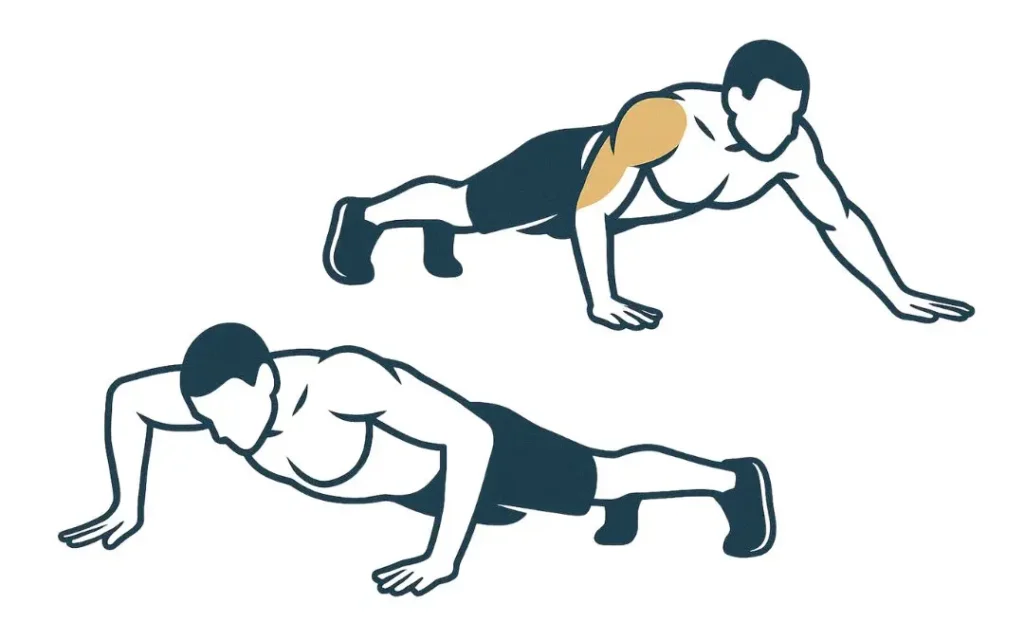
Archer push-ups are one of the best push-up variations to strengthen your chest, shoulders, and arms while improving core stability and body balance – which also carries over to your weighted dips and your muscle up. This exercise, often feared for its difficulty, is a key step for those who want to progress toward more advanced movements like the one-arm push-up. In this article, we will explore everything about this exercise, including proper technique, targeted muscles, benefits, and more. If you are looking to push your performance to the next level, this guide is for you.
What are the benefits of archer push-ups?
Archer push-ups offer a multitude of benefits that make them a must-have for athletes and bodyweight training enthusiasts.
Progression toward one-arm push-ups: One of the main advantages of this exercise is that it serves as an ideal intermediate step for those who want to progress toward one-arm push-ups. By learning to manage a significant weight transfer onto one arm, you develop not only the necessary strength, but also the stability and control essential for performing one-arm push-ups.
Improved unilateral strength: Archer push-ups allow you to work each side of the body in isolation – similar to the chest press – which helps correct muscular imbalances. This is an essential point for preventing injuries and improving overall performance in other sports disciplines.
Enhanced core stabilizer engagement: Due to the asymmetric weight distribution, stabilizer muscles such as the abdominals and lower back muscles must work harder to maintain balance.
Program or coaching?
Find your ideal format
Answer 4 questions and receive a personalized recommendation based on your level and goals.
Tailored result
Free
Targeted muscles
Archer push-ups are particularly valued for their ability to target multiple muscle groups at once. Thanks to the unequal distribution of bodyweight, this exercise intensely engages certain muscles while recruiting others for balance and stability.
- Chest (pectorals): Archer push-ups recruit the pectorals more intensely than standard push-ups. The arm performing the lowering phase bears a greater load, which leads to increased activation of the chest muscle fibers.
- Triceps: The arm bearing the weight works intensely, strongly engaging the triceps.
- Shoulders: The deltoids – especially the anterior deltoids – are heavily engaged to stabilize the movement, both on the bending side and the extended side.
- Core stabilizers: The core muscles, in particular the abdominals and lower back muscles, are recruited to maintain balance and prevent body rotation.
- Traps and lats: These back muscles help stabilize the movement, especially to keep the extended arm in place.
How to do archer push-ups?
Preparing for archer push-ups
Before jumping into archer push-ups, it is crucial to prepare your body for this demanding exercise. Here are some essential steps to make sure you are ready to take on the challenge.
-
Master standard push-ups: Before tackling archer push-ups, make sure you have excellent mastery of standard push-ups. You should be able to perform multiple sets with impeccable form. A solid push-up foundation is essential to ensure a smooth progression to archer push-ups.
-
Core strengthening: Archer push-ups require significant core stability. Exercises like planks and leg raises can help you strengthen your abdominal muscles and improve your overall body stability.
-
Shoulder mobility: Shoulder mobility plays a key role in this exercise. Regular shoulder stretches, along with mobility exercises, are essential to avoid injuries.
Movement execution
Now that you are well prepared, here is how to correctly perform archer push-ups:
-
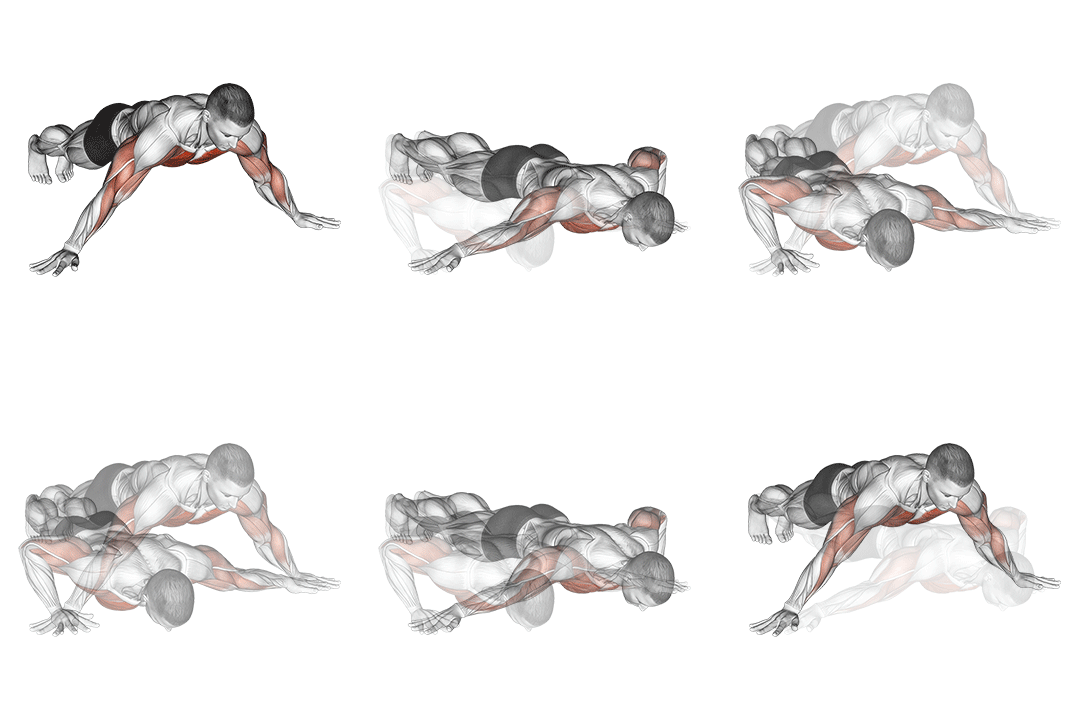
Starting position: Place your hands much wider than for standard push-ups. The spread should be wide enough so that when you lower yourself, one of your arms remains almost completely extended to the side.
-
Lowering phase: Slowly bend the working arm (the one that lowers), keeping the other arm extended. Keep your core well engaged to prevent your body from twisting during the descent.
-
Keep your body aligned: Do not let your hips sag. Your body must remain in a straight line from feet to head throughout the movement.
-
Pushing phase: Press firmly with the bent arm to return to the starting position, then switch arms on the next rep.
Variations
For those who have already mastered archer push-ups, or for those looking for a progression or regression of the exercise, here are some interesting variations to explore:
-
Knee archer push-ups: If you are a beginner, start by doing archer push-ups on your knees to reduce difficulty while maintaining muscular engagement. This allows you to focus on technique before progressing to a more advanced version.
-
Archer push-ups with resistance bands: Using a resistance band around your arms can help you master the movement by providing extra support while allowing you to develop your strength progressively.
-
Explosive archer push-ups: Once comfortable with the standard version, you can introduce explosive archer push-ups to work on your power. This involves pushing explosively to the point of slightly lifting your hands off the ground.
-
One-arm archer push-ups: The ultimate step after mastering archer push-ups is to attempt single-arm push-ups. This is an extremely difficult exercise, but one that will allow you to develop unmatched strength.
Mistakes to avoid to prevent injury
As with any exercise, it is essential to avoid certain common mistakes when performing archer push-ups in order to maximize benefits and prevent injuries.
-
Hip sagging: One of the most frequent mistakes is letting the hips sag during the movement. This creates excessive pressure on the lower back and reduces the effectiveness of the exercise. Make sure to keep your hips aligned with your spine.
-
Insufficient range of motion: Some people reduce their range of motion due to fatigue or to make the exercise easier. This can limit the benefits you get from archer push-ups. To optimize results, lower yourself far enough by fully bending the working arm while keeping the other arm extended.
-
Poor weight distribution: If you do not concentrate enough weight on the arm that is lowering, the exercise becomes less effective. You must ensure that the majority of your weight rests on the bent arm, not on the extended one, which should only serve as a stabilizer.
-
Shoulders rolling forward: A common mistake is letting the shoulders « fall » forward during the descent. This can increase injury risk and reduce engagement of the target muscles. Keep your shoulders back and stable throughout the movement.
Coach’s conclusion
As a coach, I can only encourage you to integrate archer push-ups into your training program if you want to improve your strength, stability, and mastery of advanced movements. Although this exercise takes time and practice to master, it is an incredible progression for those who want to reach the next level in their bodyweight training.