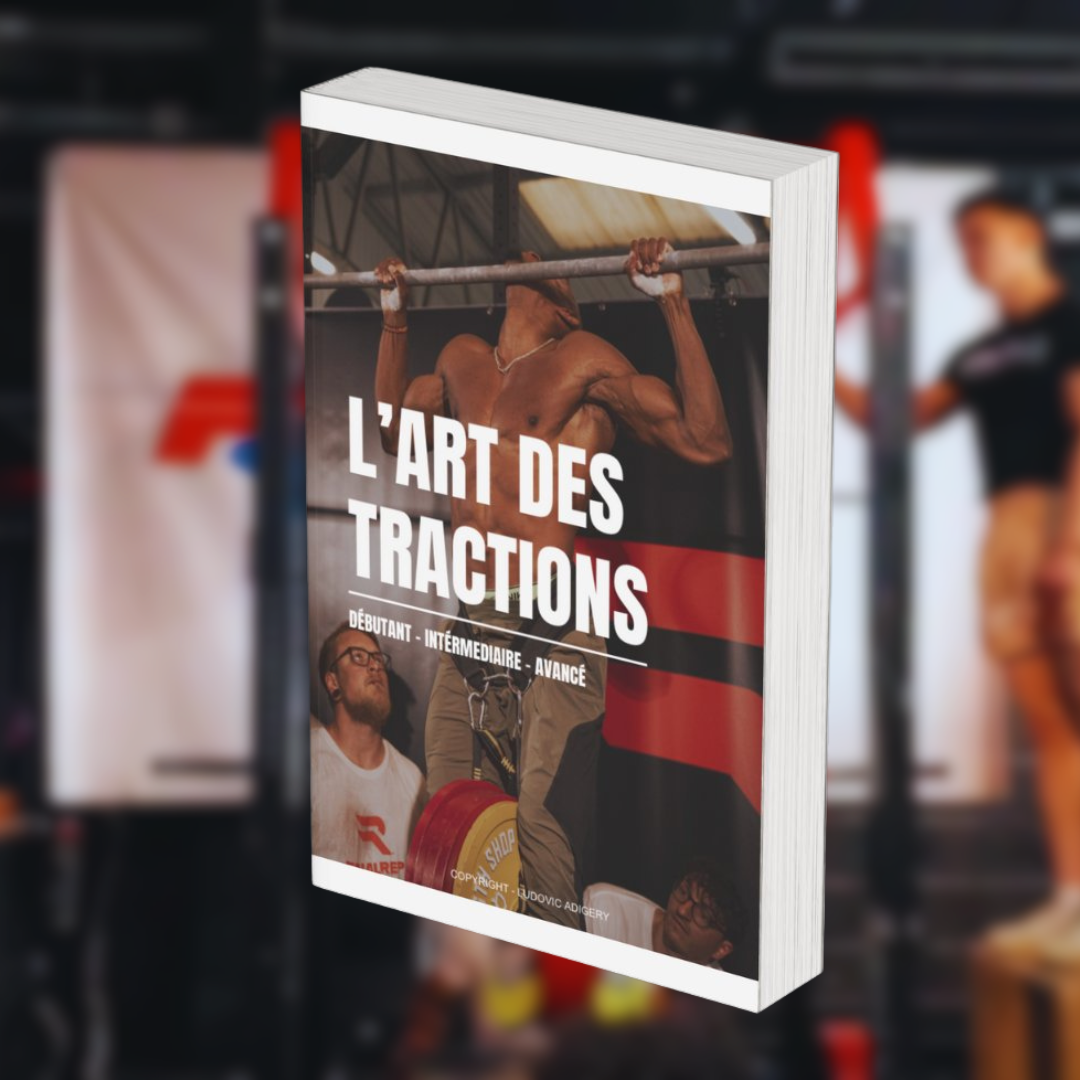
Streetlifting (weighted-bodyweight strength sport) is a strength discipline combining four movements performed with added load: the weighted muscle up, the weighted pull-up (pull/chin up), the weighted dip and the squat. In France, competitive practice is organised by the FNSL (French National Streetlifting Federation), which runs regional, inter-regional and national competitions.
This article offers an open, sourced data analysis of competitive streetlifting in France, based on the official results of 10 competitions held in 2025 and 2026. The aim: to provide reusable, data-backed benchmarks on who competes, at what level, and how performances break down.
| Key figures | |
|---|---|
| Competitions analysed | 10 (FNSL, 2025-2026) |
| Performances recorded | 367 |
| Distinct athletes | 330 |
| Weight categories | 13 (5 women’s, 8 men’s) |
| Split by sex | 78% men / 22% women |
| Average total (excluding no-lifts) | 342 kg |
| Best total | 540 kg (Frukito, +101 kg) |
| Best RIS score | 121.35 (Ludivine Compain, -52 kg) |
Methodology and sources
The data comes from the official results sheets of 10 FNSL competitions, published on streetliftings.fr:
- Regional / inter-regional level: Sud-Est (2025 and 2026), Nord-Est 2025, Ile-de-France/Centre 2025, Hauts-de-France 2025, Normandie 2026, Pays de la Loire 2026, Grand Ouest 2026;
- National level: CNSL French Championship 2025 and FNSL Espoirs (juniors) 2025.
Each performance corresponds to one athlete’s appearance in a weight category. For each performance we recorded the added loads (in kg) on the four movements – muscle up, pull-up, dip, squat – the Total (sum of loads) and the RIS (Relative Index Strength), an index that weights performance by bodyweight in order to compare athletes across categories and across sexes.
In total: 367 performances for 330 distinct athletes. The average performance figures below exclude no-lifts (athletes disqualified or who failed a movement, marked « DSQ »), i.e. 332 valid performances. The data was transcribed from the results visuals; a few minor rounding differences appear in the original sheets.
Who competes in streetlifting?
Of the 367 performances recorded, competition is overwhelmingly male: 286 men’s performances (78%) versus 81 women’s (22%).
| Category | Women | Men |
|---|---|---|
| -52 kg | 12 | |
| -57 kg | 24 | |
| -63 kg | 24 | |
| -66 kg | 60 | |
| -70 kg | 15 | |
| +70 kg | 6 | |
| -73 kg | 67 | |
| -80 kg | 58 | |
| -87 kg | 61 | |
| -94 kg | 32 | |
| +94 / -101 / +101 kg | 8 | |
| Total | 81 | 286 |
The most heavily contested categories are, for men, -73 kg (67 performances), -87 kg (61) and -66 kg (60), i.e. the light-to-middle bodyweights. For women, -57 kg and -63 kg (24 each) account for most entries. Competition is spread across the country (at least 7 regions represented) with two national events. 36 athletes competed in at least two of the analysed competitions, a sign of a core of regular competitors.
What performance level?
The average total (sum of added loads across the 4 movements, excluding no-lifts) stands at 342 kg, in a range from 93.75 kg to 540 kg.
| Indicator (excluding DSQ) | Women | Men |
|---|---|---|
| Valid performances | 64 | 268 |
| Average total | 187.4 kg | 378.8 kg |
| Median total | 192.5 kg | 378.1 kg |
| Best total | 273.75 kg | 540 kg |
| Average RIS | 82.2 | 81.5 |
| Average bodyweight | 60.3 kg | 77.1 kg |
Notable point: while raw totals naturally differ by sex and bodyweight, the average RIS is almost identical between women (82.2) and men (81.5). The relative-strength index thus does its job: once adjusted for bodyweight, the strength level of female and male athletes is comparable.
The distribution of totals shows a mostly high-standard field:
| Total achieved | Number of performances |
|---|---|
| Under 150 kg | 8 |
| 150 to 249 kg | 59 |
| 250 to 349 kg | 80 |
| 350 to 449 kg | 151 |
| 450 kg and over | 34 |
The squat: half the total
The four movements contribute very unevenly to the total. The squat alone accounts for half the total load, while the muscle up, the most technical movement, makes up only a small fraction.
| Movement | Average added load | Share of total |
|---|---|---|
| Squat | 172.6 kg | 50.4% |
| Dip | 94.9 kg | 27.7% |
| Pull-up (pull/chin up) | 58.4 kg | 17.1% |
| Muscle up | 16.3 kg | 4.8% |
This profile holds for both sexes: for men, average loads of 187 kg in the squat, 107 kg in the dip, 66 kg in the pull-up and 18 kg in the muscle up; for women, 111 kg, 43 kg, 27 kg and 7 kg respectively. The load hierarchy (squat > dip > pull-up > muscle up) is a constant of the discipline.
Records and elite level
The best performances of the period were set at the CNSL French Championship 2025, which brings together the national elite. 34 performances broke the 450 kg total barrier.
| Top 5 totals | Category | Competition | Total |
|---|---|---|---|
| Frukito (M) | +101 kg | CNSL 2025 | 540 kg |
| Raul Teslevici (M) | -80 kg | CNSL 2025 | 530 kg |
| Ludovic Adigery (M) | -94 kg | IDF/Centre 2025 | 525.5 kg |
| Christian Kevin Bikai (M) | -101 kg | CNSL 2025 | 518.75 kg |
| Tom Berthier (M) | -94 kg | Sud-Est 2025 | 517.5 kg |
| Top 5 RIS | Category | Competition | RIS |
|---|---|---|---|
| Ludivine Compain (W) | -52 kg | CNSL 2025 | 121.35 |
| Margaux Sanchez (W) | -57 kg | CNSL 2025 | 119.78 |
| Marion Canipel (W) | -57 kg | CNSL 2025 | 114.56 |
| Johan Sanon (M) | -73 kg | CNSL 2025 | 111.62 |
| Marion Canipel (W) | -57 kg | IDF/Centre 2025 | 110.77 |
In the RIS ranking, which neutralises the effect of bodyweight, female athletes in the lighter categories dominate, a concrete illustration of how relevant this index is for comparing relative strength.
No-lift rate
Across all attempts, 9.5% ended in a no-lift (disqualification or failure, « DSQ »). This rate is higher among women (21%) than men (6.3%); as the female sample is smaller, this figure should be read with caution. The muscle up and the pull-up, the most technically demanding movements, account for most of the missed attempts.
Limitations and data reuse
These statistics describe the competitive practice recorded by the FNSL across the 10 competitions studied; they do not cover all practitioners (club training, recreational, non-competitors). Athlete names may have spelling variants from one competition to another, so the distinct-athlete count is a conservative estimate of overlaps.
The data presented in this article is freely reusable for information, research or data-journalism purposes, provided the source is credited: « Source: streetliftings.fr, compilation of FNSL 2025-2026 results ». For any request for a detailed dataset, contact the editorial team.