
Key takeaways
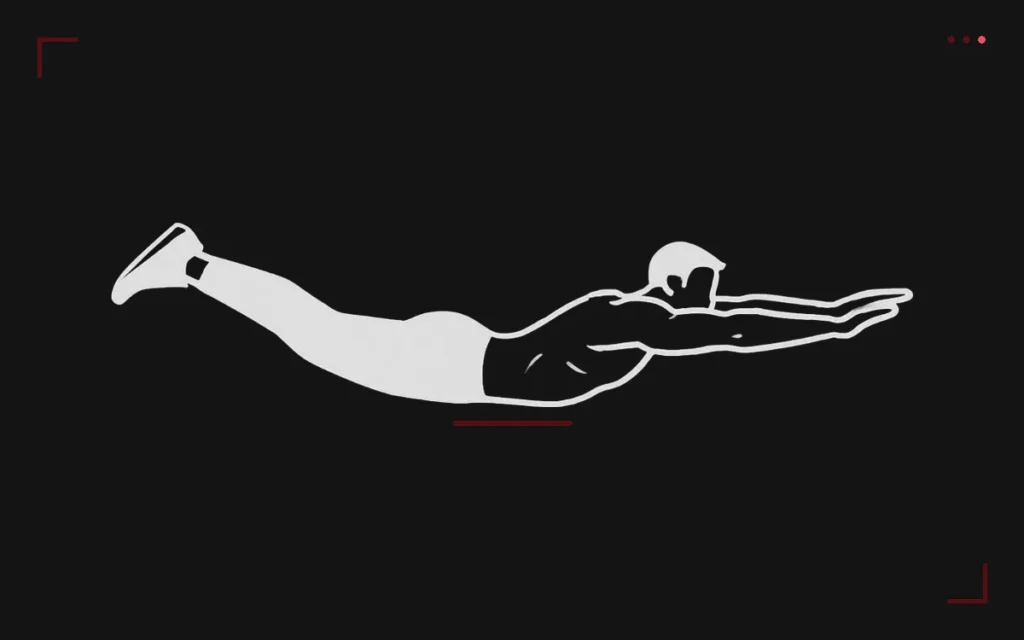
- The superman hold is an isometric extension brace: you lie face down, lift your arms, chest and legs off the floor, and hold the position.
- It trains the erector spinae, glutes, hamstrings, upper back and deep abdominals with zero load on your spine.
- The form comes down to three things: squeeze your glutes before you lift, come up only two or three inches, keep your eyes on the floor.
- The main mistake is lifting your chest high while craning your neck, which dumps the entire job on your lower back.
- Beginners run 3 sets of 10 to 15 seconds; trained lifters run 3 to 4 sets of 20 to 45 seconds, two to three times a week.
The superman hold is an extension plank: you lie face down, lift your arms, chest and legs off the floor, and hold. Three seconds when you start, thirty seconds once the position is clean. It is the simplest way to build your spinal erectors, glutes and upper back with no equipment and no load on your spine.
It is also the exercise almost everybody butchers: too high, too fast, neck cranked up, lower back pinching. Below you get the exact form cues, the hold times to aim for at your level, the four-position arm progression gymnasts use, the variations that actually earn a spot in your program, and what to do if your back already hurts.
What the Superman Hold Actually Does
The superman hold is an isometric spinal extension hold. Nothing moves: you resist. The goal is not to lift a load, it is to hold full-body extension from your fingertips to your toes for a set amount of time. You will also see it called the arch hold, the prone superman, or simply the superman exercise.
What makes it different is the absence of axial load. Unlike good mornings, loaded back extensions or the reverse hyper, nothing compresses your discs. You are training the endurance of your back extensors, not their maximal strength, which is why it is programmed in seconds rather than reps.
For a streetlifting athlete, the carryover is direct. The arch position you learn here is exactly the one that locks your pelvis on a pull-up and lets you kip cleanly. The erectors and glutes you strengthen are the ones keeping your torso solid when you hang 60 lb (27 kg) off your belt. And since it is the mirror image of the hollow hold, the two belong together: one braces you in flexion, the other in extension.
Muscles Worked by the Superman Hold
The superman hold is not a “lower back” exercise. The whole posterior chain fires at once to keep your torso and legs in the air. According to Muscle & Motion, a channel specialized in biomechanical movement analysis, the breakdown works like this: the lats and rear delts extend the shoulder, the traps and rhomboids retract the shoulder blades, the erector spinae extend the spine, the gluteus maximus extends the hip with help from the hamstrings, and the gastrocnemius and soleus plantarflex the ankle to point your toes.
| Muscle | Job in the hold | What you should feel |
|---|---|---|
| Erector spinae | Spinal extension | A long band of tension down your back, never a pinch in one spot |
| Gluteus maximus | Hip extension, lifting the thighs | Glutes rock hard from the first second, before the legs even rise |
| Hamstrings | Assisting hip extension | Work along the back of the thighs, legs straight, knees locked |
| Lats and rear delts | Shoulder extension, arms held up | A burn at the back of the shoulders after about fifteen seconds |
| Traps and rhomboids | Scapular retraction | Shoulder blades pulled toward the spine, chest open |
| Deep abdominals | Pelvic stability, ribs down | A brace around your navel that stops the arch from running away |
| Calves (gastroc and soleus) | Plantarflexion | Toes pointed hard behind you, as if reaching for the wall |
That coordination is what makes the superman hold such a useful partner to rowing. On the barbell row, your erectors hold the hinged position and usually quit before your back does. Train them isometrically and you buy yourself extra clean reps. Same logic on the weighted pull-up or the neutral-grip pull-up: a braced torso sends force into the bar instead of bleeding it into a swing.
How to Do a Superman Hold, Step by Step
- Set up face down on a mat, arms straight out front, legs straight behind, toes pointed. Forehead toward the floor.
- Press your pubic bone into the floor. That small detail stabilizes your pelvis and limits lumbar hyperextension before you even leave the ground.
- Squeeze your glutes before you move anything. Brace your abs, keep your ribs down, and clamp your glutes. Squeeze hard enough and your legs come off the floor almost by themselves. The order of operations protects your back, not the final position.
- Lift two or three inches, no more. Arms, chest and legs at the same time. Cranking your chest high only compresses your lumbar spine.
- Lift through your upper back, not your arms. According to the channel Fitnessdy, the classic beginner error is yanking your arms and legs toward the ceiling instead of lifting through your upper back and glutes. The same coach adds a cue that fixes it instantly: think about lifting your arms, not your hands.
- Get long. Reach as far as you can in both directions, fingertips to toes, like someone is pulling you from both ends.
- Keep your eyes on the floor. Neck in line with your spine, chin slightly tucked. The moment you look forward, your lower back takes over the lift.
- Breathe. Short inhale, long exhale. No breath holding during the hold.
- Lower in two seconds. Control the way down, do not let your limbs drop.
One rule for the set: it ends when the position breaks, not when the timer beeps. Chest sagging, knees bending or a pinch in your lower back all mean you are done.
How Long to Hold a Superman and How Many Sets
The answer depends on your level, and that is exactly what most pages leave out. A beginner with a cranky back has no business holding for thirty seconds: he will hold it by arching. Use these formats instead.
| Level | Format | Rest | Frequency | Goal of the session |
|---|---|---|---|---|
| Beginner or sensitive back | 5 to 8 holds of 3 seconds | 3 seconds between holds | 3 times a week | Learn to start the lift with your glutes |
| Comfortable beginner | 3 sets of 10 to 15 seconds | 45 seconds | 3 times a week | Hold without shaking or arching |
| Intermediate | 3 to 4 sets of 20 to 30 seconds | 60 seconds | 2 to 3 times a week | Back extensor endurance |
| Advanced | 3 to 4 sets of 40 to 45 seconds | 60 to 90 seconds | 2 times a week | Move up to a harder variation |
The progression rule matters more than the numbers. Until you can hold a clean minute, add time under tension. The moment you clear a minute without shaking, stop adding seconds and change the variation. Staying on the same version forever stops producing anything.
If you want a ready-made framework, the channel Phantom Core slots the superman hold into a four-exercise isometric block (wall sit, plank, superman hold, half-rep push-up hold) at 3 sets of 20 to 30 seconds for the superman, three sessions a week. Good entry point if you are not training for strength yet.
The Mistakes That Turn a Superman Hold Into Back Pain
- Lifting your chest too high. Mistake number one. A couple of inches is plenty. Go higher and you finish in lumbar hyperextension instead of finishing neutral.
- Lifting your head and looking forward. Extending your neck to get your chest up forces the movement with your lower back instead of assisting it. Eyes down, and your mid-back muscles finally engage.
- Bending your knees to lift your legs higher. According to Colossus Fitness, this is the most common error they see: trying to drive the leg toward the ceiling bends the knee and drains the exercise of its purpose. Legs straight, lift small.
- Rushing through the reps. Same coach: the goal is not to get it over with. Two to three seconds of pause at the top, controlled descent.
- Not squeezing your glutes first. With no glute activation, your lumbar extensors do the entire lift. This is the single most common cause of pain on this exercise.
- Holding your breath. In an isometric, breath holding spikes pressure and locks your whole upper body up. Exhale through the effort.
- Holding past your form. Ten clean seconds beat thirty sloppy ones.
Superman Hold Progression: I, W, T, Then Arms Forward
The difficulty of a superman hold has almost nothing to do with how high you lift. It comes from the lever your arms create. The farther your hands travel away from your shoulders, the more your posterior chain has to hold. Muscle & Motion lays out a four-position arm progression that lets you build the movement instead of suffering through it.
- I position: hands down alongside your thighs, palms toward the floor. Shortest lever, the starting point for everyone.
- W position: elbows bent, hands at shoulder height, shoulder blades pinched. Now your upper back starts paying.
- T position: arms out to the sides, elbows straight. The lever gets noticeably longer.
- Arms straight forward: the full version and the hardest one. Only go here once you can hold the T for 30 clean seconds.
If you stall before the T, the culprit is usually tight pecs or stiff thoracic vertebrae that keep you from raising your arms and squeezing your shoulder blades together. Two useful fixes, again from Muscle & Motion: actively press your hands into the floor, which opens up range in your spine and cuts the demand on your erectors, and put a pillow under your abdomen, which shifts the axis of the movement up toward the lower thoracic vertebrae. If your back is sensitive, exhale during the extension: the abdominal contraction that comes with the exhale braces your lower back.
Regressions, for when the full version is still too much:
- Lift the arms only, legs on the floor.
- Lift the legs only, arms on the floor.
- Lift one arm and the opposite leg, then switch sides.
- Drop back to the bird dog on all fours to build the coordination, then return to the floor.
On the other end, once 45 seconds with arms forward is yours, add load instead of time: a 5 lb (2.5 kg) plate held out front, light ankle weights, or a band looped around your wrists that you pull apart during the hold.
Superman Hold Variations and When to Use Them
| Variation | What it changes | Level | When to use it |
|---|---|---|---|
| Superman I, W, T | Shortens or lengthens the arm lever | All levels | Building toward the full version |
| Aquaman (opposite arm and leg) | Cross-body load, adds an anti-rotation demand | Beginner | Learning the brace without loading the lumbar spine |
| Prone floor pulldown | From the hold, you pull your elbows toward your hips like a row | Intermediate | Hitting the lats with no bar and no cable |
| Around the world | Arms trace a slow circle from your hips to overhead | Intermediate | Warm-ups and scapular control |
| Banded superman | A band at the wrists forces scapular retraction | Intermediate | Loading the upper back harder |
| Weighted superman | Adds real load (plate, ankle weights) | Advanced | When 45 seconds arms forward is easy |
| Gymnastic arch hold | Feet together, arms glued by your ears, maximum extension | Advanced | Prep work for the front lever and kipping |
| Hollow to arch roll | Rolls from the flexion brace into the extension brace | Advanced | Dynamic core work at the end of a session |
| Standing kettlebell superman | Single-leg hinge with a kettlebell in one hand | Intermediate | Training balance without lying on the floor |
On the around the world, three cues keep you out of trouble: keep your neck long and your eyes down, keep your legs active and slightly lifted rather than letting them drop, and trace a smooth circle instead of swinging your arms for momentum. If your shoulders pinch overhead, cut the range and stop the arc before the discomfort starts.
One confusion worth clearing up: the superman hold is not a plank. A plank is a prone brace on your forearms with a neutral spine. The superman hold happens lying flat, in extension, with nothing propping you up. They complement each other, they do not replace each other.
Fitting the Superman Hold Into Your Streetlifting Training
Two slots work, and they do different jobs.
- As activation, before your pulling work: 2 sets of 15 seconds in the I or W position, right after your warm-up. The point is to wake up your glutes, erectors and scapular retractors before a session from your weighted pull-up program. No fatigue, just priming.
- As an accessory, at the end of the session: 3 sets of 20 to 45 seconds. This is where you bank useful lower back volume, and since it is one of the least fatiguing lower back exercises out there, you can keep it in even during a heavy deadlift or squat week.
Kirk Charles, a NASM-certified trainer who writes the Fit Beyond 40 column for Men’s Health, uses a simple pairing to turn it into full upper-body work: at the end of the hold, plant your hands under your shoulders and your feet on the floor and go straight into a set of push-ups. Four to five supersets is plenty.
The transfer shows up fast. A lower back that holds means a pelvis that does not tip back when you clip on a dip belt for weighted dips, and a body that stays tight through the transition of a muscle-up. Pair it with the dead hang for bar-side bracing, and with the renegade row if you want the same anti-rotation work with dumbbells. If you have access to a bench, the loaded back extension is the natural next step once bodyweight holds stop challenging you.
Superman Holds and Lower Back Pain: What Really Changes
This is the intent behind half the searches on this exercise, so it deserves a straight answer. The superman hold trains the endurance of your lumbar extensors and glutes without putting an ounce of load on your spine. That makes it a sound low-impact strengthening choice, far more conservative than a good morning or a loaded back extension. It is not a treatment, and no exercise is.
The key is the order of contractions. Kirk Charles reports that out of six men over fifty he coached through superman holds, three felt lower back pain during the exercise. Two adjustments fixed it: starting the lift by squeezing the glutes, and keeping the head neutral with the eyes on the floor instead of craning the neck forward. The pain went away for all three.
If it still pinches, you have four levers before you drop the exercise:
- Lift less, even if that means barely an inch off the floor.
- Cut the hold to 3 or 5 seconds and do more holds instead.
- Exhale during the extension phase, to recruit the abs that brace your lower back.
- Slide a pillow under your abdomen, or switch to the bird dog for a few weeks.
If pain persists through all of that, or if it travels down your leg, stop and get it looked at. A core exercise does not get to outvote a medical opinion.
FAQ
What are Superman holds good for?
They build endurance in your spinal erectors, glutes and upper back without loading your spine, which is why they fit anyone who sits all day or wants a low-impact way to strengthen the posterior chain. For lifters, the arch position carries straight over to pull-ups, muscle-ups and keeping a tight torso under a dip belt. They also teach you to fire your glutes and lower back together, which most people never learn.
How long should you hold a Superman?
A beginner holds 10 to 15 seconds for 3 sets, and starts with 3-second holds if his back is cranky. A trained lifter works at 20 to 45 seconds for 3 to 4 sets. Once you can hold a clean minute, stop adding seconds and switch to a harder variation instead.
What muscles does the Superman hold work?
The erector spinae extend the spine, the gluteus maximus extends the hips with help from the hamstrings, the lats and rear delts hold the arms up, and the traps and rhomboids retract the shoulder blades. The deep abdominals stabilize the pelvis and the calves point the toes. It is the whole posterior chain, not just your lower back.
Are Supermans good for lower back pain?
They strengthen the lumbar extensors and glutes with no axial load, which makes them a conservative choice, but they are not a treatment. If you feel a pinch, lift less, cut the hold to 3 seconds, exhale as you extend, and squeeze your glutes before anything leaves the floor. Pain that persists or shoots down your leg needs a medical opinion, not another set.
Is the Superman hold the same thing as a plank?
No. A plank is a prone brace on your forearms with a neutral spine, and the work is anti-extension. The superman hold has you lying flat with nothing propping you up, and the work is active spinal extension. Run both: one braces you in flexion, the other in extension.
Can you do Superman holds every day?
It is one of the least fatiguing lower back exercises, so a short daily dose is manageable, for example 3 holds of 10 seconds. For actual progress, two to three sessions a week with longer holds works better because your extensors get time to recover. If your lower back feels sore when you wake up, spread the sessions out.

mathieu
Street workout athlete since 2019, I discovered streetlifting in 2023. Today I share my passion for the sport through streetliftings.com.