Key takeaways
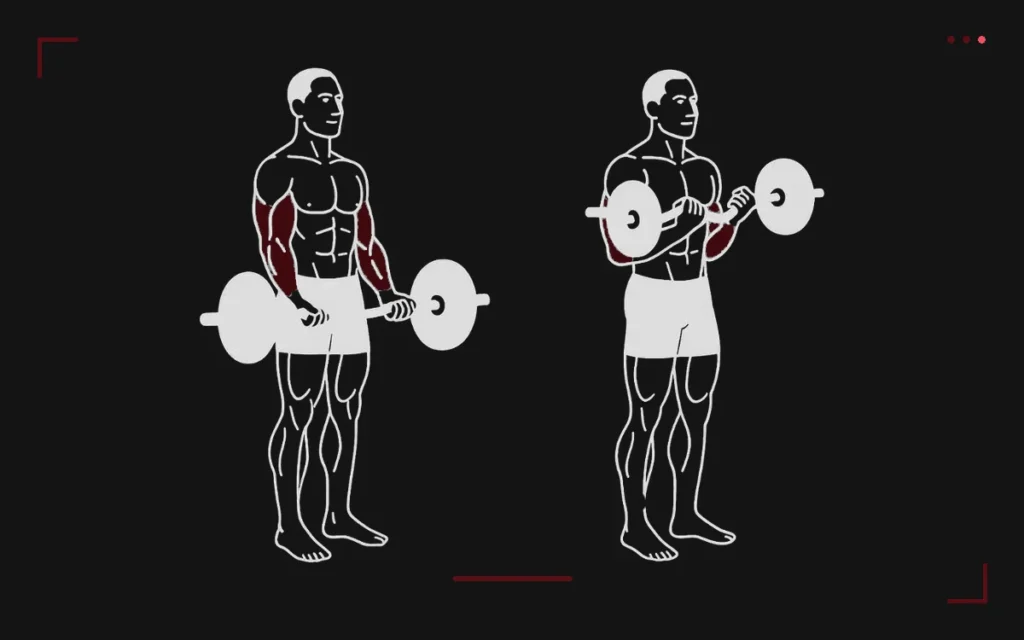
- The barbell curl means bending your elbows to bring a loaded bar from your thighs to your shoulders while your torso stays still.
- It trains the biceps brachii, the brachialis, and the brachioradialis, with the forearm flexors working isometrically.
- The key cue: elbows fixed about an inch in front of your hips, arms straight at the bottom, wrist in line, bar curled out in an arc.
- The main mistake is swinging your hips to load more weight, since the extra load goes into your lower back instead of your biceps.
- For size, run 3 to 4 sets of 8 to 12 reps twice a week with a 3-second negative on every rep.
The Barbell Curl Deserves Better Than Sloppy Reps
The barbell curl means one thing: you bend your elbows and bring a loaded bar from your thighs up to shoulder height while your torso stays still. It is the most performed biceps exercise on the planet, and also one of the most butchered. Walk into any gym and you will see it: hips rocking, wrists folding, bottom of the rep cut short. Almost nobody keeps all three clean at once.
Its real strength is not the resistance profile, which is mediocre. It is loadability. With a bar you can add 2.5 lb (1.25 kg) per side week to week. With dumbbells you usually jump 5 lb (2 kg) per hand, which wrecks your form. Jeff Nippard, coach and science communicator, actually ranks the barbell curl in B tier on his biceps tier list: tension drops to zero at the bottom, right where the biceps is most stretched, but the lift is still excellent for progressive overload and you can do it anywhere (his breakdown of the tension curve at 1:39).
So the barbell curl is not the perfect exercise. It is the best exercise for loading elbow flexion heavy, and that is exactly what you need if you want arms that fill a sleeve and elbows strong enough to hold heavy chin-ups.
Muscles Worked by the Barbell Curl
This is not a single-muscle lift. Three elbow flexors share the work, and your hand position decides which one takes the biggest cut.
| Muscle | Job during the barbell curl | How to hit it harder |
|---|---|---|
| Biceps brachii (long and short head) | Flexes the elbow and supinates the forearm. The only one of the three that can turn your palm up. | Hard supinated grip, straight bar, pressure through pinky and ring finger |
| Brachialis | The strongest elbow flexor, buried under the biceps. Roughly as big as both biceps heads combined. | Neutral or pronated grip: hammer curls and reverse curls |
| Brachioradialis | Flexes the elbow when the forearm sits neutral. The thick strip on top of your forearm. | Reverse barbell curl, overhand grip |
| Forearm flexors | Isometric only: they keep the wrist from folding back. | Do not chase them, they steal work from the biceps |
| Front delts and traps | Stabilize the shoulder and shoulder blades. No range of motion. | Nothing to do here. If they move, the bar is too heavy |
Here is the part nobody explains: the long head of the biceps crosses the shoulder joint. It gets more stretched when your upper arm sits behind your torso, which a standing barbell curl never does. To load that long head in a lengthened position you need an incline dumbbell curl or a cable curl done facing away from the stack. The spider curl does the opposite: it puts the biceps in a shortened position the whole time, which makes it a decent finisher and a poor main lift.
How to Barbell Curl Correctly, Step by Step
Setup
- Grip: supinated, hands about shoulder-width. Thumbs around the bar, but keep the grip deliberately loose in your fingers. Crushing the bar fires up your forearm flexors and takes work away from the biceps.
- Feet and torso: feet hip-width, knees soft, abs braced, ribs down. Neutral spine, no arch.
- Elbows: tucked to your ribs, then set about an inch in front of your hips. That one inch matters. With arms hanging dead vertical, tension hits zero at the bottom and you lose the most useful part of the set.
- Wrists: in line with the forearm, very slightly extended. Never curled in.
- Bottom position: arms straight, triceps flexed for a split second. That is the easiest cue to confirm you actually reached full range.
The Way Up
Do not pull the bar straight up. Push it out and around in an arc, like you are moving it away from your body before bringing it in. Jeff Nippard shows that with the exact same load, an arcing path increases the lever arm between the elbow and the bar, which means more torque and more tension on the biceps (the arc path demo at 5:00). Exhale on the way up and never let the elbows drift forward.
The Top and the Way Down
- At the top: squeeze for a second with neutral wrists. Skip the long pause, there is almost no tension in the shortened position anyway.
- Drive your pinky toward the ceiling through the whole concentric. That cue forces active supination, and supination is the one job the brachialis cannot help with, so the biceps has to eat it.
- Lower in 2 to 3 seconds, in an arc as well, resisting the whole way. Treat the negative like a failed positive, not like a trip back to the start.
- Reset between reps: reposition, breathe in, re-brace. One clean reset per rep beats ten increasingly messy reps.
The Wall Test
Jeremy Ethier, coach and founder of Built With Science, gives a 30-second check anyone can run: do a normal set, then redo it with your back flat against a wall, glutes and shoulder blades touching. If you have to drop the weight a lot, you were using momentum without knowing it (the wall test and the wrist fix at 3:52). Ethier also nails something almost nobody writes down: if your forearms burn before your biceps do, you are flexing your wrist on the way up. Set the wrist in line with the forearm before the first rep and keep it there.
Straight Bar, EZ Bar, or Short Bar: What to Pick
This comes up every arm day. The answer depends on your wrists and your goal, not on whatever is trendy.
| Bar type | Empty weight | Supination | Wrist stress | Best for |
|---|---|---|---|---|
| Olympic straight bar (7 ft) | 45 lb (20 kg) | Maximum | High | Mobile wrists, full supination work |
| Short straight bar (4 ft) | 18 to 22 lb (8 to 10 kg) | Maximum | High | Busy gyms, home setups, moderate loads |
| EZ bar, outer handles | 13 to 22 lb (6 to 10 kg) | Partial | Low | Cranky wrists or elbows, heavy sets of 6 to 8 |
| EZ bar, inner handles | 13 to 22 lb (6 to 10 kg) | Reduced | Very low | Brachialis and forearm emphasis |
The EZ bar takes torque off the wrist because your hand is no longer fully supinated. The trade-off: some tension shifts to the brachialis and brachioradialis. That is not a flaw, it is a choice. If you use the EZ bar, push hard through the pinky to keep the biceps in the game. And if a straight bar lights up your wrists set after set, stop forcing it. Elbow tendinitis will cost you two months of arm training.
Grip Width: What Actually Changes
- Shoulder-width: the default. Best compromise between range, comfort, and activation. Keep it for 80 percent of your volume.
- Wide grip: slightly more shoulder abduction, and some coaches argue it favors the long head. Range of motion shrinks and the payoff is still speculation.
- Close grip: shorter range and, according to sources Jeff Nippard cites, roughly 13 percent lower biceps EMG compared with a shoulder-width grip. Use it for variety, not as your staple.
- Overhand grip (reverse curl): much lighter loads, strong brachioradialis and upper forearm work. Great finisher, bad main biceps lift.
Mistakes That Kill Your Curl Gains
- Swinging the hips: momentum lets you load more, but the extra load goes into your lower back, not your biceps. Tension on the muscle does not go up.
- Letting the elbows travel forward: the second your elbows rise out front, your front delts take over. The shoulder is far better than the biceps at that job, so it happily takes it. Allow 10 to 15 degrees of shoulder flexion, no more.
- Breaking the wrist: curl the wrist in and your forearms do the work, cramp up, and end the set before your biceps ever fail.
- Not straightening the arms at the bottom: cutting the stretched position costs you the most profitable part of the range. Training only the bottom half of a preacher curl produced about 2.6 times more biceps growth than training only the top half, with most of that growth near the lower biceps.
- Loading for your ego: if you can get more than 15 strict reps, add weight. If you cannot get 6, take weight off. A 155 lb curl moved with your hips builds nothing.
- Dumping the negative: dropping the bar in half a second throws away half the stimulus. Count 2 to 3 seconds.
- Lifting without thinking about the muscle: an eight-week study reported by Jeremy Ethier compared two groups of curlers, one focused on squeezing the biceps and one focused on just moving the weight. The group focused on the muscle gained close to twice as much biceps.
- Curling in the squat rack: you can curl anywhere, you cannot squat anywhere. Gym etiquette, but it counts.
Sets, Reps, and Load: How to Program the Barbell Curl
The biceps is a small muscle. It recovers fast, fatigues fast, handles maximal loads badly, and handles moderate volume spread over two sessions very well.
| Goal | Sets x reps | Tempo | Rest | Frequency |
|---|---|---|---|---|
| Size (hypertrophy) | 3 to 4 x 8 to 12 | 1 s up, 1 s squeeze, 3 s down | 90 s | 2x per week |
| Elbow flexion strength | 4 to 5 x 5 to 6 | Explosive up, 2 s down | 2 to 3 min | 2x per week |
| Endurance and pump | 2 to 3 x 15 to 20 | Continuous, no pause at top | 45 to 60 s | 1x per week |
| Beginner (first 3 months) | 3 x 10, empty bar then +5 lb | 2 s up, 3 s down | 90 s | 2x per week |
Load benchmarks from the lifters we coach, offered as rough markers and not as standards: a 165 lb (75 kg) guy starting out usually lands around 45 to 55 lb (20 to 25 kg) including the bar for 10 clean reps. After a year of serious training, 90 lb (40 kg) for 8 strict reps is solid. Past 110 lb (50 kg) for 8 strict reps you are in the upper range of natural lifters. And for the question that never dies: a 45 lb bar for 10 strict reps is a perfectly respectable starting point, and it beats 90 lb heaved with your hips every time.
Weekly volume: 10 to 14 biceps sets per week is plenty across all exercises. The barbell curl takes 4 to 6 of them. Spend the rest on stretched-position work and on the preacher curl, where the upper arm is pinned to a pad and cheating is impossible.
Barbell Curl Variations That Restart Progress
- 21s in the right order: the classic runs 7 bottom-half reps, 7 top-half reps, 7 full reps. Jeff Nippard flips it: 7 top, 7 full, 7 bottom. The set now ends in the stretched position when the biceps is most fatigued, and each block gets easier instead of harder.
- Cheat curl with a controlled negative: on the last 2 to 3 reps of a set, use a touch of momentum to get past the sticking point, then fight the bar down over 4 seconds. Experienced lifters only, never beginners.
- Strict curl against the wall: glutes, upper back, and head on the wall. Zero cheating possible. Run it for 4 weeks if your form has gone bad.
- Drag curl: the bar stays in contact with your torso and slides up your body while your elbows travel back. Easy on the elbow, but total biceps length barely changes through the rep, so treat it as a comfort variation, not a growth lift.
- Bent-over curl at 45 degrees: peak tension in the shortened position and a brutal pump. Finisher, 10-plus reps.
- Heavy EZ bar curl: 6 to 8 reps on the outer handles when your wrists are done with the straight bar.
- Reverse curl: overhand grip, 30 to 40 percent lighter, 10 to 15 reps. Forearms and grip.
If you want variety without putting the bar down, pair your curls with barbell triceps work so your elbows stay balanced. For straight isolation at the end of a session, the concentration curl and the seated dumbbell curl are the easiest to control.
Why Strong Biceps Matter in Streetlifting
Nobody judges your curl in a streetlifting meet. But weak biceps cap your pulling. The long head crosses the shoulder, and supination is a direct driver of the chin-up. In practice, stronger elbows buy you three things: a cleaner lockout at the top of a pull-up, a less painful transition on the muscle-up, and tendons that hold up once the dip belt gets loaded.
It is also insurance. The elbow tendinitis that sidelines lifters almost always traces back to the same imbalance: lots of heavy pulling, zero direct elbow flexion work. Two controlled sets of barbell curls beat a month off.
If you are chasing a number, biceps work should serve the main lift, not replace it. Our weighted pull-up program puts curls at the end of the session, after the heavy pulling. The weighted muscle up program uses them as elbow-durability work during volume blocks. Even on the weighted dip program, two sets of curls at the end balance out training that otherwise only pushes. For the full four-lift picture, the streetlifting program already sets your arm volume for you.
The Coach’s 8-Week Plan to Unstick Your Curl
- Weeks 1 and 2, rebuild: empty bar or 60 percent of your usual load, 3 x 12, back against the wall, 3-second negatives. One goal: straighten the arms at the bottom and keep the elbows still. It will feel humbling. That is the point.
- Weeks 3 to 5, load: 4 x 8, adding 2.5 lb per side each week as long as all 8 reps stay clean. Second session of the week: 3 x 15 on the EZ bar.
- Weeks 6 and 7, intensify: 4 x 6 heavy, then one set of 21s in the top, full, bottom order, going until you cannot get halfway up.
- Week 8, back off: 2 x 10 at 70 percent, then start a new cycle with a heavier starting load than week 3.
Keep a log. Three columns do the job: load, reps, how it felt. If reps stall for three straight weeks while the feel stays good, your form is not the problem. Your recovery or your calories are.
FAQ
What is the barbell curl good for?
It isolates elbow flexion and lets you load heavy with very fine jumps, 2.5 lb per side. That makes it the simplest way to grow the biceps brachii and strengthen the brachialis. For streetlifters it also builds elbow durability, which cuts down the tendinitis that comes from heavy pulling with no direct flexor work.
Is a 45 lb barbell curl good?
For a beginner, an empty 45 lb Olympic bar for 10 strict reps is a respectable starting point. Quality is what counts: arms straight at the bottom, elbows locked in place, controlled negative. A clean 45 lb curl beats 90 lb heaved with your hips, which puts almost no tension on the biceps.
Straight bar or EZ bar for curls?
A straight bar allows full supination and the strongest biceps demand, but it loads the wrists harder. An EZ bar cuts that stress and shifts some work to the brachialis and brachioradialis. If a straight bar hurts your wrists or elbows, switch to the EZ bar and push hard through your pinky to keep the biceps loaded.
How many sets and reps should I do on barbell curls?
For size, 3 to 4 sets of 8 to 12 reps twice a week with a 3-second negative. For elbow flexion strength, 4 to 5 sets of 5 to 6 reps with 2 to 3 minutes of rest. Across the whole week, 10 to 14 total biceps sets is plenty once you count every exercise.
Will curls make my arms bigger?
Yes, as long as you load progressively and stop cheating. The biceps responds well to moderate volume and to the stretched position, so straighten your arms fully at the bottom of every rep. Do not forget the brachialis either, which is about as big as both biceps heads combined: hammer and reverse curls add thickness that supinated curls alone will not give you.
Why do my forearms burn before my biceps?
Because you are flexing your wrist on the way up and gripping the bar too hard. Both recruit the forearm flexors, which fail before the biceps does. Set the wrist in line with the forearm, slightly extended, and keep your fingers loose on the bar.

mathieu
Street workout athlete since 2019, I discovered streetlifting in 2023. Today I share my passion for the sport through streetliftings.com.