Key takeaways
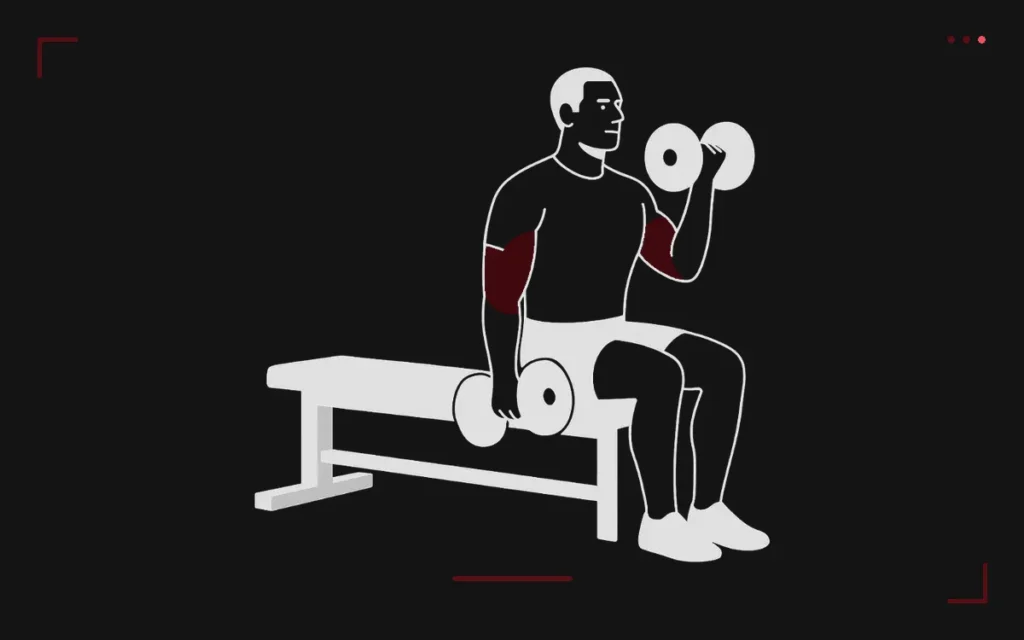
- The seated dumbbell curl is a biceps curl done with your back pinned to a pad, which removes the torso swing and hip drive.
- It trains the biceps brachii, the brachialis and the brachioradialis, and the more you recline the bench, the harder the long head gets stretched.
- Good form comes down to three things: elbows locked against your ribs, wrists in line with your forearms, and arms fully straight at the bottom of every rep.
- The main mistake is too much weight swung up out of the bottom, which sends the work into your shoulders and lower back instead of your arms.
- It works for beginners and advanced lifters alike, placed at the end of a session, for 2 to 4 sets of 8 to 15 reps.
The seated dumbbell curl does one job: it loads your biceps without letting the rest of your body help. Back against the pad, feet on the floor, no hip drive, no torso swing. Every rep has to come from the elbow. What separates a curl that builds arms from one that just burns is three settings most lifters never touch: the bench angle, the wrist position, and how far you let the weight down.
How to do the seated dumbbell curl
Setup
- Set an adjustable bench nearly upright for strict, heavy work, or between 45 and 60 degrees if you want a bigger stretch on the long head of the biceps.
- Grab a dumbbell in each hand, sit down, then pin your glutes, upper back and shoulders against the pad.
- Feet flat, about hip width apart. Do not spread your knees too wide or you will bang the dumbbells on the way down.
- Shoulders down and pulled back, chest up, elbows tucked against your ribs. They stay there for the whole set.
- Arms nearly straight and perpendicular to the floor, palms facing your thighs if you plan to rotate, or already supinated if you prefer one grip from start to finish.
Rep by rep
- At the bottom, squeeze your triceps for a beat to straighten the arm fully. That is the moment the biceps is most stretched.
- Bend the elbows without pushing your arms forward. Only the forearms travel.
- Once the dumbbells clear your thighs, rotate your wrists so the palms turn up, if you started neutral.
- Curl to peak contraction with your palms facing your shoulders, then stop. Go higher and the forearm goes vertical, which hands the load to gravity instead of your biceps.
- Hold the squeeze for a second, then lower in 2 to 3 seconds with your wrists in line until the arms are straight again.
Breathing and tempo
Exhale on the way up, inhale on the way down. The lowering phase should last roughly twice as long as the lift. That single tempo rule is the highest-return change you can make here, because a controlled descent forces the biceps to work through the whole range instead of handing the rep back to gravity. On heavy sets, have a partner hand you the dumbbells at the bottom so you do not jerk them into position.
Muscles worked by the seated dumbbell curl
It is an isolation lift, but four muscles share the load, and they do not pay off the same way visually.
| Muscle | Job in the lift | What it changes on your arm |
|---|---|---|
| Biceps brachii, long head | Bends the elbow and turns the forearm. Stretches when the arm sits behind the torso | The peak, and arm height from the side |
| Biceps brachii, short head | Bends the elbow. Works harder when the arm is in front of the torso | Arm thickness from the front |
| Brachialis | Pure elbow flexor, active with every grip | Pushes the biceps up and splits biceps from triceps |
| Brachioradialis | Bends the elbow, mostly with a neutral or pronated grip | The upper forearm sweep near the elbow |
| Front delt and coracobrachialis | Stabilize, then take over the second your elbows drift forward | Nothing on your biceps: that is wasted work |
Grip changes less than the guy on the next bench will tell you. Across 16 subjects, biceps activity did not change with hand position, and the brachioradialis only stood out in pronation, with a neutral grip reading the same as supination (Kleiber, Frontiers in Physiology, 2015). What actually shifts the work is where your arm sits relative to your torso, which means the bench angle.
The best bench angle for seated dumbbell curls
This is the most important setting and the one nobody adjusts. The further back the pad goes, the further your arm travels behind your torso, the more the long head is stretched at the bottom, and the less weight you can handle.
| Bench setting | What it does | Who it suits |
|---|---|---|
| Upright, 85 to 90 degrees | Arm in line with the torso, strictest version, heaviest loads | Heavy work, cranky elbows or shoulders |
| Inclined to 60 degrees | Mild long-head stretch, best trade-off between tension and comfort | The default for most lifters |
| Inclined to 45 degrees | Maximum stretch at the bottom, lighter dumbbells required | Mobile shoulders, chasing the biceps peak |
| Seated on the end of a flat bench, no pad | No back support, so the torso can cheat, but the range is unrestricted | Hammer curls, light sets, flat-bench-only gyms |
There is a quick self-test for going too low. According to Jeff Cavaliere, the coach behind the ATHLEAN-X channel, your arms should hang dead vertical in the bottom position. If they angle forward instead, you do not have the passive flexibility in the long head for that angle, and the tendon pays for it. Move the pin up one notch, the arms go vertical again, and you keep the benefit without the strain. In the same video he adds a finishing cue: bring the dumbbells slightly in toward your chest at the top instead of leaving them out in front, so the outer long head, the part that builds the peak, finishes the rep.
Mistakes that kill your seated curl sets
- Swinging out of the bottom. A curl is hardest when the elbow hits 90 degrees, and your body will always find a way around that spot. According to Jeremy Ethier, coach and founder of Built With Science, one test settles it: do a set with your usual form, then do a set with zero body English. If you have to drop the weight a lot, you were curling with momentum, and the extra load was going into your lower back, not your arms.
- Elbows drifting forward. The moment the elbow travels forward, your front delt is lifting the dumbbell. A little movement at the end of a hard set is fine. A lot means the dumbbell is too heavy.
- Elbows sliding back. This one is subtle and very common. According to Horton Barbell, a strength coach who works with athletes, pulling the elbow behind you turns the curl into a row, which shortens the hard part of the rep and lets you use weight you have not earned. He also makes a point worth hearing: sitting down does not stop people from turning a curl into a full-body movement, it just makes it obvious.
- Cutting the bottom short. The most expensive mistake on the list. Ethier cites a study where one group trained only the bottom half of a preacher curl and another only the top half: after five weeks, the bottom-half group averaged roughly 2.6 times more biceps growth, mostly in the lower part of the muscle. Straighten the arm on every single rep.
- Curling with a flexed wrist. Bend the wrist to help the weight up and your forearm flexors take a cut of the work, then quit before your biceps do. Keep the wrist in line with the forearm, or slightly extended.
- No reps in reserve. If your last three reps only happen because your form falls apart, you are no longer doing a seated curl. Pick a load that leaves 1 to 3 reps in the tank.
Grips and variations
- With rotation: start neutral, supinate once you clear the thighs. The most complete version, since it trains the biceps’ second job.
- Fixed supination: palms up the whole way. Easier to learn and a little kinder on the wrists under heavy loads.
- Hammer grip: thumbs up, no rotation. Leans on the brachioradialis and usually feels better on sore elbows. The hammer curl earns a slot in your rotation.
- Incline bench: same movement at 45 or 60 degrees, arms behind the torso. The incline dumbbell curl is the strongest option for the long head.
- Alternating: one arm curls while the other stays straight, or while the other holds the top position. More load per arm, more focus, longer sets.
- Single arm: one dumbbell, free hand resting on your thigh. Use it to bring a lagging arm back.
When you want a different arm position without changing the principle, the preacher curl and the spider curl put the arm in front of the torso and hit the short head, the concentration curl drives the top-end squeeze, the cable bicep curl keeps tension constant from end to end, and the barbell curl is still the tool for heavy loading.
Seated vs standing dumbbell curls
Standing, you can handle more weight, but part of it gets lifted by your hips and low back. Seated with a pad behind you, that escape route closes and the biceps gets exactly what you hand it. Here is how to split them across a week:
- Seated for quality sets: learning the pattern, full-range work, long finishing sets, and any time you want an honest comparison between your two arms.
- Standing for short heavy sets, and when you are moving fast between exercises with no bench free.
Seated has one more use that rarely gets mentioned. Horton Barbell points out that it is the position he gives athletes coming back from a lower-body injury, when they are cleared to lift but still on crutches or in a brace: it keeps them stable and training the upper body while the leg heals.
Sets, reps and load
Biceps recover fast, but they already get fed by every pulling exercise you do. Two to four sets of seated curls, once or twice a week, covers it in most programs.
| Goal | Sets and reps | Tempo | Rest |
|---|---|---|---|
| Learning the movement | 2 to 3 sets of 12 to 15 | 1 second up, 3 seconds down | 60 to 90 seconds |
| Building size | 3 to 4 sets of 8 to 12, leaving 1 to 3 reps in reserve | 1 second up, 1 second squeeze, 2 down | 90 seconds |
| Sore elbows | 3 sets of 15 to 20, light, hammer grip | Continuous, no pauses | 60 seconds |
| Finisher after a heavy session | 2 sets of 10 to 12, then a 20 second hold | Controlled, no swing | 60 seconds |
Add reps before you add weight. Going from 20 lb (9 kg) dumbbells to the next pair at 25 lb (11 kg) is a 25 percent jump in one step, which is a lot for a small muscle. Earn two extra reps per set over two or three weeks, then move up and start again at the bottom of the rep range.
Where the seated curl fits in a streetlifting program
In streetlifting your biceps are never the goal, but they are often the link that gives out. On a supinated weighted pull-up, the biceps own the top half of the rep, and a weak arm caps you long before your back does. So treat the seated curl as accessory work: two or three sets at the end of the session, after the heavy lifts, never before them. The real progress comes from loading the pulls week after week, which is what the weighted pull-up program is built to do.
The same logic applies to the rest of your week. Your elbows already take a beating in a weighted dip program, so there is no sense stacking five arm exercises on the same day. The explosive pull in a weighted muscle up program asks for elbows that hold up and biceps that can decelerate, and long sets of seated curls build exactly that. If you are putting a week together from scratch, start from a full streetlifting program and slot the curls into whatever room is left.
One last coaching note. If thicker arms are the target, pair the seated curl with chin-ups. The chin-up loads heavy with your own body weight, the curl cleans up the technique and finishes the muscle through a full range. Run both for three months before you draw any conclusion about your genetics.
FAQ
Are seated dumbbell curls effective?
Yes, as an isolation lift they are one of the cleanest ways to load the biceps. The back pad removes the hip drive and torso swing that let you cheat a standing curl, so the weight you lift is the weight your biceps actually move. You will handle less than you do standing, and that is the point.
What is the best angle for seated dumbbell curls?
Nearly upright lets you go heaviest with the strictest form. Setting the pad between 45 and 60 degrees puts your arm behind your torso and stretches the long head at the bottom, but you have to drop the load. Use this test: in the bottom position your arms should hang dead vertical. If they angle forward, move the pin up one notch.
Seated dumbbell curls vs standing: which is better?
Neither is better, they do different jobs. Seated is for quality: full range, no momentum, honest left-to-right comparison, long finishing sets. Standing is for short heavy sets and for training fast when no bench is open. Most lifters do well keeping both and using the seated version for the bulk of their direct biceps work.
Which biceps head does the seated dumbbell curl target?
Both heads work on every rep, but the bench angle shifts the emphasis. An upright pad keeps the arm in line with the torso and splits the work fairly evenly. Reclining to 45 or 60 degrees moves the arm behind the body and stretches the long head, the one responsible for the peak. Grip changes far less than most lifters think.
How much weight should I use for seated dumbbell curls?
Pick a load that lets you straighten your arms at the bottom and curl without swinging, while leaving 1 to 3 reps in reserve. If you need a torso jerk to start the first rep, it is too heavy. On light dumbbells, the next pair up is often 20 to 25 percent heavier, so add reps before you add plates.
How many sets of seated curls per week?
Two to four sets, once or twice a week, is enough in most programs. Your biceps already get worked by every pull-up and row you do, so piling on more direct volume mostly adds fatigue. Train in the 8 to 15 rep range, stop short of total failure, and progress by earning reps first.

mathieu
Street workout athlete since 2019, I discovered streetlifting in 2023. Today I share my passion for the sport through streetliftings.com.