Hunting for the best weightlifting shoes usually starts with the wrong question. Brand and colorway do not matter. What matters is one thing: a stiff, raised heel changes your ankle angle, and that changes how deep you can sit and how the load splits between hip, knee and ankle. If your heels peel off the floor at the bottom of a squat, a heeled shoe is the most direct fix you can buy. If your ankles are already mobile, it buys you almost nothing. Here is how to decide, self-test included.
What a raised heel actually does to your squat
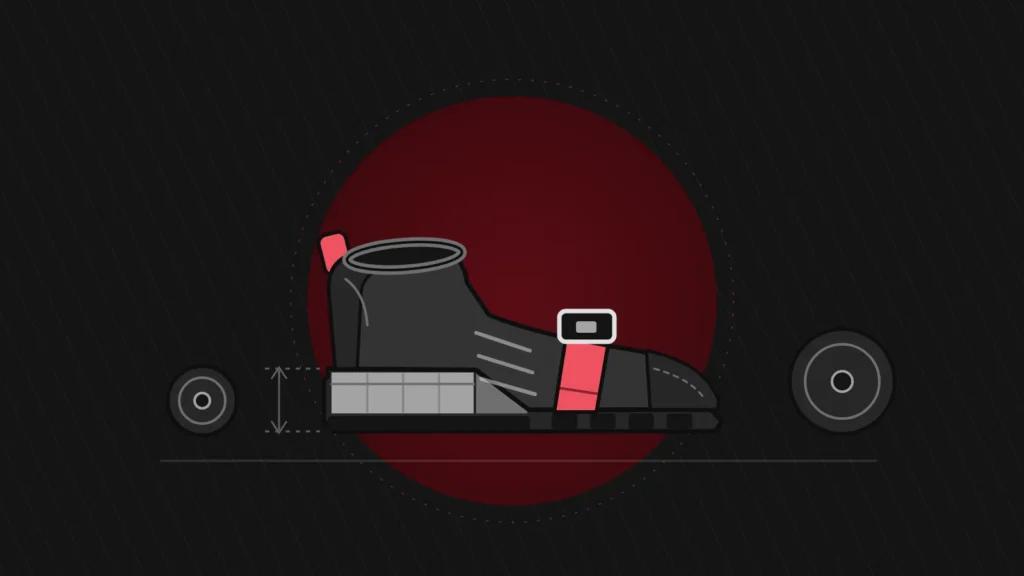
To descend in a squat, your shin has to travel forward over your foot. That is ankle dorsiflexion. When you run out of it, your body finds a workaround: heels lift, chest dives forward, low back rounds at the bottom. A raised heel solves it from the equipment side. It starts your foot slightly plantarflexed, so you have more ankle range left in the tank for the same depth.
This is not gym-bro theory. In a 2016 study in the Journal of Sports Sciences, 32 lifters performed back squats loaded and unloaded, in weightlifting shoes and in regular athletic shoes, under 3D motion capture and on a force plate. In both load conditions, the weightlifting shoes produced significantly less ankle flexion and more knee flexion. One finding is worth your attention: unloaded, the experienced lifters exploited the effect more than the novices, with greater knee and hip flexion. The heel opens a door, your technique still has to walk through it.
What the heel does not do
The “stays more upright” claim is oversold. Reviews of the available research find ankle dorsiflexion dropping roughly 2 to 5 degrees depending on the protocol, but the effect on actual torso angle in a high-bar back squat is inconsistent across studies. A heel will not fix a butt wink, will not replace bracing, and will not add 45 lb (20 kg) to your squat. It lets you reach depth without your heels leaving the platform.
Muscles worked shift when the heel goes up
Move the ankle angle and you move the labor. A 2022 study in Bioengineering had 20 trained lifters squat at 70% of their one-rep max using heel insoles of 0, 0.6 in (1.5 cm) and 1.2 in (3 cm). The higher the heel, the less ankle dorsiflexion. Vastus lateralis activation rose with the 1.2 in insole in men, the calf did more, the tibialis anterior did less. Most telling: the share of joint work taken by the ankle climbed sharply, while the hip’s share dropped in the men tested.
In plain terms, a heel makes your squat more vertical and more quad-driven, less posterior-chain dominant. That is exactly what an Olympic lifter wants on a deep high-bar squat, and what a streetlifting squat competitor wants in order to stay under the bar. If you squat low-bar on purpose to load the hips, that same shift works against you: you end up training the muscle group you were trying to spare.
Best weightlifting shoes vs flat shoes vs running shoes
Forget rankings for a second. Pick the category first, then the pair. Anything that compresses under load steals force and stability from you.
| Shoe type | Heel | Who it suits | Skip it if |
|---|---|---|---|
| Weightlifting shoe | Stiff, raised | Deep high-bar squats, snatch, clean and jerk, stiff ankles | You want one pair for every session |
| Flat squat shoe | Flat, hard sole | Low-bar squats, deadlifts, streetlifting, mobile ankles | Your heels lift the moment you break parallel |
| Running shoe | Compressible foam | Running, nothing under a barbell | You are lifting anything heavy |
| Barefoot or socks | None | Mobility drills, light sets, technique | Your gym bans it or you want lateral support |
For actual model picks, the squat shoes guide already lines up flat and heeled pairs with their specs, so this article will not repeat that comparison.
The streetlifting case
In streetlifting, the squat is one lift out of four. A heel does nothing for your weighted dips, weighted pull-ups or muscle-ups: you are hanging or supported on bars, floor contact is irrelevant, and a heavy weightlifting shoe is just extra load you have to carry in your belt or vest. Most athletes keep a flat pair for the weighted dip program and the weighted muscle-up program, then pull out the heeled pair only on heavy squat days. For a sense of what the top end looks like, the streetlifting squat world records show the loads being moved.
Heel height, stiffness and straps: the specs that matter
Four things, in this order.
- Heel height. The standard wedge sits around 0.75 in. On a Nike Romaleos 4, the measured effective heel height is 0.78 in (20 mm). Higher is not better: the taller the heel, the more you load the knees and calves, and the stranger your flat-shoe lifts will feel when you switch back.
- Stiffness. The heel should be wood or dense TPU, never foam. Store test: squeeze the heel between two fingers. It should not give at all.
- Strap setup. One or two midfoot straps on top of the laces. That is what stops your foot sliding forward when you rebound out of the hole.
- Width. Lifting shoes often run narrow. If your toes cannot spread, you lose the tripod foot that the whole lift is balanced on. Order your true width, not your sneaker size.
On the rules side, the International Powerlifting Federation caps the underside of the shoe at 2 in (5 cm) at any point, and loose inner soles that did not come with the shoe at 0.4 in (1 cm). No commercial lifting shoe comes close to that ceiling, and weightlifting boots are explicitly an approved footwear category, so you are fine on the platform.
Do you really need a heel? The wall test
Measure before you buy. The weight-bearing lunge test takes two minutes and a tape measure.
- Face a wall, front foot flat, and drive your knee toward the wall without ever letting the heel rise.
- Walk the foot back to the farthest distance where your knee still touches the wall with the heel down.
- Measure from the wall to your big toe. At least 5 in (12.5 cm) is considered normal range.
- Test both sides. A clear left-right gap means you have an ankle to unlock before you spend a dollar.
Under 5 in, a raised heel helps you immediately, and you also have mobility homework. Over 5 in, and if you can hold a full squat with both heels planted without tipping backward, you do not need a heeled shoe to squat. Keep a flat pair and put the money somewhere else.
Your action plan
- Run the wall test on both legs and write down the numbers.
- Film a 70% squat from the front and the side. Watch one thing only: do your heels stay down at the bottom.
- If they lift, train three sessions with about 0.8 in of heel wedge, two 5 lb plates or a board under your heels. It costs nothing and tells you whether a heel suits you before you pay for one.
- If the trial works, buy a stiff pair around 0.75 to 0.8 in of heel, in your true foot width.
- Keep a flat pair for deadlifts and bar work, and save the heel for squat days. Run the squat on a real strength block like the squat program, and keep building upper body pulling with the weighted pull-up program.
Three mistakes to avoid
Buying a heel to hide a stiff ankle and never training mobility. The heel compensates, it does not fix. Keep ten minutes of ankle mobility a week on the calendar.
Squatting in running shoes because “they cushion.” Foam compresses unevenly under 300 lb (135 kg) and your balance drifts sideways. It is the fastest way to miss a max attempt.
Using one pair for everything. A 0.8 in heel on a deadlift lengthens the bar path and shoves you onto your toes. Two pairs, two jobs.

mathieu
Street workout athlete since 2019, I discovered streetlifting in 2023. Today I share my passion for the sport through streetliftings.com.