
Key takeaways
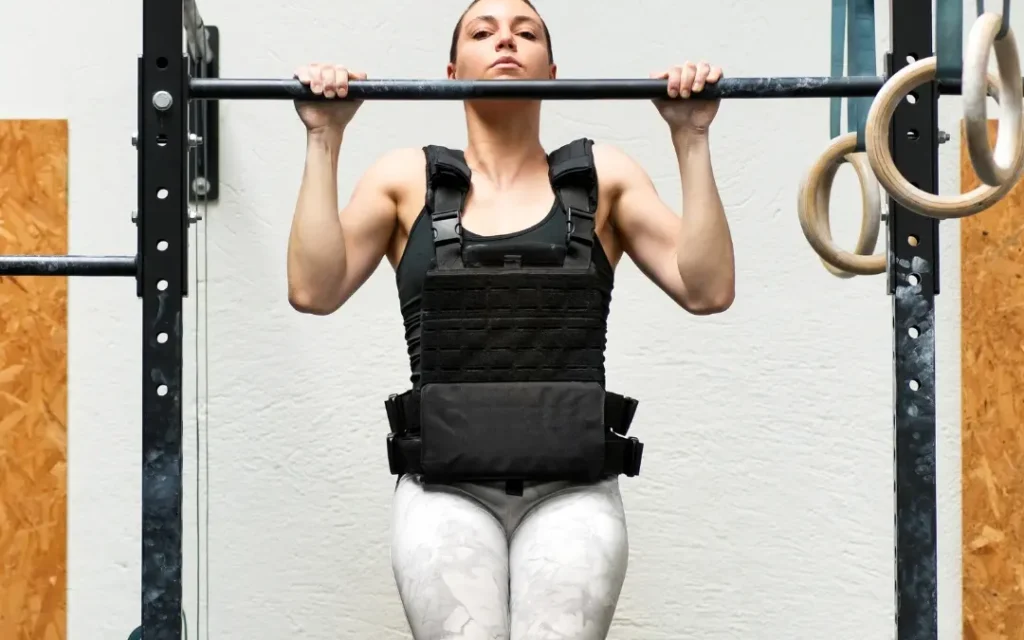
- Adding weight to pull-ups means loading the movement with a dip belt, weighted vest, backpack or dumbbell so you can keep progressively overloading once bodyweight stops being enough.
- The sensible green light is 8 to 15 strict full-range pull-ups, with scapular control and a 2 to 3 second lockout at the top.
- Start at 5 to 10 % of bodyweight, which is 10 to 16 lb (4 to 7 kg) for most lifters, then climb in 2.5 to 5 lb (1.25 to 2.5 kg) steps.
- A dip belt hangs the load under your hips and leaves the shoulders free; a vest spreads the load but tops out around 45 to 65 lb (20 to 30 kg).
- The costliest mistake is loading faster than your technique: cut range of motion, swinging and sore elbows end progress within three weeks.
Adding weight to pull-ups means loading a bodyweight exercise with external resistance: plates hanging from a dip belt, a weighted vest on your torso, or a dumbbell squeezed between your feet so your back has to move more than your usual 175 lb (80 kg). It is the only way to keep applying progressive overload once you can knock out twelve clean reps without blinking, and it is the foundation of streetlifting, the sport that ranks athletes on their max weighted pull-up, dip, squat and muscle-up.
This guide answers the three questions that stop everyone, in order: when to start, what gear and how much load, and how to program the following weeks so the plates actually go up.
When are you ready to add weight to pull-ups?
Short answer: when your bodyweight pull-up is clean and repeatable, not when it is merely possible. Load a sloppy pull-up and you only amplify the flaw. Elbows drift back, shoulders eat the difference, and progress dies within three weeks.
The common coaching benchmark is 8 to 15 strict full-range reps. But rep count alone tells you very little. Here are the four tests to pass, according to SW Academy, a coach who specializes in weighted pull-ups and lays them out in his video on when to start adding weight:
- 10 to 15 full-range pull-ups. Elbows fully straight at the bottom, whole head over the bar or chest touching it at the top. If your last reps barely get your forehead level with the bar, they do not count.
- Scapular control. You can do a scapular pull-up: arms straight, you rise a couple of inches purely by depressing the shoulder blades, no elbow bend.
- 6 to 8 pull-ups with a 2 to 3 second hold at the top. The top lockout is the first thing that breaks under load.
- 3 to 5 explosive pull-ups with no swing and a hard stop at the top.
That bar is set high on purpose. There is a looser reading: according to Alexandre, a calisthenics coach, the 10-rep threshold is often overstated, and 5 reps can be enough if you already have training experience, decent technique and a way to measure progress. The risk he flags is not injury, it is early specialization. A beginner who spends 80 % of his sessions on heavy strength work skips the muscle he needs most, and hits a wall twelve months later.
So here is the call. Under 5 strict reps: build the base first with inverted rows, 3 to 5 second slow negatives, band-assisted reps and structured back volume. Between 5 and 9 reps: you can start very light, leaving reps in reserve. Past 10 clean reps: the belt is your single best progression tool.
Dip belt, weighted vest, backpack or dumbbell: picking your gear
Gear is not a comfort detail. It decides the maximum load you will ever reach and where that load acts on your body.
| Method | Usable load | Strengths | Limits | Best for |
|---|---|---|---|---|
| Dip belt | 2.5 lb (1.25 kg) to 220 lb (100 kg) and up | Load hangs under the hips, shoulders stay free, micro-plates possible | Plates bought separately, setup takes practice | Strength, streetlifting, maxes |
| Weighted vest | 2 to 45 lb (1 to 20 kg), rarely over 65 lb (30 kg) | Load spread across the torso, on in 10 seconds, great for circuits | Low ceiling, crowds the chin and shoulder mobility | Volume, conditioning, pull-ups and push-ups back to back |
| Loaded backpack | 10 to 55 lb (5 to 25 kg) | Free, available anywhere, dense if you load plates | Unstable, pulls you backward, straps dig into the shoulders | Getting started, travel, outdoor bars |
| Dumbbell or kettlebell between the feet | 10 to 55 lb (5 to 25 kg) | No special gear, forces full-body tension | Adductors quit before your back does, the weight can drop | Short sets, improvising |
| Barbell or dumbbells on the feet (dorsiflexion) | 10 to 100 lb (5 to 45 kg) | Technique has to be strict, excellent diagnostic tool | Needs sturdy ankles and patience | Fixing a pull-up that cheats |
| Band anchored to the floor | Variable resistance | Hardest right at the top of the rep | Load impossible to quantify precisely | Top lockout, set finishers |
The dip belt: the standard, if you know how to get into it
The dip belt is the reference tool because it places the load under your hips, in line with gravity, without touching shoulder mobility. The ceiling comes from your plates and your back, not from the belt.
The real obstacle is practical: threading a chain through three 45 lb plates while standing up is a nightmare. The method shown by And Muscles 4all, a street workout athlete, in his dip belt setup demo solves it:
- Stack the plates flat against a wall, stable, before you touch the belt.
- Sit on the floor with your back to the wall and the belt already behind you. You thread the chain sitting down, not balancing on one leg.
- Run the chain through the first ring, pull it snug so it cannot slide, then clip the carabiner to the second ring.
- Before you stand up, pull the strap up into the small of your back. A belt sitting too low tips forward on the first rep.
- Pull your shirt out of the strap. Caught in the buckle, it tears and you waste the set adjusting gear.
Dip belt or weighted vest: which one
This is not a preference, it is an objective. If you want a max pull-up, a weighted muscle-up or a competition total: belt, no debate, because a weighted vest tops out around 45 to 65 lb (20 to 30 kg) and gets in the way of clearing your chin. If you run pull-ups, dips and push-ups in circuits, or you want to add 18 lb (8 kg) to an entire session: vest, because you strap it on once and the weight is included in the purchase.
How much weight to add, and how fast
The classic mistake is loading what your ego wants instead of what your technique can hold. Two useful markers: 5 to 10 % of bodyweight for your first loaded session, and 2.5 to 5 lb (1.25 to 2.5 kg) jumps after that. For a 165 lb (75 kg) lifter, that means a first step between 10 and 16 lb (4 to 7 kg), not 35.
If you are starting from fewer than 10 reps, be even more careful: according to Alexandre, a calisthenics coach, you should start between 2.5 and 11 lb (1.25 to 5 kg) and always keep reps in reserve, for example 5 sets of 2 when you could hit 5. You teach your body the load before you chase difficulty.
Second rule, and it runs against instinct: do not start at your max. If 27 lb (12.5 kg) for 3 sets of 5 has you gritting your teeth, start at 18 or 22 lb (8 to 10 kg), add 2 lb (1 kg) a week, and come back to 27 lb a month later. The same load will feel light. That is exactly the logic SW Academy defends, and it separates the lifter who gains 2 lb a week for six months from the one who stalls at his starting max.
For fine steps, gear matters. Two 1 lb micro-plates beat a 10 lb jump. And for a compact load, thin cast iron plates or a kettlebell beat the fat rubber bumpers that bang your knees on every rep.
Muscles worked by weighted pull-ups
The weighted pull-up is a vertical pull that recruits the whole posterior chain of the upper body. Adding load does not change which muscles fire, it raises the tension on each of them.
- Latissimus dorsi. The prime mover. It drives the arm down and back, which is why elbow path decides how much lat you actually get.
- Teres major, rhomboids, mid and lower traps. They stabilize the shoulder blades and finish the rep at the top. The more you pull your sternum to the bar, the harder they fire.
- Biceps brachii, brachialis, brachioradialis. Elbow flexors, heavily loaded with an underhand or neutral grip.
- Forearms and finger flexors. Past 45 lb (20 kg) of added load, grip is often the limiter before the back is.
- Abs, obliques, glutes. Under load, bracing is not optional: the belt swings under your hips and tries to turn you into a pendulum.
- Rear delt and rotator cuff. Barely prime movers, but directly exposed if the shoulder is not packed at the bottom.
One point people forget: grip changes the split. A wide overhand grip emphasizes the lats, an underhand grip shifts load to the biceps, and a neutral grip spreads it between back and arms while sparing the shoulder and wrist. Rotating grips from session to session is cheap insurance against overuse tendon pain.
Technique: one clean weighted pull-up, rep by rep
Under load, every flaw costs you plates. Here is the sequence.
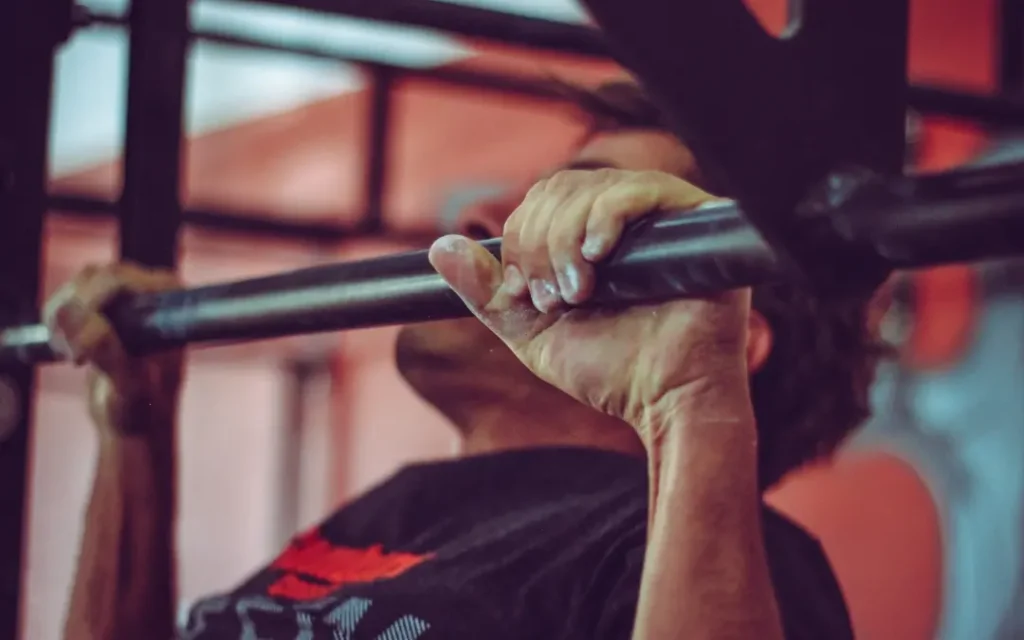
- Grip first. Crush the bar finger by finger instead of dangling from it. According to Squat University, who breaks down in his video on the McGill pull-up the protocol powerlifter Brian Carroll learned from Dr. Stuart McGill, that lobster-claw grip radiates strength through the whole body. Street workout athletes also lock the thumb over the bar to secure the hold under load.
- Active dead hang, not a limp hang. Arms straight, elbows locked, shoulders engaged. You depress the shoulder blades before a single elbow bends.
- Brace and set the legs. Cross the legs and bend them slightly, squeeze glutes and abs. The goal is to kill energy leaks and stop the load from turning you into a pendulum. Pauline, a streetlifting world champion, even points her toes forward to hold a neutral rib cage and lower back.
- The pull. Pull your sternum to the bar instead of lifting your chin. According to Nassim Sahili, a strength training creator, the elbow should aim at the iliac crest, which means a slight external rotation before the first rep, elbows not flared straight out to the sides.
- The check. Still per Nassim Sahili, film yourself from the side and watch your sternum: it should travel straight up and down, no arc, no zigzag. If the sternum drifts forward, biceps, traps and teres major take over for the lats.
- The descent. Lower for 2 to 3 seconds and never let go at the bottom. Do not drop into fully relaxed arms with 65 lb (30 kg) hanging off you: keep the tension, because your elbow and shoulder absorb the shock.
- Validate the bottom. Pause with the elbow locked and the shoulder blades released. That is the competition dead stop: without it you do not know whether the rep was full.
One logistics detail that prevents a lot of accidents: the bar should be at a height you can reach without jumping, and it must not move. Jumping for the bar with 55 lb strapped to your waist is the fastest way to tweak a shoulder before rep one.
Programming weighted pull-ups: sets, reps, frequency
A weighted pull-up session is planned. Picking your load by feel when you walk up to the bar is the number one reason people plateau.
| Goal | Sets and reps | Load | Rest | Frequency |
|---|---|---|---|---|
| Breaking into load | 5 x 2 to 3 | 2.5 to 11 lb (1.25 to 5 kg), 3 reps in reserve | 2 min | 2 times a week |
| Max strength | 3 to 5 x 3 to 6 | Heavy, 1 to 2 reps in reserve | 2 to 3 min | 1 to 2 times a week |
| Hypertrophy | 3 to 4 x 6 to 12 | Moderate | 90 to 120 s | 2 times a week |
| Double progression | 3 x 5 to 8 | Fixed load, add 2.5 to 5 lb once 3 x 8 is hit | 2 to 3 min | 1 to 2 times a week |
| Max and power | 5 to 8 x 1 to 2 | Very heavy, long rest | 3 to 5 min | 1 time a week |
Two progression methods hold up over time.
Double progression. You pick a load and a rep range, say 3 sets of 5 to 8 at 22 lb (10 kg). Week 1 you hit 6, 6, 5. Week 2, 7, 6, 6. Week 3, 8, 8, 7. Once all three sets reach 8, you add 5 lb (2.5 kg) and drop back to 5 or 6 reps. The cycle restarts.
The weekly kilo. You keep 3 sets of 5 and add 2 lb (1 kg) every session or every other week without touching the format. That is SW Academy’s preferred method, with a three-stage plateau exit: 3 x 5 for as long as it climbs, then 3 x 3, then a volume block at 7 to 9 reps, then back to 3 x 5 on a higher strength base.
For the weekly layout, the most durable setup is one heavy loaded session plus one bodyweight or weak-point session. Alternating loaded and unloaded days keeps your bodyweight numbers climbing, which load alone will not do. If you want a plan already built, the weighted pull-up program handles periodization for you, and the weighted dip program does the same job on the opposing vertical press, which you should balance across the week.
Mistakes that stall your progress
- Loading too fast. A 10 lb jump feels motivating, then it wrecks your technique and fries your elbows. 2.5 or 5 lb steps always win over twelve months.
- Cutting range of motion. A half rep at 45 lb is worth less than a full rep at 35 lb. If your chin barely clears, take a plate off.
- Swinging. Hanging load amplifies every oscillation. If you have to kick your legs, the set is over.
- Ignoring the shoulders. Face pulls, external rotations, band pull-aparts and a real scapular warm-up are not optional when you add weight twice a week.
- Skipping the press. For every heavy pull, a heavy press. Overhead work and weighted push-ups keep the shoulder balanced.
- Loading everything. If every set is heavy, your bodyweight max stalls and your back volume collapses. Keep one unloaded session.
- Underrating grip. If your hands fail before your back, add loaded dead hangs and chalk instead of reaching for straps every set.
Adding weight at home, without a belt
No belt, no vest? Three options hold up.
The backpack is the simplest: plates flat against the back panel, padded with a towel so they cannot shift, straps cinched tight. Past 45 lb (20 kg) it pulls you backward and changes the path, but for the first 20 lb it does the job perfectly. Gallon water jugs even give you fine steps when you have no plates.
A dumbbell or kettlebell between the feet works for short sets. The flaw is known: your adductors give out before your back and the weight ends up on the floor. Cross your ankles over the handle instead of pinching it between your soles.
The dorsiflexion method is the most interesting one technically. You rest a dumbbell, kettlebell or EZ bar on top of your feet, ankles pulled up, legs straight under your torso. According to Dr. Joel Seedman, PhD, a strength coach, this dorsiflexion loading method makes cheating impossible: any swing or asymmetrical pull and the weight slides off your feet. It also sets up instant drop sets, since you dump the load and keep going at bodyweight without leaving the bar.
Last resort when nothing is available: make the pull-up harder instead of heavier. Five-second lowering, 3-second pause at mid-height, explosive reps, towel grip. And if you want a number to chase, the 5 x 5 protocol with 3 to 5 minutes of rest popularized by climber Cameron Hörst in this max strength guide for weighted pull-ups is one of the easiest to follow: a load you could take for 7 to 8 reps, twice a week.
Once your weighted pull-ups are moving, the rest of the streetlifting total follows fast: same overload principle applied to the squat, the dip and the muscle-up.
FAQ
At what point should I add weight to my pull-ups?
Most coaches put the line at 8 to 15 strict full-range reps: elbows locked at the bottom, chin clearly over the bar at the top. Beyond rep count, you should also control your shoulder blades and be able to hold the top lockout for 2 to 3 seconds. Under 5 strict reps, build the base with inverted rows, slow negatives and band-assisted pull-ups instead.
How much weight should I start with on pull-ups?
Use 5 to 10 % of your bodyweight for the first loaded session, roughly 10 to 16 lb (4 to 7 kg) for a 165 lb lifter. Then add 2.5 to 5 lb (1.25 to 2.5 kg) at a time, not 10. And do not open at your current max: if 27 lb (12.5 kg) has you grinding, start at 18 to 22 lb and add 2 lb a week.
Is a 45 lb weighted pull-up good?
It is a solid intermediate marker. For a 180 lb lifter, 45 lb (20 kg) is about a quarter of bodyweight, which already means a clean and strong pull. Competitive streetlifters work far above that, and coaches who specialize in the lift treat 65 lb (30 kg) as a realistic medium-term target for a dedicated lifter. Judge it relative to your bodyweight, not as an absolute number.
How many pull-ups should a 200 lb man be able to do?
There is no official standard, and bodyweight matters a lot: the same strength level produces fewer reps at 200 lb than at 150 lb. As a practical benchmark, 8 to 10 strict full-range reps puts a 200 lb lifter in good shape and is enough to start adding weight. If you are under that, train reps and back volume before touching a belt.
Can I add weight to pull-ups without a belt?
Yes. A loaded backpack handles the first 20 lb comfortably, a dumbbell or kettlebell crossed under the ankles works for short sets, and resting a dumbbell or EZ bar on top of dorsiflexed feet both loads the movement and forces strict mechanics. You can also make the rep harder instead of heavier with 5-second lowering, mid-range pauses or a towel grip.
How often should I train weighted pull-ups?
One to two heavy sessions a week, with 48 to 72 hours between them, covers almost everyone. The most durable layout is one loaded session plus one bodyweight or weak-point session, so your unloaded numbers keep climbing too. Loading every single pull-up session is how people stall their rep max and lose back volume.

mathieu
Street workout athlete since 2019, I discovered streetlifting in 2023. Today I share my passion for the sport through streetliftings.com.