
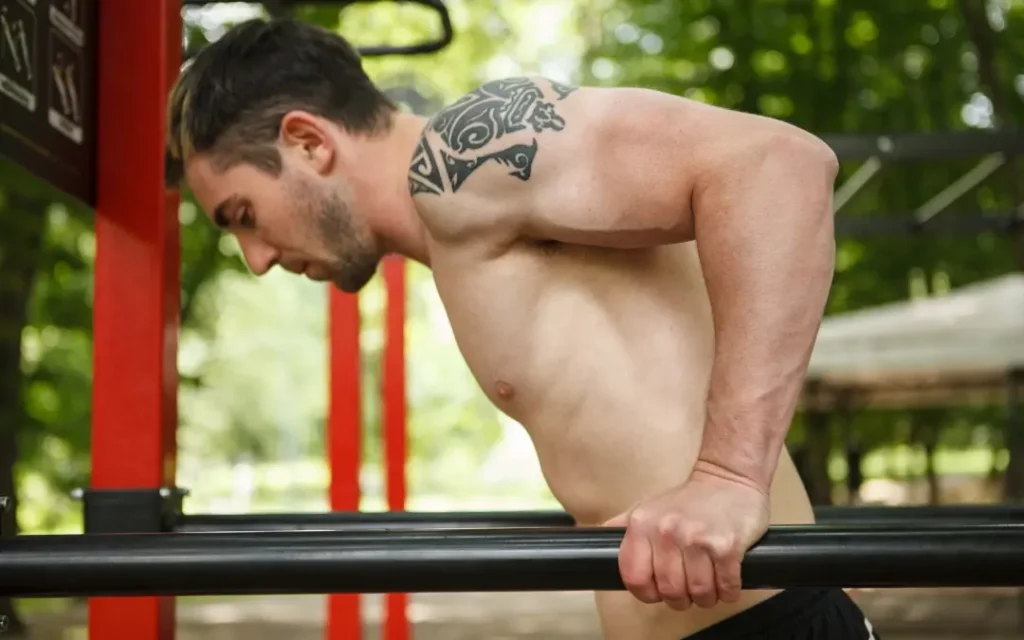
Key takeaways
- Weighted dips with dumbbells mean pinching the weight between crossed ankles or just above the knees, then dipping until your arms hit 90 degrees.
- The lift builds the triceps, lower chest and front delts, and demands serious bracing once the load passes 20 lb (10 kg).
- The key cue is to pull the shoulder blades down and apart, never squeeze them together, and to stop at parallel instead of chasing depth.
- The main mistake is loading before you own 12 to 15 strict bodyweight reps, which magnifies form faults rather than fixing them.
- A dumbbell works up to about 25 to 35 lb (10 to 15 kg); past that, a dip belt is the only option that keeps your legs straight and the load under your hips.
Adding weight to dips with a dumbbell is the fastest fix when there’s no dip belt in the gym bag: cross your ankles, pinch the dumbbell between your feet or just above your knees, and start dipping. Free, instant, no setup. But the method has a low ceiling and one flaw almost nobody mentions, because it forces your legs into the exact position every serious coach tells you to avoid under load. Here’s how to do it right, what load to start with based on your bodyweight, how it stacks up against a belt or a vest, and the loaded-dip technique that keeps your shoulders healthy.
How to add weight to dips with dumbbells, step by step
You have three placements, from most stable to most precarious. Try each one unloaded before you hang 35 lb (16 kg) off your body.
- Dumbbell between the feet, ankles crossed. Set the dumbbell on the floor between the bars, press up to straight arms, hook your crossed ankles over the dumbbell handle and squeeze your feet together. This is the most solid option up to roughly 20 to 25 lb (10 to 12 kg).
- Dumbbell between the thighs, just above the knees. You pinch it with your adductors, knees bent. More comfortable for light loads, but it slips the second your legs fatigue or sweat up.
- Dumbbell resting on crossed ankles, legs straight out front. Hex dumbbells only, and nothing above 15 to 18 lb (7 to 8 kg). One small swing and the weight hits the floor.
A few details that decide whether the set works. Use a hex dumbbell: round ones roll away while you’re reaching for them, and they spin between your feet mid-set. Load the dumbbell before you get on the bars, never while you’re hanging. Put a mat or foam pad underneath, because you will drop it at failure, and a 45 lb (20 kg) dumbbell falling 16 inches onto concrete breaks plates and feet. Finally, plan to stop one or two reps earlier than you expect: your core and adductors quit before your triceps do.
The built-in flaw. Holding a dumbbell forces you to cross your ankles and tuck your legs under your hips. That’s the one position coaches rule out under load: per FitnessFAQs, a calisthenics channel with over a million subscribers, crossing the legs behind the body creates a disconnected torso, brings on hamstring cramps, and triggers that worm-like spinal wave halfway through the rep. With a dumbbell you accept that trade. It’s fine at 20 lb. It’s a problem at 60.
When should you start adding weight to dips?
The threshold isn’t up for debate: 12 to 15 strict bodyweight reps, full range, zero shoulder pain, before your first plate. Strict means no knee kick, no swing, and a visible pause at the bottom. Loading before that point doesn’t speed anything up. It magnifies whatever’s already broken and turns a cranky shoulder into tendinitis.
| Level | Bodyweight benchmark | Load to use | Working format |
|---|---|---|---|
| Beginner | Under 12 clean reps | None | 4 x 8 to 12 bodyweight, or band-assisted dips |
| Intermediate | 12 to 20 clean reps, quiet shoulders | 10 to 25 lb (5 to 10 kg) | 4 x 6 to 8 |
| Advanced | 20 plus reps | 25 to 65 lb (10 to 30 kg) | 5 x 5 or 4 x 6 |
| Streetlifting level | Months of consistent loaded work | 65 lb (30 kg) and up, to bodyweight | 6 x 3, 5 x 3, heavy controlled singles |
For your very first load, use 5 to 10 % of your bodyweight. It won’t look impressive, and that’s the point: you’re testing how the shoulder responds before you push.
| Your bodyweight | First load (5 to 10 %) | Closest common dumbbell |
|---|---|---|
| 135 lb (61 kg) | 7 to 14 lb (3 to 6 kg) | 10 lb |
| 155 lb (70 kg) | 8 to 16 lb (4 to 7 kg) | 15 lb |
| 175 lb (79 kg) | 9 to 18 lb (4 to 8 kg) | 15 or 20 lb |
| 200 lb (91 kg) | 10 to 20 lb (4.5 to 9 kg) | 20 lb |
From there, move up in 2.5 to 5 lb (1 to 2.5 kg) jumps, and only once you hit your target reps with the same depth you had on set one. A jump that’s too big never shows up on the belt, it shows up in your range of motion: you stop going as deep and call it progress. That’s the whole logic behind our weighted dip program, where the load only moves when the technique holds.
Dumbbell, dip belt or weighted vest: what to use
A dumbbell gets you through a session. It is not a long-term loading tool. Here’s what each option actually costs you.
| Option | Realistic ceiling | Upside | Downside |
|---|---|---|---|
| Dumbbell between the legs | 25 to 35 lb (10 to 15 kg) | Free, available in every gym, nothing to buy | Unstable, forces crossed legs, wastes energy on holding it |
| Dip belt with chain | No practical limit (belts rated past 600 lb) | Load hangs under your center of gravity, adjustable to the pound, legs stay straight | Costs money, chain length needs dialing in |
| Weighted vest | 40 to 65 lb (20 to 30 kg) | Even distribution, nothing to hold, works for push-ups and squats too | Fixed load increments, gets in the way when you lean forward |
| Loaded backpack | 35 to 45 lb (15 to 20 kg) | You already own one, easy outdoors | Weight sits high and behind you, pulls you off balance, straps must be cinched tight |
| Chain and carabiner on a lifting belt | 90 lb (40 kg) and up | Costs a few dollars, extremely strong | Short chain means the plate rubs, no padding means no comfort |
Past 35 lb (15 kg), switch to a dip belt. The load hangs free under your hips, your legs stay straight and locked together, and you can add 2.5 lb whenever you want. A weighted vest still earns its place on longer sets and circuits, but the weight pressed against your torso fights you the moment you lean forward to bias the chest. Same reasoning applies on the pulling side, which we break down in our guide to adding weight to pull-ups.
Muscles worked by weighted dips
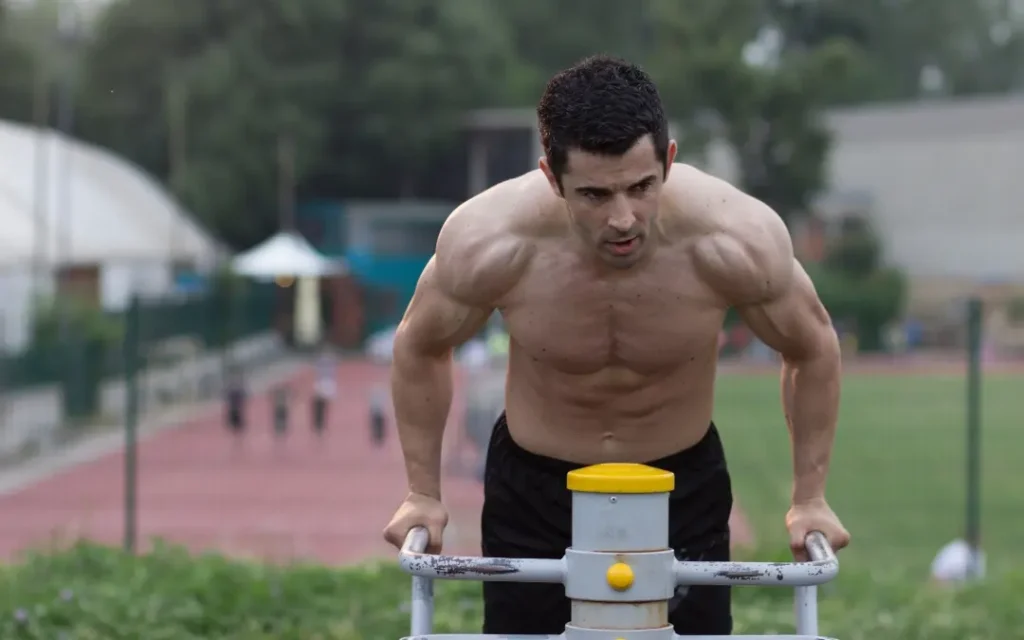
Weighted dips are a complete vertical push. Adding load doesn’t change which muscles do the work, it raises the tension on all of them and makes the stabilizers work far harder than they do at bodyweight.
| Muscle | Job in the movement | Demand |
|---|---|---|
| Triceps brachii | Elbow extension | Highest with an upright torso and tucked elbows |
| Lower pectorals | Arm adduction and flexion | Highest with the torso leaned forward |
| Anterior deltoid | Shoulder flexion, driving out of the hole | Heavy, especially at the bottom |
| Serratus anterior and lower traps | Depressing and controlling the shoulder blades | Isometric, constant through the set |
| Abs and glutes | Bracing, stopping the body from swinging | High once the load passes 20 lb |
| Adductors | Holding the dumbbell in place | Specific to the dumbbell method |
The triceps-versus-chest dial isn’t grip width, it’s torso angle. Stay vertical and the triceps eat the load. Lean forward about 30 degrees, legs out in front, hands squeezing in toward each other, and the lower chest takes over. Under heavy load, the upright version is the safer bet for the joint. That pressing strength carries straight over to the top half of a weighted muscle-up, where you have to press out above the bar after the transition.
Loaded dip technique: six coaching points
Bodyweight dip technique and weighted dip technique are not the same thing. Under load, three things stop being optional: shoulder blade position, lower-body rigidity, and depth.
- Depress the shoulder blades, don’t squeeze them together. This is the most misunderstood cue in the lift. Per the physical therapist on the Myprotein France channel, a competitive dipper with 127 lb (57.5 kg) at the world championships and 132 lb (60 kg) in training, pulling the blades together puts you in thoracic extension and loads the front of the shoulder hard, which is where the shoulder, sternum and collarbone pain comes from. The fix: pull the blades down and apart, round the upper back slightly, and hold that position from the first rep to the last.
- Build the straight-arm support hold first. Per Eric Flag, a street workout coach, you should be able to hold 45 to 60 total seconds of active support, arms at 99 % extension rather than locked out, before you load anything. Point the inside of your elbows forward so the bend travels backward instead of out to the sides. A shoulder that can’t hold 30 seconds empty won’t hold 45 lb.
- Brace through the upper chest. Unlike a squat, you don’t breathe into the belly here. Fill the top of the rib cage, hold it on the way down, exhale at the top. The torso becomes one block.
- Squeeze the legs. With a belt: legs straight, thighs pressed together. If your legs swing backward during the press, you lose the rep. With a dumbbell, your legs are already busy, so you have to brace the abs harder to compensate.
- The heavier you load, the less you descend. At bodyweight you chase full range. Loaded, you stop at parallel, arms around 90 degrees. The bottom position already stretches the front of the shoulder, and every pound added amplifies that. If you’re tall and long-armed, be stricter still.
- Pause at the bottom, never bounce. A quarter second of stillness before you press. Without it you’re using the stretch reflex instead of your own strength, and your elbows and shoulders absorb the difference.
Mistakes that stall your weighted dips
- Loading before 12 clean reps. The number one mistake and the most expensive one in training time.
- Shoulders shrugged toward the ears. A weak, unstable position, and the single biggest source of shoulder pain in regular dippers.
- Hunched upper back with the head jutting forward. The classic giveaway that the load is too heavy. If you see it on video, take 10 % off.
- Range of motion shrinking as the weight climbs. Film one set from the side every couple of weeks. It’s the only honest judge you have.
- Elbows flaring past 45 degrees. Shearing the shoulder at the bottom for no return.
- Skipping the warm-up. Two empty sets at partial range, then one set at half your working load. Weighted dips load the shoulder, elbow and wrist through a wide arc.
- Round dumbbells on a hard floor. A logistics detail with a real injury attached.
Programming weighted dips: two template sessions
Two sessions a week, at least 48 hours apart, will carry you a long way. One heavy day, one bodyweight volume day: the alternation protects your shoulders while still piling up work.
Session A, strength. Warm up, then 5 sets of 5 with your current load, stopping one to two reps short of failure. Rest 3 minutes. Finish with one drop set: strip the weight off and keep going at bodyweight until you’re two reps from failure.
Session B, volume and technique. 4 sets of 8 to 12 bodyweight reps at full range, fixing one technical point at a time. Three useful variations: tempo dips with a 3-second controlled descent, paused dips with a 1 to 3 second hold at the bottom to train the drive out of the hole, and EMOM work, for example 10 minutes of 4 reps at 45 lb (20 kg) every minute on the minute. The Myprotein France physical therapist favors that last format because it accumulates heavy volume while keeping fatigue low.
Three intensity techniques are worth using when you don’t want to add weight: partial reps at the end of a set, in the top half of the range only and never at the bottom; rest-pause, 15 to 20 seconds off then two or three more reps; and controlled 3 to 4 second negatives on your last reps. Keep them for moderate loads. Stacked on top of a heavy belt they grind your shoulders down for very little return.
On rep ranges, the logic matches weighted pull-ups: 1 to 6 reps for maximal strength, 6 to 20 for size, finishing volume sets 1 to 3 reps shy of failure. Heavy and light loads build comparable muscle when sets are taken near failure, but heavy loads drive maximal strength further, according to a meta-analysis of 21 studies (Schoenfeld, 2017). If you want both inside the same week, our streetlifting programs lay that alternation out across full cycles.
Shoulder, sternum and elbow pain: what to do
Weighted dips aren’t dangerous on their own. They’re intolerant of rushing. Three complaints come up over and over.
- The front of the shoulder pinches at the bottom. Cut 2 to 4 inches off your depth, take 10 % off the load, and check that your shoulder blades are still pulled down. If it persists, go back to bodyweight for two weeks.
- Sternum or rib pain. Common under 25: per Eric Flag, sternum ossification isn’t finished until age 20 to 25, which leaves it more mobile and more sensitive to pressure. It’s also a sign of too much volume. Cut frequency and depth, and swap one session for a horizontal press.
- Pain at the elbow crease. Take the weight off, no negotiation. Never drop into straight arms under load: brake every descent.
Three modifications work well for cranky shoulders. Keep the torso upright instead of leaned over, since leaning deepens the stretch on the joint. Deliberately shorten your range on heavy loaded sets and save full range for your bodyweight work. And if dips hurt even empty, build your pressing elsewhere first, for instance with weighted push-ups, then come back to the bars.
One last piece of context. Lifters have called the weighted dip the upper-body squat for decades, and the label holds up. The range of motion beats a bench press, there’s no bench to brace against, and the bottom position gives you nowhere to hide. That’s exactly why it builds so much pressing strength, and exactly why it punishes an impatient progression. Before you load anything, go back and own the bodyweight dip.
FAQ
How many dips should you do before adding weight?
Aim for 12 to 15 strict bodyweight reps at full range with no shoulder pain before your first plate. Strict means no knee kick and a clear pause at the bottom. Below that benchmark, added weight just magnifies whatever is already wrong with your form.
How much weight should you start with on dips?
Use 5 to 10 % of your bodyweight, which lands between 7 and 20 lb (3 to 9 kg) for most lifters. A 10 or 15 lb dumbbell is plenty for your first few sessions. After that, move up in 2.5 to 5 lb jumps, and only when you hit your target reps at the same depth you had on set one.
How can you add weight to dips without a dip belt?
Three options: a dumbbell pinched between crossed ankles, a weighted vest, or a loaded backpack with the straps cinched tight. The dumbbell is the most precise up to 25 lb (12 kg), the vest distributes better but caps out around 40 to 65 lb, and the backpack pulls you off balance because the weight sits high and behind you.
What muscles do weighted dips work?
The triceps brachii, lower pectorals and anterior deltoid are the prime movers. The serratus anterior and lower traps work isometrically to keep the shoulder blades depressed, and the abs handle the bracing. Stay upright and the triceps dominate; lean forward about 30 degrees and the chest takes over.
Are weighted dips bad for your shoulders?
Not when they're done properly. The risk comes from the bottom position under load, which stretches the front of the shoulder hard. Stopping at parallel on heavy sets, keeping the shoulder blades down and apart, and never loading an already painful shoulder removes most of the danger.
How often should you train weighted dips?
Two sessions a week with at least 48 hours between them is enough to keep progressing for a long time. Alternate one heavy day of 5 sets of 5 with one bodyweight volume day at full range. Your shoulders and triceps need that recovery window between loaded sessions.

mathieu
Street workout athlete since 2019, I discovered streetlifting in 2023. Today I share my passion for the sport through streetliftings.com.