
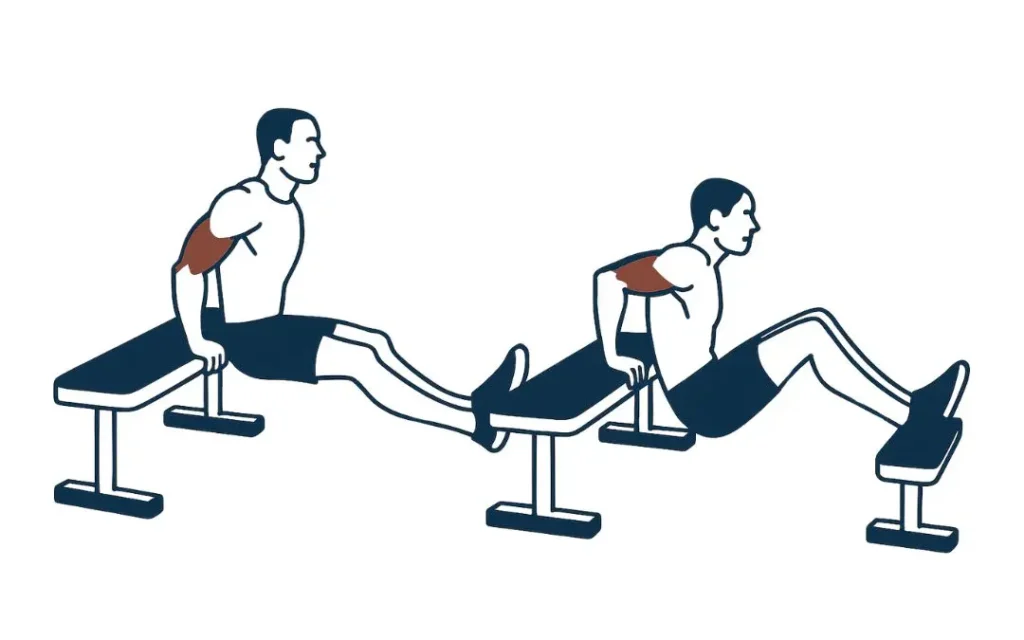
Bench dips are a go-to exercise for building the triceps, while also engaging the shoulders and chest. Easy to set up, effective, and adaptable to all fitness levels, they are perfect for a home or gym workout. Let’s look at how to perform them correctly, which muscles they target, and how to progress toward more demanding variations.
How to Do Bench Dips
Setup
Before you start, position two benches parallel to each other, far enough apart that you can rest your heels on one and your hands on the other. Make sure both are stable to avoid any tipping during the exercise.
Starting position:
-
Sit on the rear bench with your hands flat on either side of your hips, fingers pointing forward.
-
Extend your legs and place your heels on the opposite bench.
-
Slowly slide your hips off the bench so you are suspended, arms straight, shoulders down, and gaze straight ahead.
Proper Execution
-
Controlled descent: Slowly bend your elbows to approximately 90 degrees, keeping your elbows close to your body. Your hips travel straight down toward the floor without drifting away from the bench.
-
Push phase: Press through your palms to return to the starting position. Keep your arms almost fully extended without locking out your elbows.
-
Breathing: Inhale on the way down, exhale on the way up.
Expert tips:
-
Keep your torso upright and avoid leaning too far forward, which would shift emphasis to the chest rather than the triceps.
-
Do not descend too deep – a 90-degree angle at the elbow is sufficient to avoid over-stressing the shoulders.
-
Start with sets of 10 to 15 reps and 60 to 90 seconds of rest between sets.
Program or coaching?
Find your ideal format
Answer 4 questions and get a personalized recommendation based on your level and goals.
Tailored result
Free
Target Muscles
Bench dips primarily target the triceps brachii, the muscles located at the back of the upper arm. But they work more than just that:
-
Triceps: the primary target, especially during the arm extension phase.
-
Lower chest: mildly engaged, particularly if you lean your torso slightly forward.
-
Anterior deltoids: the shoulders kick in to stabilize and assist the movement.
-
Stabilizer muscles: the core and lower back work isometrically to maintain a stable posture.
Taking It to the Next Level
Once you have mastered bench dips, it is time to progress toward more demanding variations to keep building strength and muscle mass.
Bodyweight Dips on Parallel Bars
This is the natural next step to increase intensity. This variation is performed on dip bars, arms straight and feet off the ground.
Key differences:
-
The range of motion is greater.
-
Your full bodyweight is supported by your arms alone.
-
Less assistance from the legs means more demand on the triceps and chest.
This version requires a solid core and good joint stability.
Tip: If it is too difficult, start with the negative phase only (lower yourself slowly and use your legs to push back up).
Weighted Dips
For more advanced athletes, weighted dips are a powerful method to boost strength and promote muscle hypertrophy.
How to perform them:
-
Use a dip belt with weight plates, a weighted vest, or hold a dumbbell between your legs.
-
Add weight gradually to avoid injury.
-
Work in shorter sets (6 to 10 reps) with heavier loads to stimulate muscle growth.
Coach’s Takeaway
Bench dips are an excellent gateway to more complex strength exercises. Accessible and effective, they help sculpt the triceps while strengthening the upper body as a whole. Performed correctly and with consistent progression, they can become a cornerstone of your training routine.
Don’t forget: warming up is essential, as is recovery. Listen to your body, adjust your training volume, and stay consistent – visible results will follow.
Ready to blast your triceps? Get to those benches!
More Exercises to Build Your Triceps
- Assisted Dips
- Chair Dips
- Triceps Kickback
- Skullcrusher
- EZ-Bar Skull Crusher
- High-Cable Triceps Extension
- Low-Cable Triceps Extension
- Dumbbell Triceps Extension