
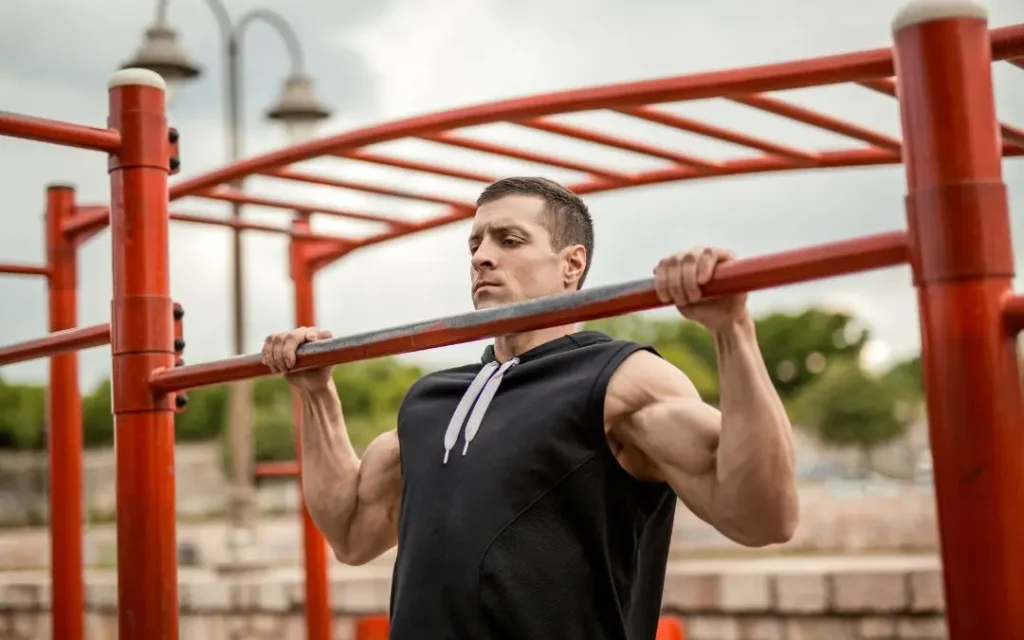
Pull-ups are among the most effective exercises for building upper-body strength, yet they intimidate a lot of people. Whether you are a beginner or at an intermediate level, progressing at pull-ups requires a precise strategy, consistency, and a solid understanding of the movement. Here is a complete guide on how to progress at pull-ups, with concrete advice you can apply starting today.
How to Perform a Pull-up Correctly
Hand placement and posture
Proper execution is essential to progress at pull-ups without getting injured. Hand placement plays a key role in muscle recruitment:
- Pronated grip (palms facing forward): targets the back (latissimus dorsi) and forearms.
- Supinated grip (palms facing you): emphasizes the biceps.
- Neutral grip (palms facing each other): easier on the shoulders, balances biceps and back recruitment.
Hand width: shoulder-width or slightly wider for optimal back engagement.
Movement execution
- Full hang: arms extended, shoulders engaged (scapulas slightly retracted).
- Pull phase: contract your back and arms to pull your chin above the bar, with no swinging.
- Controlled descent: lower yourself slowly while keeping the muscles engaged.
Tip: Keep your legs straight or slightly bent, and avoid swinging your body – stay strict.
Muscles worked
- Back: latissimus dorsi, trapezius, rhomboids
- Arms: biceps, brachialis
- Shoulders: posterior deltoids
- Core: abs, lower back (stabilization)
Program or coaching?
Find your ideal format
Answer 4 questions and get a personalized recommendation based on your level and goals.
Tailored result
Free
What Equipment Do You Need for Pull-ups?
You don’t need a gym to progress at pull-ups. Here are the most commonly used options:
- Wall-mounted or door-frame pull-up bar (ideal at home)
- Street workout structure (outdoor parks)
- Power rack with a fixed bar
- Gymnastic rings: to vary the movement and recruit more stabilizers
The key is to have a solid, secure support so you can execute the movement correctly.
Understanding the Fundamentals of Pull-up Training
Before chasing higher numbers, you need to understand the core principles that govern progression:
- Progressive overload: gradually increase difficulty over time (volume, intensity, added weight)
- Recovery: essential for muscles to get stronger
- Specificity: to progress at pull-ups, you need to do them regularly
- Movement quality: control and technique come first
Without these fundamentals, stagnation is guaranteed – no matter how much you train.
Pull-up Training Techniques
If you cannot do a pull-up yet:
- Assisted pull-ups with a resistance band
- Negative pull-ups: start with your chin above the bar, lower yourself slowly
- Inverted rows to strengthen the horizontal pull pattern
- Isometric holds: hold the top or mid position
If you can do 1 to 5 pull-ups:
- EMOM sets (Every Minute On the Minute)
- Fractional rep sets: 3 sets of 2 + 1 assisted rep
- Grease The Groove: multiple short sets spread throughout the day
If you can string together 6 to 15 pull-ups:
- Light weighted pull-ups
- Slow tempo: 2-0-2 (2 sec up, pause, 2 sec down)
- Supersets with rowing or bicep curls
If you exceed 15 pull-ups:
- Heavy weighted pull-ups
- Explosive or clapping pull-ups
- Strength cycles (e.g. 5×5 or 3×3 with added weight)
The Best Training Frequency to Progress
Progressing at pull-ups requires frequent but smart training:
- Beginners: 2 to 3 times per week, with at least one rest day between sessions.
- Intermediate: 3 to 4 times per week, alternating between volume and intensity.
- Advanced: up to 5 times per week if recovery and sleep are optimal.
Pull-up Training Program
| Day | Type | Exercises |
|---|---|---|
| Day 1 | Strength |
5 x 3 weighted pull-ups (or negatives for beginners) 3 x 10 barbell rows 3 x 12 bicep curls |
| Day 2 | Volume |
4 x max strict pull-ups 3 x 15 face pulls 3 x 15 close-grip push-ups |
| Day 3 | Technique & assistance |
5 x 5 assisted or negative pull-ups 3 x 20 sec isometric hold (top position) 3 x 10 TRX rows |
| Day 4 | Endurance (optional) |
EMOM 10 min: 3-5 pull-ups/minute 3 x 20 hanging crunches |
Finally, Move on to Weighted Pull-ups to Keep Progressing
Once you have mastered at least 10-12 strict pull-ups, it is time to level up with added weight:
- Weighted vest
- Dip belt
- Loaded backpack
Benefits:
- Develops maximal strength
- Improves performance in streetlifting
- Makes bodyweight pull-ups much easier
Start light (2.5 to 5 kg) and increase progressively. Favor 3×3, 5×5, or pyramid formats.
Tips to Stay Disciplined in Your Training
Progressing at pull-ups takes patience and consistency. Here are some tips to stay on track:
- Set a concrete goal (10 pull-ups, weighted pull-ups, one-arm pull-up…)
- Keep a training log
- Film yourself to correct your technique
- Train with a partner to stay motivated
- Don’t skip the joint warm-up (shoulders, elbows)
- Include mobility work to prevent pain
Coach’s Conclusion
Whether you can do zero or 20 pull-ups, you can always progress at pull-ups by following the right method. What matters is respecting your current level, mastering technique, and having a structured progression plan.
Don’t rush through the stages: consistency, listening to your body, and the drive to push yourself will make all the difference. Add pull-ups to your routine, track your progress, and you will be surprised by the results in just a few weeks.
Ready to pull yourself up?
Start Here
- Streetlifting Program
- Weighted Muscle Up Program
- Weighted Pull-up Program
- Weighted Dip Program
- Squat Program

mathieu
Street workout athlete since 2019, I discovered streetlifting in 2023. Today I share my passion for the sport through streetliftings.com.