
A pull-up and dip station, the free-standing frame most brands label a power tower, is the cheapest way to get both basic upper-body movements into an apartment. No drilling, no load-bearing wall to hunt for, two exercises ready in three seconds. The catch: every one of these frames looks identical in the product photo, and the gap between a solid one and a wobbly one is huge. Here is what actually decides the purchase, and what is pure marketing.
Pull-Up and Dip Station: What a Power Tower Adds
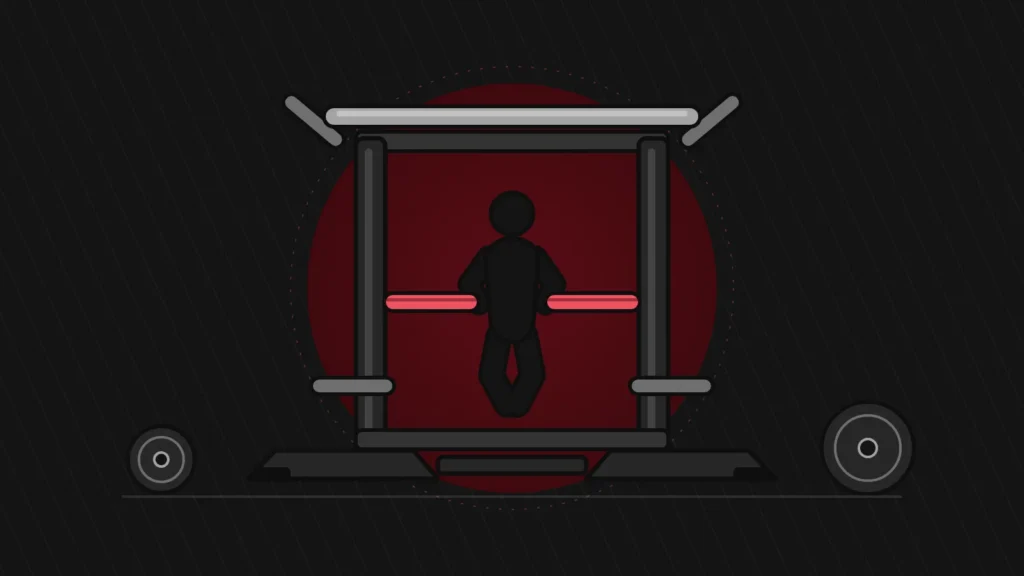
A power tower is a self-supporting frame: two uprights, an H-shaped or U-shaped base, a pull-up bar on top, two parallel handles at hip height for dips, usually armrests for knee raises and low handles for push-ups.
Against a wall-mounted or ceiling-mounted bar, you trade rigidity for freedom. You can move it, break it down, set it up in a rental without touching the drywall. If you own the place and you have a stud wall or solid joists, a mounted bar is stronger for the same money, and the pull-up bar buying guide breaks down the mounting options. Same logic on the pressing side: if all you want is dips, a pair of low parallel bars is more stable and stores flat, which is what the dip bars guide covers. The tower is the one piece that gives you both inside about ten square feet.
Weight Capacity, and What That Number Hides
This is the headline spec and the most misread one. Consumer towers run from 220 lb (100 kg) to 440 lb (200 kg) of rated capacity. That number covers your bodyweight plus everything you are carrying. At 180 lb (82 kg) bodyweight with a 45 lb (20 kg) belt, you are at 225 lb (102 kg) standing still, so a tower rated 220 lb is already past its limit, before you account for the force spike at the bottom of a pull-up, which runs well above your static weight.
Look at what produces that rating instead. Two towers from the same manufacturer, 110 lb (50 kg) apart on paper, show exactly where the money goes:
| Spec | Rated 330 lb (150 kg) | Rated 440 lb (200 kg) |
|---|---|---|
| Steel wall thickness | 1.2 mm | 1.5 mm |
| Frame weight | 35.7 lb (16.2 kg) | 49.4 lb (22.45 kg) |
| Overall height | 82.7 in (2 100 mm) | 90.6 in (2 300 mm) |
| Base footprint | 30.1 x 36.2 in | 30.1 x 36.2 in |
| Bar height settings | 10 levels, 67 to 82.7 in | 10 levels, 74.8 to 90.5 in |
Three things to take from those published manufacturer specs. First, three tenths of a millimeter of steel is the whole difference between a 330 lb and a 440 lb rating, so wall thickness is the real spec to chase. Second, frame weight climbs from 35.7 lb to 49.4 lb: a 7 ft tower that weighs 35 lb empty is light, and you feel it the moment you swing. Third, the footprint is identical on both models. Stability is not what the capacity rating measures.
One more check: the usage class. EN ISO 20957-1, updated in December 2024, sorts stationary training equipment into class H for domestic use and class S for professional or commercial gym use. A brand that publishes its class is telling you it tested the frame. A brand that cites no standard at all is just asking you to trust the sticker.
Footprint, Tipping and Ceiling Height
The base decides everything
A pull-up tower loads in cantilever: your body hangs in front of the bar, not under the center of the frame. Swing even slightly and the rear feet start to lift. Three things fight that: a deep footprint, floor crossmembers that bolt together instead of just slotting in, and feet that grip. Around 36 in (90 cm) front to back is the minimum for an adult, and the heavier you are, the more depth you want.
Run this test on assembly day. Hang with straight arms, then deliberately rock your hips front to back. If a foot leaves the floor, push the tower against a wall, load the base with plates, or send it back. Do not add weight until that test is clean.
Measure your ceiling before you order
This is the most common and most avoidable mistake. A standard tower tops out at 82.7 in (2.10 m), a reinforced one at 90.6 in (2.30 m). Add roughly 10 in for your hand above the bar at the top of a pull-up, plus clearance for your head: you want 8 to 12 in free above the bar so you are not ducking. With a typical 8 ft (2.44 m) American ceiling, a 90.6 in tower will not run at its top setting.
Check hang clearance too. You need to finish a rep with straight arms without your feet touching, knees bent if that is what it takes. Muscle-ups are stricter still, since they need room above the bar and a frame that does not flex: confirm both before you start the weighted muscle-up program, and never kip on a light tower.
Dip Handle Spacing
The dip handles on a tower are almost always fixed, and that is their real weakness. On brand-name racks, adjustable dip handle spacing spans roughly 16 to 25.5 in across the common series. Your reference is your own shoulder width: at the bottom of the rep, your forearms should be vertical. If they splay outward, the handles are too wide and you are loading the front of your shoulder for nothing.
Measure your shoulder width and compare it to the published spacing before you order. An inch of difference is manageable, four inches is not. Towers with slightly converging V-shaped handles are the better compromise: you pick your own width by sliding your hands forward or back.
Muscles Worked on a Pull-Up and Dip Station
On the bar you hit the lats, teres major, lower traps, rhomboids, rear delts, biceps and brachioradialis, with the finger flexors and your brace holding everything together. On the dip handles you shift to the lower pec, triceps, front delts and pec minor, with the scapular stabilizers holding the position.
That is the genuine case for one of these frames: a vertical pull and a vertical press on the same structure, so your upper body stays balanced without buying anything else. Knee-raise pads and push-up handles are a bonus, not a reason to pick one model over another.
Adding Weight Without Tipping the Frame
A decent tower handles added load fine, as long as you change how you move. The weight hangs below you and behaves like a pendulum, so any leg drive goes straight into the frame. Three rules: start from a dead hang with no swing, lower under control, and keep your legs still and slightly in front of you to kill the sway.
On gear, a dip belt beats a weighted vest on a tower. The belt keeps the load low and close to your axis, while a vest moves mass upward and lengthens the lever that lifts the rear of the base. For programming, nothing exotic is needed: the weighted pull-up program and the weighted dip program set the loads and the progressions, and the frame changes nothing about how the sets run.
Mistakes to Avoid Before You Order
- Buying without measuring the ceiling. Room height, minus 90.6 in of tower, minus 10 in of hand above the bar. If the math goes negative, pick a shorter model.
- Reading the rating as usable load. Bodyweight plus added weight has to sit well under it. Keep at least 65 lb (30 kg) of margin.
- Ignoring wall thickness. Under 1.5 mm, forget heavy loading. If the spec sheet does not list it, assume it is thin.
- Picking the lightest frame. Under 44 lb (20 kg) empty for a 7 ft tower means a frame that vibrates. Shipping weight is a quality signal, not a drawback.
- Torquing the bolts in one pass. Assemble loose, square the tower in place, then tighten everything down. Re-torque after two weeks, which is when the slop shows up.
- Standing it on bare hardwood. A half-inch mat under the base protects the floor, damps vibration and gives the feet something to bite.
If your room fails those six checks, do not force it. A mounted bar plus a set of low parallel bars usually costs less, takes less space and does not move a millimeter.

mathieu
Street workout athlete since 2019, I discovered streetlifting in 2023. Today I share my passion for the sport through streetliftings.com.