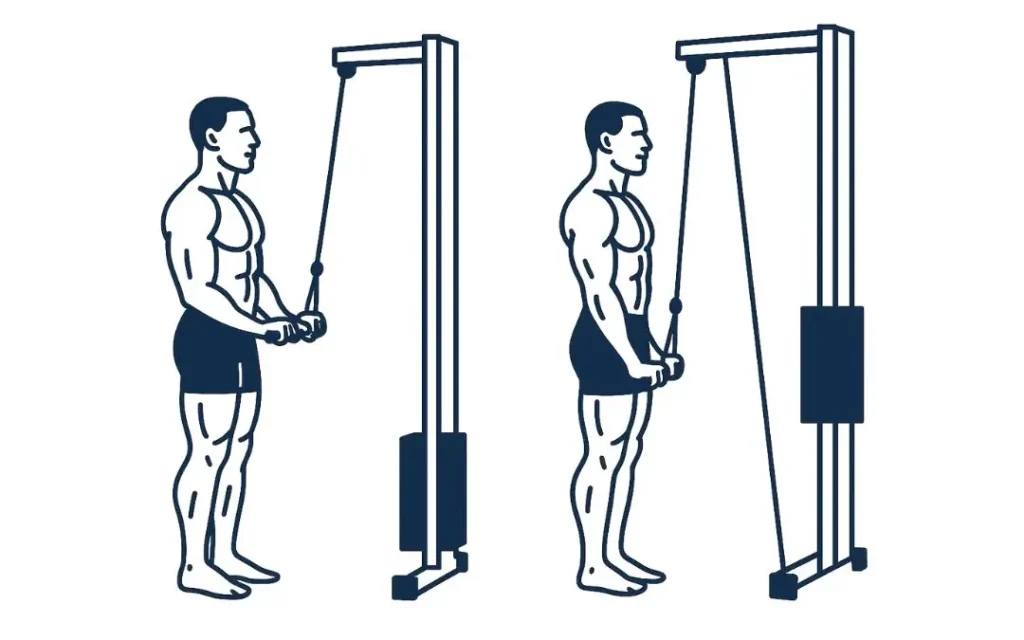
The low pulley triceps extension is a must-have exercise for anyone looking to strengthen and sculpt the back of their arms. Whether you are a beginner or an experienced athlete, adding this movement to your training sessions will not only build more powerful triceps but also improve the overall look of your arms. That said, technique is everything – get it right and you will get the most out of this exercise while staying injury-free.
Exercise Technique
Before you start performing the low pulley triceps extension, it is essential to fully understand the correct technique. A poorly executed exercise will not deliver the results you are after – and worse, it could lead to pain or injury.
The exercise is performed on a cable machine fitted with a straight bar, rope, or V-bar attachment. The principle is straightforward: pull the load downward while keeping your elbows close to your torso and engaging only the triceps.
The key to maximising the effectiveness of this exercise lies in controlling every phase of the movement – from the push down to the return. Poor tempo management or incorrect posture can reduce triceps tension and limit your gains.
Program or coaching?
Find your ideal format
Answer 4 questions and receive a personalised recommendation based on your level and goals.
Tailored result
Free
Muscles Targeted
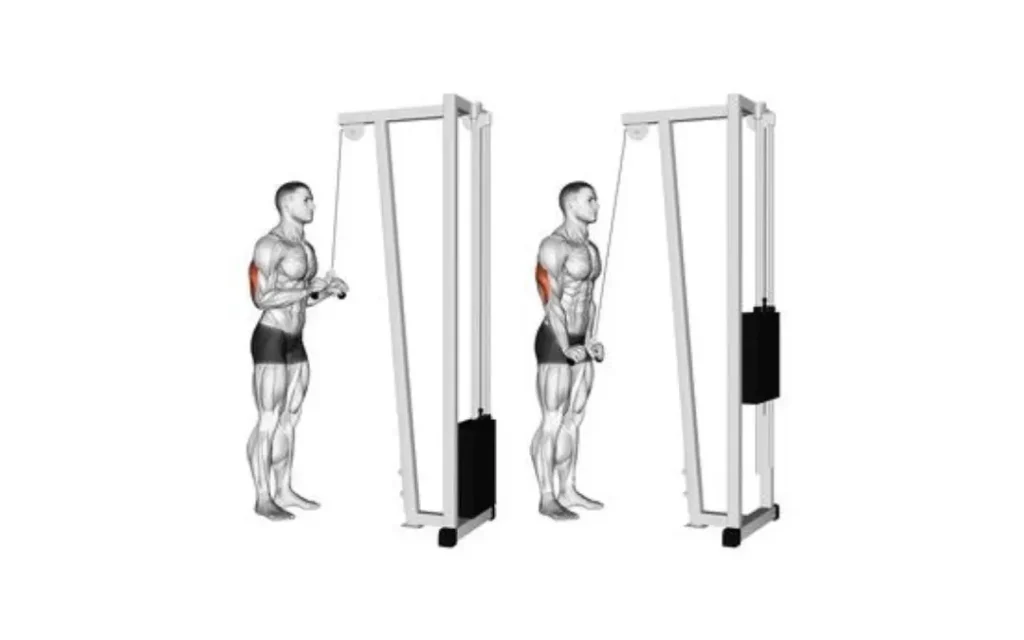
The low pulley triceps extension, like the dumbbell triceps extension, primarily targets the following muscles:
-
Triceps brachii: The main muscle worked by this exercise. It is made up of three heads:
- Long head: The portion of the triceps most involved in elbow extension and shoulder stabilisation.
- Lateral head: Located on the outer side of the triceps, it is heavily recruited during pushing movements.
- Medial head: Less visible, but it plays an essential role in arm stability and strength.
-
Posterior deltoids: Located at the back of the shoulders, they are slightly activated to stabilise the shoulder joint during the exercise.
-
Core muscles (abs and lower back): These muscles engage to maintain a stable posture and prevent extraneous movement, especially with heavier loads.
Why Do Low Pulley Triceps Extensions?
Build strong, voluminous triceps: The triceps account for roughly two-thirds of your arm’s muscle mass. If your goal is bigger, better-looking arms, you need to train this muscle specifically. The low pulley triceps extension lets you target it deeply, promoting balanced, harmonious development.
Improve stability in pushing movements: Strong triceps are essential for all pushing movements – whether that is the bench press, the overhead press, or everyday functional movements. By strengthening your triceps, you also improve the stability and efficiency of these lifts.
Prevent muscular imbalances: It is common for gym-goers to focus too heavily on biceps at the expense of triceps. This can create muscular imbalances and increase the risk of injuries, particularly at the elbows and shoulders. Incorporating low pulley triceps extensions redresses that balance and gives your triceps the attention they deserve.
How to Do Low Pulley Triceps Extensions
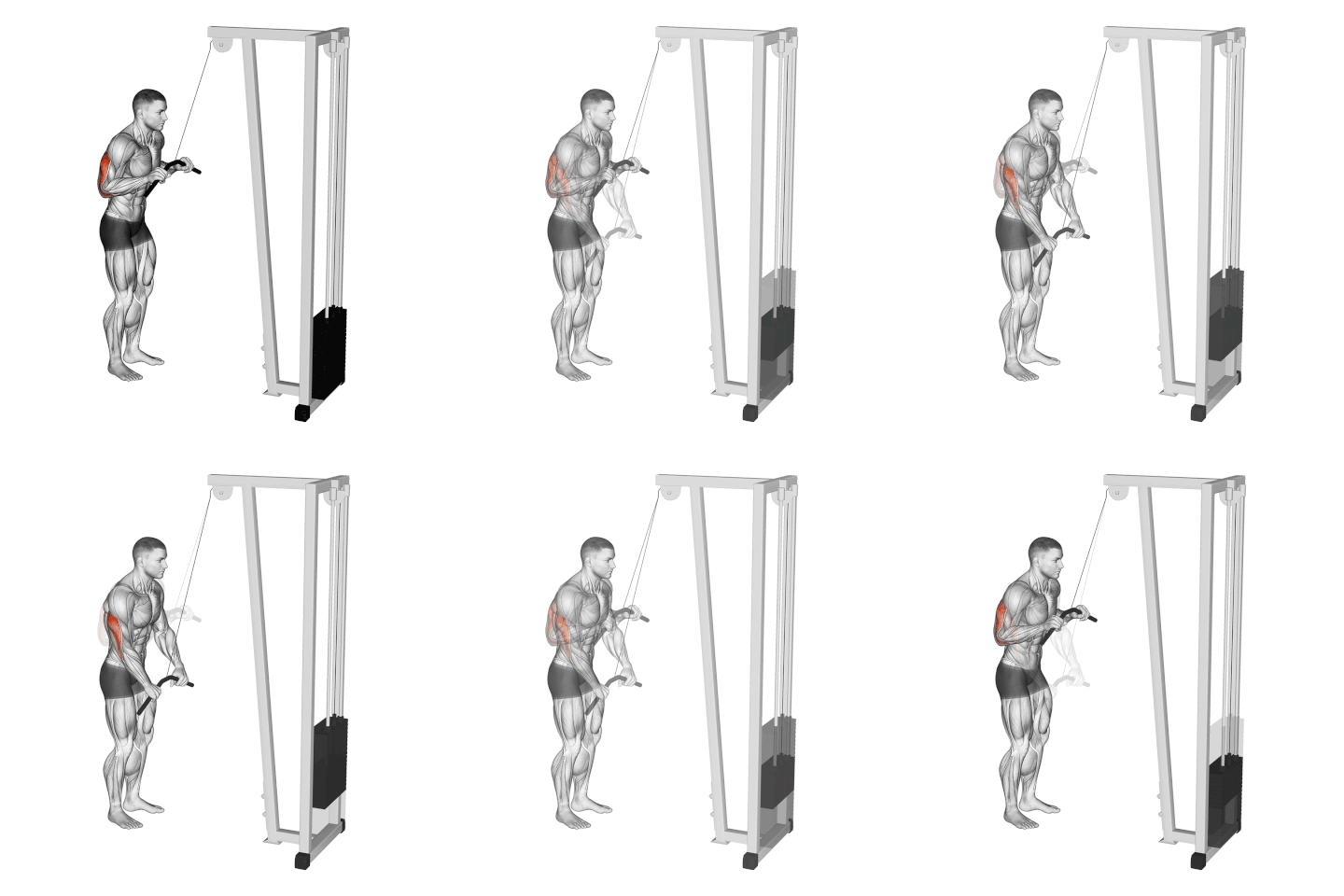
Now let’s get to the practical side. Mastering the technique is crucial to maximise results and prevent injuries. Here is a detailed breakdown of each step for performing the low pulley triceps extension correctly.
Cable Machine Setup
-
Machine position: Set the pulley so it is positioned above your head. The handle should be at chest height when you are in the starting position.
-
Attachment choice: You can use different attachments depending on your preference and the stimulus you want. The straight bar is ideal for overall triceps development, while the rope allows a greater range of motion and better isolation.
-
Appropriate weight: Choose a weight with which you can perform 10 to 15 reps while maintaining good technique. Do not go too heavy at first – poor execution can cause joint pain, particularly at the elbows.
Execution
-
Starting position: Grip the attachment with both hands, palms facing down (pronated grip). Stand facing the machine with your feet hip-width apart for good stability. Your elbows should be slightly bent and tucked into your sides.
-
Controlled push-down: Exhale and push the attachment downward, fully extending your arms. Keep your elbows close to your body throughout the movement to properly isolate the triceps. The extension should be complete, but avoid locking out your elbows at the bottom.
-
Return to starting position: Inhale and slowly bring the attachment back up, controlling the ascent. Keep your elbows fixed to ensure full triceps tension throughout the movement.
-
Sets and reps: Perform 3 to 4 sets of 10 to 15 reps depending on your goals (strength or hypertrophy). Rest 45 seconds to 1 minute between sets.
Mistakes to Avoid to Stay Injury-Free
Using too much weight: The most common mistake is trying to lift too heavy. This typically leads to poor execution, with excessive involvement of the shoulders and back instead of the triceps. Work with a weight you can control smoothly throughout the full range of motion.
Letting your elbows drift: When the elbows flare out or shift during the exercise, tension on the triceps drops and other muscles – such as the shoulders – take over. Keep your elbows pinned to your sides to maximise the exercise’s effectiveness.
Poor posture: Another frequent mistake is arching the lower back excessively or leaning too far forward. Always maintain a tall, stable posture to avoid unnecessarily loading the lower back.
Not controlling the eccentric phase: The eccentric phase (when you return the weight upward) is just as important as the push-down. Many athletes neglect this part and let the weight fly back up. Always control the return to keep constant tension on the triceps.
Coach’s Conclusion
This exercise, while accessible to everyone, demands careful attention to maximise results and avoid injury. The triceps extension is a foundational movement for arm development and a valuable support exercise for all pushing lifts. Remember that consistency is the key to success. By regularly including low pulley triceps extensions in your training sessions, you will quickly notice improvements in both arm strength and muscle definition. Adjust the weight, vary the attachments, and monitor your technique to keep progressing. Always keep the basics in mind: appropriate load, stable posture, and controlled execution.
Start Here
- Streetlifting Program
- Weighted Muscle Up Program
- Weighted Pull-Up Program
- Weighted Dip Program
- Squat Program