
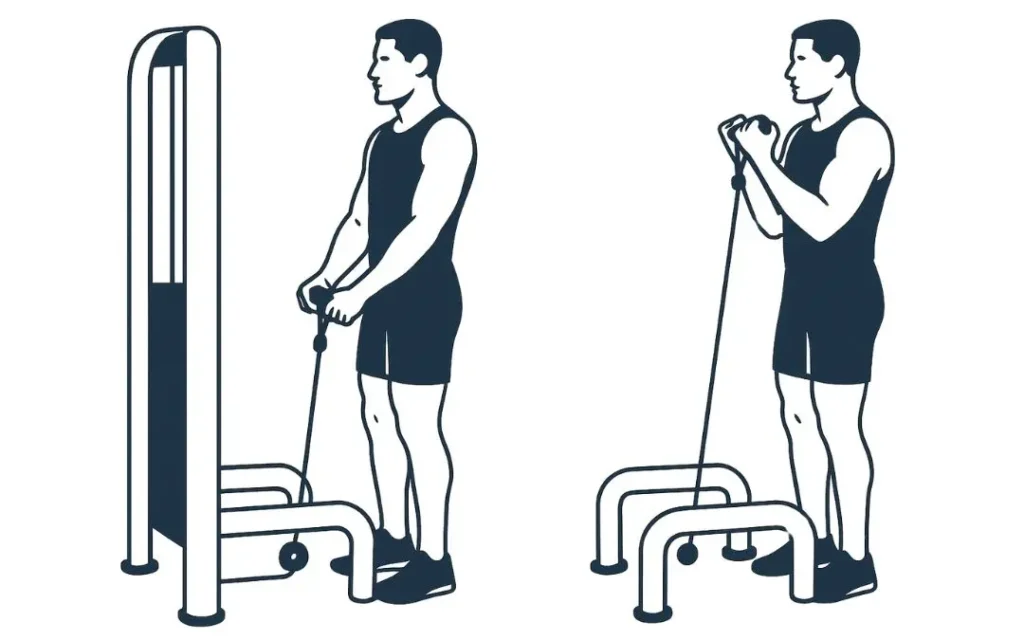
The cable bicep curl is a must-have exercise for effectively training your biceps. Thanks to the constant tension provided by the cable, this movement recruits muscle fibers deep within the arm and optimizes upper-arm development. Whether you are a beginner or an experienced lifter, mastering the low-cable bicep curl is a real asset for your strength training progress.
How to Do the Cable Bicep Curl Correctly
Setting Up the Cable
To perform the cable bicep curl under the best conditions, the first step is to prepare your workstation properly.
-
Set the pulley to the lowest position, at floor level.
-
Use a straight bar or EZ bar for a comfortable grip, or a rope attachment if you prefer a more dynamic variation.
-
Choose a weight appropriate to your level: you should be able to execute the movement cleanly without cheating.
-
Stand facing the machine, feet shoulder-width apart, torso upright, core engaged, and arms extended toward the cable.
This setup guarantees a smooth and safe execution of the cable curl.
Executing the Cable Bicep Curl
The low-cable bicep curl is performed with flawless technique:
-
Inhale before starting the movement.
-
Flex your elbows by contracting the biceps, keeping your elbows pinned against your torso.
-
Curl the bar or rope up to shoulder level without jerking.
-
Hold a brief pause at the top of the movement to maximize the contraction.
-
Exhale slowly as you lower the weight under control back to the starting position.
Program or coaching?
Find your ideal format
Answer 4 questions and receive a personalized recommendation based on your level and goals.
Tailored result
Free
Targeted Muscles
The cable bicep curl primarily targets:
-
The biceps brachii, the muscle responsible for elbow flexion.
-
The brachialis, often overlooked but highly active during this movement.
-
The brachioradialis, located on the forearm, which also contributes to elbow flexion.
Thanks to the constant resistance of the cable, the muscle is engaged throughout the full range of motion, making this an excellent alternative to dumbbell or barbell curls.
Is the Cable Bicep Curl the Best Arm Exercise?
Among the wide range of arm exercises, the low-cable bicep curl stands out for several advantages:
-
Constant tension: unlike dumbbells, the cable never releases tension, even at the bottom of the movement.
-
Full range of motion: the exercise works the muscle from the fully stretched position all the way to peak contraction.
-
Less cheating: the fixed stance limits momentum and demands strict execution.
That said, it should not be your only movement. For complete arm development, it makes sense to pair the low-cable curl with dumbbell curls, hammer curls, or incline curls.
But in terms of contraction quality, the cable bicep curl is one of the most effective exercises available.
Tips to Build Bigger Arms with the Low-Cable Curl
Here are a few tricks to get the most out of the low-cable bicep curl:
-
Vary your grip: supinated, neutral with a rope, or reverse grip to target different heads of the biceps.
-
Play with tempo: slow down the eccentric phase for more tension (3-4 seconds on the way down).
-
Work unilaterally: isolate one arm at a time to correct imbalances.
-
Increase volume: 3 to 5 sets of 10 to 15 reps, with 45 to 60 seconds of rest.
-
Add a deliberate squeeze: contract hard at the top of the movement to improve neuromuscular recruitment.
Common Mistakes to Avoid
Done incorrectly, the cable curl can quickly become counterproductive. Here are the most common mistakes to watch out for:
-
Arching the back or leaning the torso backward: this is a sign the weight is too heavy.
-
Flaring the elbows: this reduces the effectiveness of the movement and shifts stress onto the shoulders.
-
Using momentum: the goal is to contract the biceps, not to swing the weight up with inertia.
-
Reps that are too fast: favor a slow, controlled execution.
Coach’s Conclusion
The cable bicep curl is a highly effective exercise for building the arms and developing powerful, well-defined biceps. Beyond the constant tension, it offers a wide variety of variations to avoid plateaus and make lasting progress. Integrated intelligently into your program, it can become a go-to weapon for arm growth.
Train with clean form, stay consistent, and remember: in strength training, technique always trumps load.
Other Bicep Exercises to Explore
- How to Do Chin-Ups and Explode Your Biceps with Supinated Pull-Ups
- Seated Dumbbell Curl: Build Bigger Arms
- Hammer Curl
- Preacher Curl
- Incline Dumbbell Curl
- Concentration Curl
- Barbell Curl
- Spider Curl