
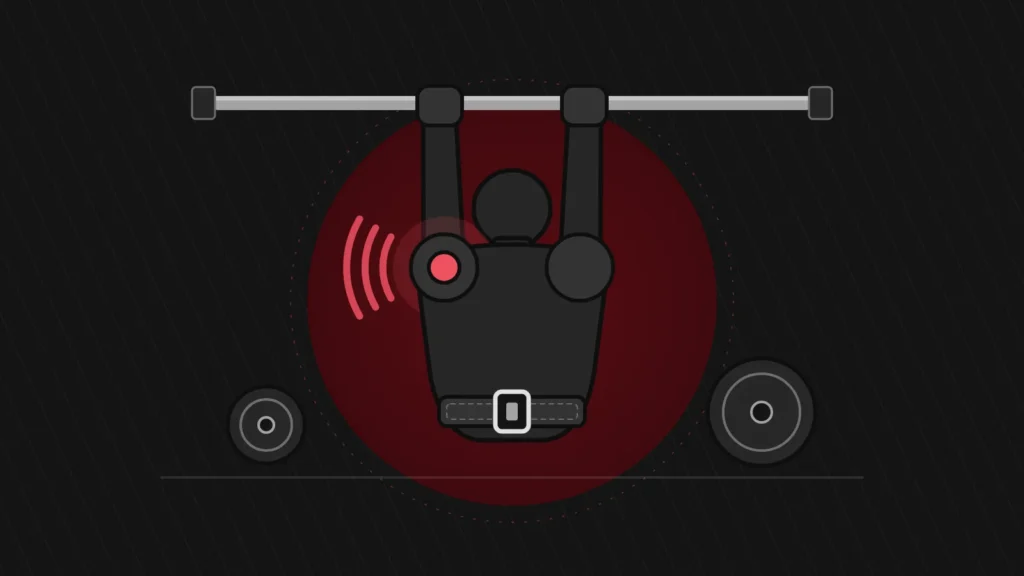
Shoulder pain from pull ups is the single most common complaint among people who actually live on the bar. In a survey of 93 street workout practitioners, 62.4% reported an injury in the previous 12 months, and the shoulder was the most injured site at 23.0%, ahead of the upper back at 18.4% (Ngo et al., Orthopaedic Journal of Sports Medicine, 2021). Here is where the pain sits, what you change today, and how to ramp back. One thing first: this is not a diagnosis. A shoulder that keeps nagging gets looked at by a doctor, who names the problem, not a coach.
Shoulder pain from pull ups and dips: three spots that tell you something
Your shoulder does not hurt “in the shoulder.” It hurts in one spot, in one position, and those two facts are worth more than any diagnosis you find online.
In that same survey, tendinopathy was the most reported diagnosis among injured practitioners at 31.0%. Across the general population, 44% to 65% of all visits for shoulder pain come down to subacromial impingement, and the shoulder is the third most common source of chronic musculoskeletal pain in primary care behind the back and the neck (Singh et al., Cureus, 2022). Your case is neither exotic nor serious by default.
| Where it hurts | What is loaded | Position that wakes it up | What loads it at the bar |
|---|---|---|---|
| Front of the shoulder, at the bottom of a dip | Anterior capsule and ligaments, clavicular head of the pec major | Arm pulled behind you, elbow behind the torso | Deep dip, heavy belt, going slack at the bottom |
| Top and outside, on the way up | Rotator cuff tendons, subacromial space | Arm raised against resistance, hand reaching behind the back | Very wide grip, kipping, high pulling volume |
| Upper back, toward the shoulder blade | Scapular stabilizers, mid and lower traps | Straight-arm hang, end of a long hold | Long hangs, pulling with no scapular engagement |
Four causes that keep showing up on weighted pull-ups and dips
In the street workout survey, the number one perceived cause was overtraining at 56.9%, followed by poor execution at 27.6%, fatigue at 25.9% and skipping the warm-up at 19.0%. The four mistakes below are those percentages in plain English.
Dipping too deep
Check this first. A 3D motion capture study on 13 experienced lifters measured an average self-selected maximum shoulder extension of 88.7 degrees. A bar dip uses 88.0% of that range, ring dips 68.9%, but bench dips use 101.4%, more range than the lifter allows himself in a free test, which is why the authors advise against bench dips as a regular exercise (McKenzie et al., IJERPH, 2022). At end range, the brakes are the clavicular head of the pec major on the active side and the anterior band of the inferior glenohumeral ligament on the passive side, and the same group recommends not working at end range on every rep (Strength and Conditioning Journal, 2021). Translation: stop around 90 degrees of elbow bend, and do not hang 65 lb (30 kg) off a belt to chase one more inch.
Going too wide on the bar
The super wide grip gets sold as the back grip. The data does not back it up: a review of the EMG work concludes that grip width is not well supported as a determinant of lat activation, on pull-ups or on the lat pulldown, while a wide grip does raise upper trap, mid trap and lateral deltoid activity (Journal of Functional Morphology and Kinesiology, narrative review). You pay with an extreme abducted shoulder and a shorter range, and gain nothing on the back. About 1.5 times your shoulder width is plenty, and if the top of the shoulder is the sore spot, the neutral grip pull-up is the friendliest variation.
Kipping under load
A hip snap to force the last rep with 45 lb (20 kg) on the belt is an acceleration absorbed by a shoulder that no longer has active control. A clean missed rep beats a yanked rep every time. If you need momentum, the load is too heavy for today.
All pulling, zero external rotation
Three sessions a week of pull-ups and dips, not one set of external rotation or scapular work: that is the classic imbalance. Two sets of external rotation and two of horizontal rowing at the end of a session cost five minutes and keep the muscles that hold the humeral head in place doing their job. The rest of the prehab is in our guide on protecting your joints in streetlifting.
What you change in today’s session
Shutting everything down is the wrong instinct. For rotator cuff tendinitis and impingement, the American Academy of Orthopaedic Surgeons describes first-line care as rest plus activity modification, meaning you avoid the overhead work that triggers symptoms, then physical therapy to restore motion, then a strengthening program for the cuff once pain improves (OrthoInfo, AAOS). For subacromial pain, the update of systematic reviews in physical therapy makes a strong recommendation for exercise as first-line treatment, while laser, shockwave and ultrasound carry moderate evidence of no effect (Pieters et al., Journal of Orthopaedic and Sports Physical Therapy, 2020). For your next session:
- Drop the belt, bodyweight only on pull-ups and dips.
- Raise the bottom of your dip: elbows to 90 degrees, torso upright, no sinking.
- Narrow your grip, or switch to neutral if the top of the shoulder is sore.
- Cut all momentum: controlled tempo, shoulders engaged before you pull.
- Add two sets of external rotation and two of horizontal rowing at the end.
- Keep pain under 4 out of 10 during the exercise.
That 24-hour rule is your only dashboard. Same or less pain the next morning: you progress. More pain: wait 72 hours and come back one notch lower. And stop skipping the warm-up, the run sheet is in our pull-up warm-up protocol.
The step-by-step ramp back
Four steps, one hard criterion each. You only advance if the 24-hour rule holds for two or three sessions in a row.
| Step | Content | Dose | Criterion to move up |
|---|---|---|---|
| 1. Mobility and isometrics | Light band external rotation, scapular holds in a hang | 4 holds of 30 to 45 s, 3 sets of 15 external rotations, daily | Pain under 4 out of 10, stable at 24 h |
| 2. Partial range | Bodyweight pull-ups on the top half, bodyweight dips to 90 degrees | 4 sets of 6 to 8, 3 s lowering | Two sessions with no next-day flare |
| 3. Full range | Back to your normal range, still no added weight | 4 sets of 8, 2 min rest | One full week with no morning stiffness |
| 4. Back on the belt | Restart the weighted progression | Start at 50% of your old load, add 2.5 to 5 lb (1.25 to 2.5 kg) | Three weeks with no residual pain |
From there, loading follows the progression in the weighted pull-up program, and the weighted dip program handles the bottom position and the lockout. The weighted muscle up program waits until step 4 is done: the transition is the most aggressive movement there is for a cranky shoulder. If the elbow is the problem instead, the protocol differs, see elbow pain from pull ups. For what the belt changes about risk, read our take on whether weighted pull-ups are dangerous.
When to see a doctor
No improvising on these signals. Get seen quickly for sudden or severe shoulder pain, an arm you cannot move, a shoulder that looks deformed or badly swollen, pins and needles that do not go away, loss of feeling in the arm, a shoulder that is hot or cold to the touch, pain that started after a fall, severe pain in both shoulders, or fever (NHS, Shoulder pain). Book a regular appointment if the pain gets worse or has not improved after two weeks.
Keep the real timeline in mind. The AAOS notes that early symptoms are often mild, which is exactly why people train through them until range of motion becomes limited and painful. Expect six to eight weeks of rehab work before you judge anything, and sometimes six months or more for full recovery. Your next strength block goes after that, not before.
Mistakes to avoid
- Stopping everything and waiting it out. An immobilized shoulder loses capacity, and the pain comes right back on your first session.
- Keeping the load and only cutting the range. On a painful shoulder, the belt comes off first, the range second.
- Hunting the deepest possible dip. Ninety degrees covers the job, the rest loads the anterior capsule.
- Stacking stretches. What you are missing is stability, not range.
- Judging mid-set. A shoulder that heats up on rep five tells you nothing, the next morning tells you everything.
- Going back to your old load. Three pain-free weeks do not hand you back the 55 lb (25 kg), start at half.

mathieu
Street workout athlete since 2019, I discovered streetlifting in 2023. Today I share my passion for the sport through streetliftings.com.