
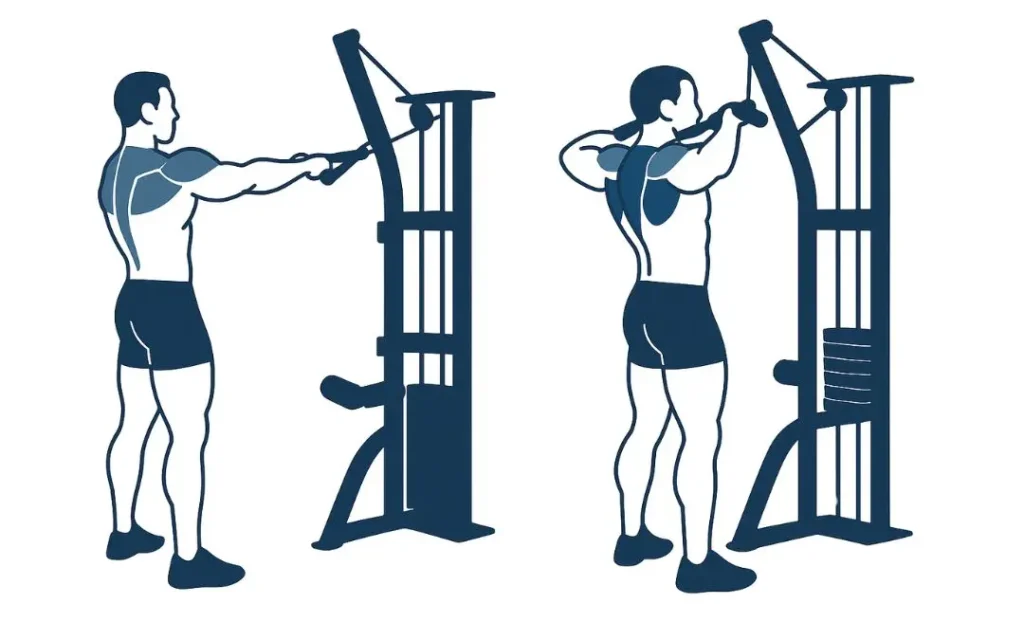
The Face Pull is a fundamental exercise in weightlifting and streetlifting, known for its effectiveness in reinforcing posture, preventing shoulder injuries, and developing the upper back muscles. Too often overlooked in favor of more spectacular movements, it is nonetheless one of the best exercises to balance your training and strengthen your posterior chain. Here is everything you need to know to master the Face Pull and integrate it effectively into your routine.
How to perform the face pull
To execute the Face Pull correctly, you need a high pulley and a rope attachment. The goal is to pull the rope toward your face while activating the right muscles.
Steps to follow:
-
Set the pulley at eye level.
-
Grip the rope with palms facing each other, thumbs pointing up.
-
Step back to put tension on the rope and adopt a stable stance, feet hip-width apart.
-
Drive your elbows outward and backward, aiming for eye or forehead level.
-
At the end of the movement, deliberately squeeze your shoulder blades together.
-
Return slowly to the starting position, controlling the eccentric phase.
Program or coaching?
Find your ideal format
Answer 4 questions and receive a personalized recommendation based on your level and your goals.
Tailored result
Free
Muscles targeted during the face pull
The Face Pull primarily works the posterior chain of the upper body, often neglected in programs centered on pushing movements (bench press, weighted dips, etc.).
Here are the muscles involved:
-
Posterior deltoids: for balanced and functional shoulders
-
Mid and lower trapezius: key to scapular stability
-
Rhomboids: for retracting the shoulder blades
-
Rotator cuff (infraspinatus, teres minor): essential for shoulder health
Face pull variations
The face pull is a highly versatile exercise that can easily adapt to your environment and your goals. Here are the main variations to diversify your training sessions and target the upper back and shoulder muscles differently:
Face pull with resistance band
Perfect for training at home or outdoors, this version remains very effective for strengthening the posterior deltoids and scapular muscles.
-
Anchor a resistance band to a solid support at face height
-
Grip each end with palms facing each other
-
Step back to create constant tension in the band
-
Pull toward your face, spreading your hands and driving the elbows back and outward
-
Hold at the end of the movement squeezing the back, then return slowly to the starting position
Seated cable face pull
Ideal for a more controlled and stable execution, this variation is performed on a cable machine at the gym.
-
Sit facing the pulley, set at face height
-
Take the rope in a neutral grip (palms facing each other)
-
Pull the rope toward your face while keeping the elbows raised
-
Hold the contracted position at the back
-
Return slowly to the starting position
Single-arm face pull
This unilateral version is perfect for correcting muscle imbalances and improving coordination.
-
Set the pulley or anchor a resistance band at face height
-
Hold the handle or the end of the band with one hand
-
Step back to put the muscle under tension
-
Pull toward your face making sure to keep the elbow away from the torso
-
Pause at the end of the movement, then return slowly
-
Repeat with the other arm
Face pull with external rotation
This variation adds external rotator strengthening work, essential for joint health.
-
Perform a standard face pull until your hands reach face level
-
Add an external rotation of the shoulders: rotate your hands upward while keeping the elbows fixed
-
Return to the face pull position
-
Release the arms back to the starting position
These variations allow you to adapt the exercise to your available equipment, your level, or specific goals (rehabilitation, strength, muscle balance, etc.). Introduce them progressively into your sessions for harmonious upper-body development.
Integrating the Face Pull into your training program
The Face Pull can be used in several ways depending on your goals:
-
Warm-up: to activate the posterior chain before pushing exercises (bench press, weighted dips…)
-
End of session: to reinforce posture and prevent muscle imbalances
-
Dedicated back/posture day: within a streetlifting or corrective training program
Programming examples:
-
3 to 4 sets of 12 to 20 reps
-
Tempo 3-1-3 (concentric, pause, eccentric)
-
Superset with push-ups or weighted dips to balance muscle chains
Tip: combine it with other postural exercises such as Y-T-W or trap raises for complete reinforcement.
Coach’s conclusion
The Face Pull is far more than a secondary exercise: it is a cornerstone for shoulder health, performance, and muscle balance. In weightlifting as in streetlifting, it contributes to a strong and functional upper back, and prevents chronic pain caused by imbalances. Make the Face Pull an essential part of your routine, and you will see lasting progress in your posture, your weighted pull-ups, and your shoulders. A small exercise for big results!
Start Here
- Streetlifting Program
- Weighted Muscle Up Program
- Weighted Pull-Up Program
- Weighted Dip Program
- Squat Program
Other exercises to strengthen your shoulders
- Reverse Pec Deck
- Bent-Over Reverse Fly
- Seated Dumbbell Press
- Behind-the-Neck Press
- Pike Push-Up
- Military Press