
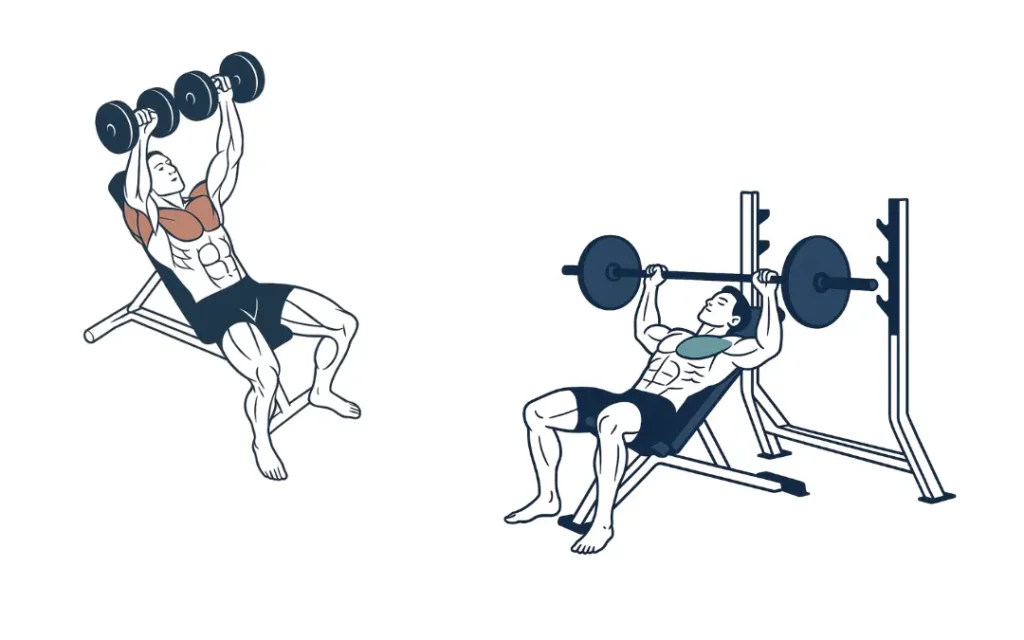
The incline press is a must-have strength training exercise for anyone looking to develop the upper chest and improve their pushing power. Whether performed with a barbell or with dumbbells, it effectively strengthens the upper portion of the chest – a zone often neglected in standard training routines. In this article, we explain in detail how to properly execute the incline press, which muscles it targets, how it compares to the flat bench press, and – most importantly – how to integrate it intelligently into a program, especially to boost performance on weighted dips.
How to Do the Incline Press
Before you get started, it is essential to understand the execution technique, whether you choose to work with a barbell or with dumbbells. The bench angle (30 to 45 degrees) is a key factor for targeting the upper chest without over-stressing the shoulders.
Barbell Incline Press – Execution
-
Set the bench angle: Incline the backrest between 30 and 45 degrees.
-
Starting position: Lie on the bench with your feet flat on the floor. Grip the barbell slightly wider than shoulder-width.
-
Controlled descent: Slowly lower the barbell toward the upper chest, keeping the elbows slightly flared.
-
Drive: Press the barbell back up, squeezing the pecs at the top – do not fully lock out the elbows.
-
Breathing: Inhale on the way down, exhale as you press.
The barbell incline press lets you load more weight – ideal for building strength and muscle mass.
Dumbbell Incline Press – Execution
-
Setup: Sit on an incline bench (30 to 45 degrees) with a dumbbell in each hand.
-
Starting position: Hold the dumbbells above your chest with arms extended but not locked out.
-
Controlled descent: Lower the dumbbells to each side on a slight diagonal, elbows at 45 degrees.
-
Explosive drive: Press the dumbbells back up, making sure to contract the pecs at the top.
-
Range of motion: Take advantage of the freedom dumbbells allow to emphasize the muscular stretch at the bottom.
Dumbbells offer a more natural range of motion, ideal for recruiting more muscle fibers – especially in finishing work or unilateral strengthening phases.
Program or coaching?
Find your ideal format
Answer 4 questions and get a personalized recommendation based on your level and goals.
Tailored result
Free
Muscles Worked
The incline press is a compound exercise that engages several muscle groups:
-
Upper pectorals (clavicular head): the primary target zone thanks to the incline angle.
-
Anterior deltoids: the shoulders are heavily involved, especially if the bench angle is too steep.
-
Triceps brachii: essential for arm extension at the end of the movement.
-
Serratus anterior and trapezius (secondary): contribute to scapular stability.
Comparison with the Flat Bench Press
| Criteria | Incline Press | Flat Bench Press |
|---|---|---|
| Target zone | Upper chest | Mid chest |
| Maximum load | Lower | Higher |
| Shoulder involvement | Greater | Less |
| Goal | Aesthetics, upper chest volume | General strength, overall mass |
| Accessibility | Requires more technique | More intuitive |
Adding the Incline Press to Your Program
To get the most out of the incline press, it is recommended to place it early in the session, right after your warm-up, when strength levels are at their peak – as we explain in the streetlifting training program.
Sample push-day routine:
- Weighted dips: 3×6-8
-
Incline barbell press: 4×6-8
-
Flat dumbbell press: 3×8-10
-
Incline dumbbell flyes: 3×12-15
By training the incline press consistently, you strengthen the upper chest, which is particularly beneficial for progressing on weighted dips. Improved scapular stability and greater pushing power enhance control and depth throughout the dip movement.
Coach tip: If you are stalling on weighted dips, try using the incline press as a pre-fatigue exercise or performing it at a slow tempo (3-1-1). This will build muscular endurance and your ability to sustain continuous tension – both crucial for weighted dips.
Coach’s Conclusion
The incline press is far more than a simple bench press variation. It plays a central role in balanced upper-body development by specifically targeting the upper pecs and improving overall posture. Whether you train it with a barbell for strength gains or with dumbbells to optimize range of motion and muscle activation, this exercise is essential in any well-structured strength training routine.
Include it intelligently in your push sessions, especially if you want to progress on weighted dips, increase chest volume, or simply build more pushing power. Remember: consistency, sound technique, and progressive overload are the keys to success.
Start Here
- Streetlifting Program
- Weighted Muscle Up Program
- Weighted Pull-Up Program
- Weighted Dip Program
- Squat Program
More Chest Exercises
- Assisted Dips
- Weighted Push-Up Program
- Build Your Chest with Weighted Dips
- Decline Press
- Flat Dumbbell Press
- Pec Deck
- Chest Press
- Cable Crossover
- Archer Push-Ups
- One-Arm Push-Ups