
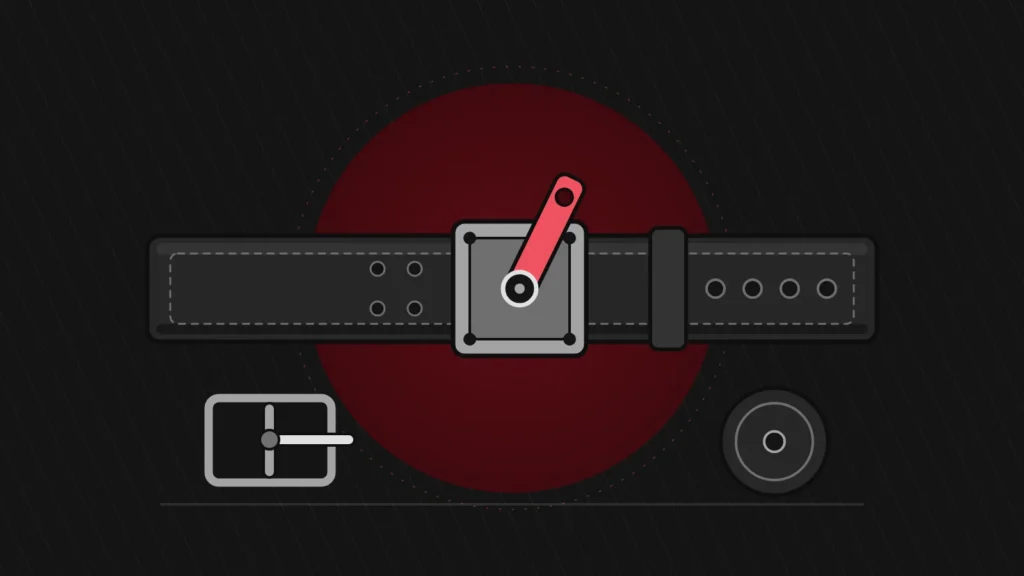
A lever belt locks shut in one flick and pops open just as fast. A prong belt threads through a hole, like a very thick dress belt. Under a heavy bar, both do the same job, and both are legal in competition. What changes is everything that happens between your sets. Here is the honest breakdown, and which one belongs in your gym bag.
Lever belt vs prong belt: what actually changes
Support is not the differentiator. At the same thickness and width, a lever belt and a prong belt are the same slab of stiff leather wrapped around your trunk. The buckle is what separates them, and the buckle decides how you use the belt week after week.
On a prong belt, a metal tongue drops into a punched hole. You pick the hole, you cinch, you go. No moving parts, adjustable on the spot, within the holes the maker gave you.
On a lever belt, the buckle is bolted to one fixed position on the leather. You flip the lever, a cam locks it down, and the tightness is identical to your last set. To change that tightness, you unscrew the lever and move it to a different set of holes, which means grabbing a screwdriver. That is the whole trade: speed on one side, adjustability on the other.
If you are still not sure a belt belongs in your training at all, read our take on whether you actually need a squat belt before you shop for buckles.
The lever belt: identical tightness on every set
What you gain
Repeatability. Once the lever sits at the right notch, every close gives you the exact same compression. You stop wondering whether you were on the fourth or the fifth hole during your warm-up. Across a heavy squat session of six to eight working sets, that is one less variable to manage.
Then there is the release. After a double at 90 percent, you want to breathe. A lever opens with a thumb flick, while a prong needs a hard pull on the strap to free the tongue. Lifters who like a brutally tight belt also get more compression out of a lever, because the cam gives you mechanical advantage as it closes.
What you give up
Flexibility. If you want the belt looser for deadlifts than for squats, you need a screwdriver between exercises, and nobody does that. You also give up tolerance for bodyweight swings. Gain or drop seven or eight pounds (3 to 4 kg), eat a big pre-workout meal, start a cut, and your setting is suddenly wrong.
Last thing: a lever is a mechanical part. The screws back out over time. A quick tighten every few weeks is part of owning one, same as conditioning the leather.
The prong belt: single, double, and fine adjustment
The prong wins everything the lever loses. One hole tighter for your top sets, one hole looser for volume, adjusted with no tools in the middle of a session. That is the logical pick if your bodyweight moves, if you use the belt across several exercises, or if you share it with a training partner.
Then you choose how many tongues. Single prong is the common option: faster to fasten, cheaper, and plenty strong. Double prong spreads the load across two points instead of one, which slows down the leather stretching around the holes over the years, but it costs you a few seconds every time you line up two tongues in two holes.
For most lifters, single prong is the right answer. Double prong earns its keep only if you plan on years of very heavy work and want to protect the leather. For specific models and build quality, see our lifting belt buying guide.
Lever vs prong: the comparison table
| Criterion | Lever belt | Prong belt |
|---|---|---|
| Closing | One flick, cam lock | Tongue in a hole, then cinch |
| Resizing | Screwdriver required | No tools, hole by hole |
| Opening between sets | Instant | Stiffer, needs a firm pull |
| Maximum tightness | Higher | High, limited by hand strength |
| Changing bodyweight | Poor fit | Handles it easily |
| Moving parts | Lever and screws to check | None |
| Price | Roughly 20 to 30 dollars more | The cheaper of the two |
| Best for | One use case, stable weight | Multiple uses, variable weight |
What the IPF rulebook allows
Good news: both are legal. The International Powerlifting Federation technical rules, section 3.6, state that the belt may have a buckle with one or two prongs or of the “quick release” type, and the rulebook spells out that quick release means lever. Neither buckle gets an edge from the rules.
The dimensions are where the rules bite. Belt width tops out at 10 cm (about 4 inches), thickness at 13 mm (roughly half an inch) along the main length, and the buckle at 13 cm on the outside. The body must be leather, vinyl or a similar non-stretch material, with no padding, bracing or hidden supports inside the laminations. All of it is checkable in the IPF technical rulebook effective March 1, 2026.
Streetlifting federations are stricter about where you can use it. Under the French FNSL rules revised on March 5, 2024, the belt is permitted on the squat only, with the same 13 mm ceiling. Your belt covers one of the four competition lifts, so size your budget accordingly.
On thickness, keep it simple. The 10 mm build is the default: stiff enough for almost everyone and far more comfortable. The 13 mm build suits very heavy lifters chasing maximum rigidity who accept a long, painful break-in period.
Which one to pick for your squat
Go lever if your bodyweight is stable, the belt only comes out for heavy squats, and you want identical tightness session after session. That is the competitor building toward a max over a training block, the way our squat strength program is laid out.
Go prong if you are bulking or cutting, if the belt sees several exercises, or if you are new to belts and have no idea yet how tight you like them. It is also the sane first belt: you learn your preferred setting before locking anything in place.
Keep the priorities straight, though. The belt touches one of the four streetlifting lifts. The other three are loaded with a dip belt, not a lifting belt, and the real progress comes from the weighted pull-up program, the weighted dip program and the weighted muscle-up program. No buckle has ever added pounds to a total on its own.
Mistakes to avoid with your lifting belt
- Buying a lever before you know your setting. Start with a prong, log the hole you use for two months, then switch if you still want to.
- Cranking it as tight as it goes. You need room to take a big belly breath and push out against the leather. If you cannot breathe, it is too tight and it is doing nothing for you.
- Wearing it the whole session. Open it between sets. That is exactly where the lever pays off.
- Ignoring the lever screws. Check them every three or four weeks so the buckle never lets go mid-rep.
- Defaulting to 13 mm. Thicker is not better. If you squat under 400 lb (180 kg), 10 mm will serve you better and feel far less punishing.
- Using the belt to cover a weak brace. It amplifies abdominal pressure you already know how to create without it.
Short version: stable bodyweight and one use case, buy the lever. Fluctuating weight or mixed use, buy the single prong. Either way, go 10 mm thick, 4 inches wide, non-stretch leather, and you are legal everywhere.

mathieu
Street workout athlete since 2019, I discovered streetlifting in 2023. Today I share my passion for the sport through streetliftings.com.