
Looking for an effective exercise to progress on weighted dips and build and sculpt your pecs? The Peck Deck is one of the best options for a targeted, intense chest workout. Whether you are a beginner or an advanced athlete, this machine lets you isolate your pectoral muscles with a guided, safe range of motion. In this article, discover how to perform the Peck Deck correctly, its benefits, and the mistakes to avoid to maximize your results.
Exercise Technique
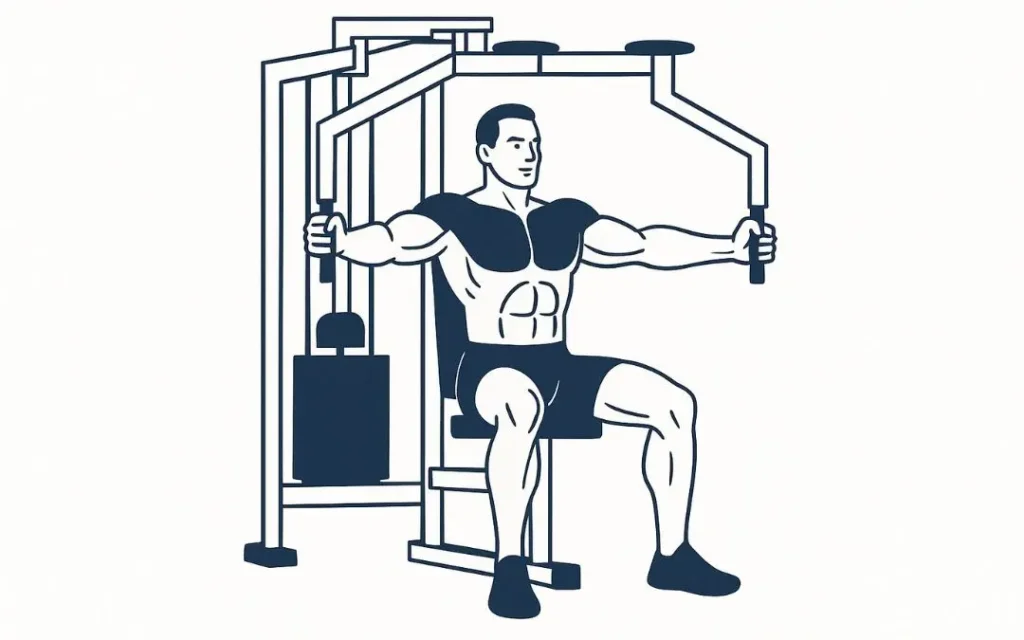
The Peck Deck is a gym machine designed to isolate and intensely work the pectorals. This guided exercise allows for safe and controlled execution, ideal for beginners and advanced practitioners alike. Through a closing arm movement toward the front, it maximizes muscular contraction of the pecs. If you do not have access to the machine, you can substitute archer push-ups or one-arm push-ups.
Program or coaching?
Find your ideal format
Answer 4 questions and get a personalized recommendation based on your level and goals.
Tailored result
Free
Muscles Targeted
The Peck Deck primarily works the pectoralis major, like the chest press and the cable crossover, which is the main muscle of the chest. However, other muscles are also involved:
-
The pectoralis minor, located beneath the pectoralis major, assists in arm adduction.
-
The anterior deltoids, at the front of the shoulders, are engaged to stabilize the movement.
-
The triceps, which play a secondary role in maintaining arm position.
What Are the Benefits of the Peck Deck?
The Peck Deck is an excellent exercise for building chest mass and definition. Here are its main advantages:
-
Maximum isolation: Unlike exercises with dumbbells or barbells, the movement is guided, allowing you to target the pectorals exclusively.
-
Increased safety: The absence of free weights reduces the risk of injury and suits beginners.
-
Focus on muscular contraction: The machine lets you stay focused on the contraction without having to manage weight balance.
-
Improved neuromuscular connection: Ideal for feeling the pectoral work and enhancing the mind-muscle connection.
How to Do the Peck Deck?
Setup for the Peck Deck
-
Adjust the machine: Set the seat so the handles are aligned with the lower portion of the pectorals.
-
Position yourself correctly: Sit down, press your back against the backrest, and place your forearms against the pads.
-
Choose the right weight: Opt for a load that allows you to control the movement while feeling effective muscular tension.
Execution of the Movement
-
Starting the movement: Grasp the handles and bring them progressively forward by contracting your pectorals.
-
Contraction phase: Once the arms are brought together, hold the position for one second to maximize the contraction.
-
Controlled return: Slowly return to the starting position while maintaining constant tension on the pectorals.
Mistakes to Avoid to Prevent Injury
Although the Peck Deck is a safe machine, certain mistakes can limit its effectiveness or increase injury risk:
-
Using too heavy a weight: This reduces the range of motion and increases the risk of compensation by other muscles.
-
Not adjusting the seat correctly: Poor alignment can cause excessive stress on the shoulders.
-
Not controlling the negative phase: The return of the arms must be slow and controlled to maximize muscular stimulation.
-
Lifting the back off the backrest: Keeping the back pressed against the pad helps avoid excessive tension on the shoulders and lower back.
Coach’s Conclusion
The Peck Deck is an essential exercise for strengthening and sculpting the pectorals. It offers perfect isolation, safe execution, and optimal muscle contraction. Add it to your training program to maximize chest development. Remember to vary your exercises alongside it – such as the bench press or weighted dips – for a complete pectoral workout.