Key takeaways
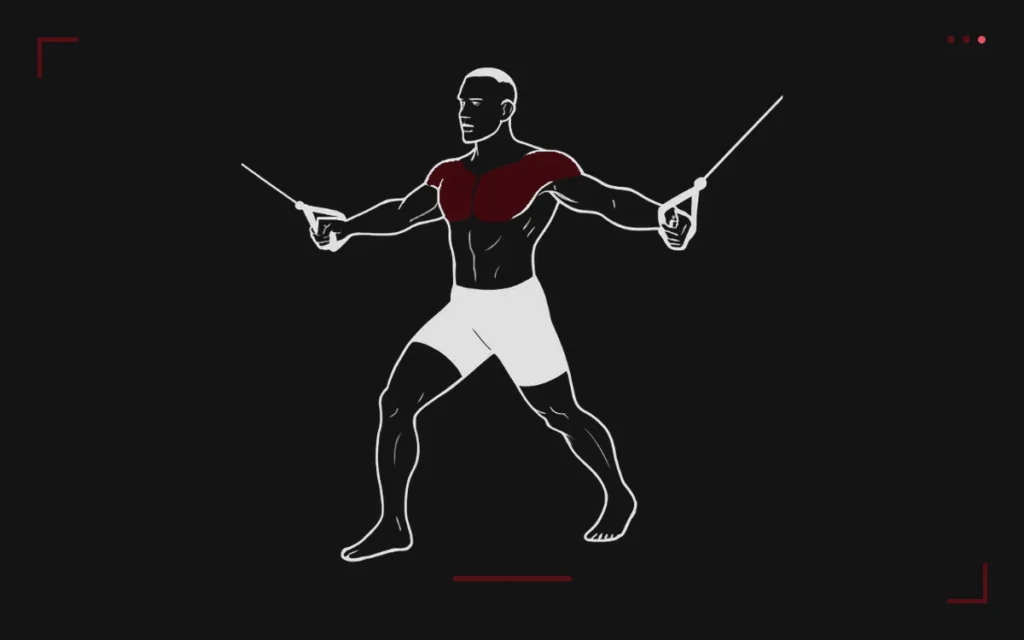
- The cable crossover fly is a chest isolation movement where only the shoulder moves and the elbow angle stays locked through every rep.
- It trains the pectoralis major, mainly the sternal head, with the front delt and biceps assisting and the triceps barely involved.
- The key to execution is placement: keep one foot inside the line of the cables, take one stride out, then bring your hands together from underneath your chest.
- The main mistake is letting the shoulders roll forward, which dumps the tension into the front delt and kills the feeling in the chest.
- Run 3 to 4 sets of 10 to 12 reps, either as a finisher after pressing or as a pre-fatigue drill before presses and dips.
The cable crossover fly is the most precise way to keep your chest under tension through a full range of motion. The cable never stops pulling, while a dumbbell loses almost all of its resistance the moment your hands come together. The machine is not the hard part. Your distance from the pulleys, the angle of your torso and the path your hands travel decide whether the work lands in your chest or in your shoulders. Here are the settings, the technique, the mistakes, the variations and the programming.
Muscles worked by the cable crossover fly
The fly is a single-joint movement: only the shoulder moves, and your elbow angle stays locked from start to finish. The function you are training is shoulder adduction, bringing the arm toward the midline of your body. Your triceps, which do heavy work on the chest press and on dips, barely participate here.
- Pectoralis major, sternal head: the prime mover. It pulls the arm across your body and contracts hardest once your arms actually cross.
- Pectoralis major, clavicular head: your upper chest. It only gets real emphasis when the movement travels from low to high.
- Pectoralis minor: it does not move your arm. It pulls the shoulder blade forward and down, so it works as a stabilizer. That matters, because most exercise pages still list it as a mover on the fly. It is not one.
- Anterior deltoid: it always assists, and it takes over the second your shoulder rolls forward or your pulleys sit too low.
- Biceps brachii and coracobrachialis: they flex and stabilize the arm. If you feel them burning before your chest does, that is a positioning error, not a bonus.
- Serratus anterior and scapular stabilizers: rhomboids, mid and lower traps, rotator cuff. They keep the shoulder blade pinned down for the whole set.
Compared with the peck deck, which locks you into one path, the cable lets you pick your angle of attack. That freedom is the whole point, and also the reason so many lifters feel nothing.
Setting the pulleys for the chest region you want to hit
Understand this first: you do not isolate one region of the pectoral. You shift where the peak tension lands. According to Ryan Humiston, coach and fitness creator, the chest is one of the few muscles where you can genuinely move the peak contraction around just by changing the angle of the arm, the elbow, even the pressure on the hand. Cables are the best tool for that.
| Pulley height | Region emphasized | Where your hands finish | Execution cue |
|---|---|---|---|
| Just above head height (high to low) | Lower chest | At hip and pubic bone level | Torso stays upright, chest proud, no extra forward bend during the set |
| Chest height (standard) | Mid chest, sternal head | In front of the sternum | Learn this version first, it is the most natural path |
| Hip height (low to high) | Upper chest | Top of the sternum | Do not set the pulleys below hip height or the front delt takes the set |
| Low pulley, one arm at a time | Inner and upper chest | Opposite shoulder | Brace hard, do not let your torso rotate |
One detail almost nobody writes down: wrist rotation changes where you feel the squeeze. Humiston points out that turning your palm toward the ceiling and tilting your torso a little further forward walks the peak contraction up from the inner chest toward the upper chest. Try both hand positions on one light set and you will feel which one connects for you.
How to do the cable crossover fly, step by step
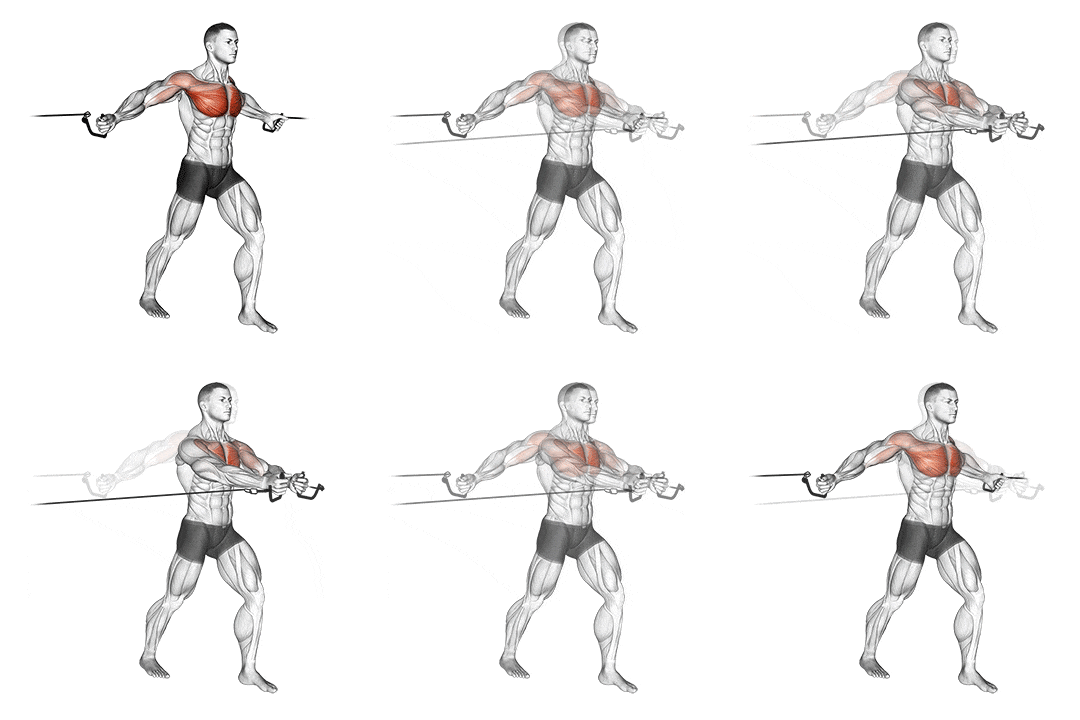
- Mount the machine properly. With real weight on the stack, do not try to grab both handles with your arms already spread. According to ATHLEAN-X, the channel run by a physical therapist and strength coach, grab one handle, pin it against your chest, walk yourself over to the other pulley, grab the second one the same way, then step into position. That is how you load this movement without putting your shoulder at risk on rep one.
- Use the doorway rule. Picture the two cables as the frame of a doorway. Stay inside the doorway and you end up pulling the weight toward you, which turns it into biceps work. Step way out in front and the fly becomes a press, with a lot of extra stress on the front of the shoulder capsule. The fix from ATHLEAN-X: leave one foot in the doorway and take one single stride out.
- Step back far enough that the stack never touches down during the set. Two or three feet of travel is usually enough.
- Lock the lower body. Staggered stance, knees slightly bent, glutes and core tight. Without that base, the weight drags you backward and you start compensating with your lower back.
- Set the shoulder blades. Pinched together and pulled down, chest up, shoulders back. That setup is what keeps the tension in the chest instead of dumping it into the delt.
- Keep a slight bend in the elbow and never change it. Locking the arm straight adds elbow stress without adding chest stretch. If the angle opens and closes rep to rep, you are pressing, not flying.
- Start leaning forward, finish by driving back. Lean forward at the start to pre-stretch the chest, then push your torso back as your hands come together, like you are pressing into an imaginary bench behind you. The opposite error, leaning further forward as the set goes on, puts your shoulder in front of your chest and hands it the work.
- Bring your hands together from underneath. According to Scott Herman of ScottHermanFitness, your hands need to meet under your chest in a scooping motion, not in a straight line out in front of you. That single cue is what unlocks the feeling for most people who say they never feel cable flys.
- Finish in full adduction. It is not your hands that need to cross, it is your arm: your bicep should touch your chest. End the rep by squeezing your shoulders down and your elbows toward your ribs. Alternate which arm goes on top every rep so both sides get the same work.
- Return slowly while you inhale, until your elbows reach shoulder height. No higher. Exhale on the way in.
Mistakes that shift the tension into your shoulders
- Shoulders rolling forward. As soon as the weight climbs, the shoulders round and the tension moves to the delts, the rotator cuff and the serratus. Fix it by pausing before every rep with your chest up and your blades packed.
- Too much range in the open position. Lifting your elbows above shoulder height does not stretch the pec any further, it just compresses the joint. If it already pinches at shoulder height, shorten the range.
- Stopping in front of your sternum. Skip the crossover and you skip the part of the rep where the sternal head contracts hardest.
- Turning the fly into a press. If your elbows extend and flex every rep, the weight is too heavy. Strip a plate and redo the set with a frozen elbow angle.
- Going too light, too. The opposite error is real: treating the fly as a weightless stretch and wasting the chance to load the eccentric. ATHLEAN-X is blunt about it, most lifters could handle noticeably more weight while keeping clean form.
- Rushing the reps. The fly is not an explosive movement. Speed it up and you lose the constant tension that made you pick the cable in the first place.
- Letting the stack yank your arms back. Control the way out. That eccentric is the most productive part of the rep and also the one that hurts shoulders when it is uncontrolled.
- Leaning forward on the high-to-low version when you want lower chest. On that variation the torso stays upright, chest out, hands finishing low at the hips. Bending the torso drags the work back toward the mid chest.
Cable fly variations and when to use them
- Standard fly, pulleys at shoulder height. The version to own first. Natural path, mid chest, easiest to feel.
- High-to-low cable fly. Hands finish at hip level, emphasis on the lower chest. This is your direct substitute if dips are off the table or your gym has no decline bench, which makes it a clean complement to the decline bench press.
- Low-to-high cable fly. Bottom to top, emphasis on the upper chest, the region that lags for most lifters. Pair it with the incline press.
- Single-arm cable fly. One side at a time, torso braced, no rotation. Use it when one side is visibly behind, and because it is the easiest version to check whether your front delt is taking over.
- Seated or bench-supported fly. The bench removes the balance problem. Useful if you lose your stance as soon as the weight climbs, or if you want everything going into the squeeze.
- Finishers on the last set. Top-end partials for 15 to 20 reps, then back to full range. Or the scoop method: hands tight underneath the chest, palms touching, contraction held one to three seconds.
Sets, reps and weight: the programming
The cable fly is an isolation movement. It does not replace a press, it finishes what a press started. Put it either at the front of the session as a pre-fatigue and connection drill, or at the end, after the dumbbell bench press and your dips.
| Goal | Sets | Reps | Tempo | Rest | Spot in the session |
|---|---|---|---|---|---|
| Learning the movement | 2 to 3 | 12 to 15 | 2 seconds out, pause in the stretch | 60 seconds | Early, light weight |
| Hypertrophy | 3 to 4 | 10 to 12 | 2 seconds out, 1 second squeeze | 60 to 90 seconds | After presses and dips |
| Eccentric overload | 3 | 8 to 10 | 3 seconds out | 90 seconds | Right after your warm-up, form locked |
| Finisher and pump | 1 to 2 | 15 to 20 partials, then full range | Continuous, no pause | 45 seconds | Last exercise of the day |
Starting weights look small on this movement, and that is normal: the number is per hand, on a long lever. Standards published by the Fitbod app, built from more than 4.5 billion logged sets, put a beginner around 20 lb (9 kg) per hand for 8 reps, an intermediate lifter at 22.5 lb (10 kg) and an advanced lifter at 30 lb (14 kg). If you are well above that with clean form, good. If you are well above that by pressing with your elbows, you are doing a different exercise.
Cable fly, dumbbell fly or pec deck
| Criterion | Cable crossover fly | Dumbbell fly | Pec deck |
|---|---|---|---|
| Tension at the top | Maximum, the cable keeps pulling | Almost none, gravity stops resisting | Good, varies by machine |
| Tension in the stretch | Strong | Maximum, and also the riskiest point | Moderate, range is capped |
| Movement path | Free, adjustable by pulley height | Free, dictated by gravity | Fixed, not adjustable |
| Beginner friendliness | Moderate, needs control | Moderate to hard | Easy, best for learning the squeeze |
| Crossing the arms | Yes | No | No |
| Availability in a busy gym | One or two stations, usually taken | Always open | Usually open |
If your shoulders are cranky, cables and the pec deck are friendlier than dumbbells because you control the open position. Still, keep this in mind: arms wide open at the very end of the eccentric is the most stressful moment of any fly, cables included.
What the cable fly adds to your streetlifting
In streetlifting your chest works mostly in vertical pushing and at a decline angle. The cable fly does two specific jobs. First, it teaches you to recruit the pec instead of the shoulder, which changes everything on dips once the belt gets heavy. Second, it lets you add chest volume without adding joint stress on a day when your shoulders are already loaded.
In practice, two sets of high-to-low flys at the end of a session slot straight into a weighted dip program, and the low-to-high version supports the upper-chest lockout work in the weighted muscle up program. If pulling is your priority, keep flys light so they do not eat recovery from your weighted pull-up program. And if you train at home with no cable stack, the weighted push-up program is your best bodyweight stand-in.
FAQ
What do cable crossover flys work?
They train the pectoralis major, with the strongest contraction in the sternal head once your arms cross your midline. The front delt, biceps and coracobrachialis assist, while the pec minor, serratus and scapular stabilizers hold your shoulder blade in place. Triceps involvement is close to zero, which is what separates a fly from a press.
Which cable fly is most effective?
The one that matches your target. Pulleys just above head height bias the lower chest, chest height hits the mid chest, hip height brings in the upper chest. If you are learning the movement, start at chest height, since it follows the most natural arm path.
How do you do a cable fly correctly?
Set the pulleys, pin the handles to your chest to get into position, then take one stride out of the cable line with a staggered stance. Pack your shoulder blades down, keep a slight elbow bend, lean forward to pre-stretch, then drive your torso back as your hands scoop together under your chest. Finish with your bicep touching your chest and your elbows squeezing toward your ribs.
How effective are cable flies?
Very, for chest isolation and mind-muscle connection, but they are not a mass builder on their own. Use them alongside a press, not instead of one. Their real advantage is constant tension from the stretched position all the way to full adduction, something dumbbells cannot give you.
How much weight should you use on cable flys?
Per hand on 8 reps, published Fitbod standards land around 20 lb (9 kg) for a beginner, 22.5 lb (10 kg) for an intermediate and 30 lb (14 kg) for an advanced lifter. Most lifters can go heavier than they think, as long as the elbow angle never changes and the shoulders stay packed.
Can cable flys replace dips for lower chest?
For lower chest emphasis, the high-to-low fly is the best substitute when dips are not an option or your gym has no decline bench. It will not load your triceps or shoulders the way dips do, so it does not replace a pressing movement in your program.

mathieu
Street workout athlete since 2019, I discovered streetlifting in 2023. Today I share my passion for the sport through streetliftings.com.