
Key takeaways
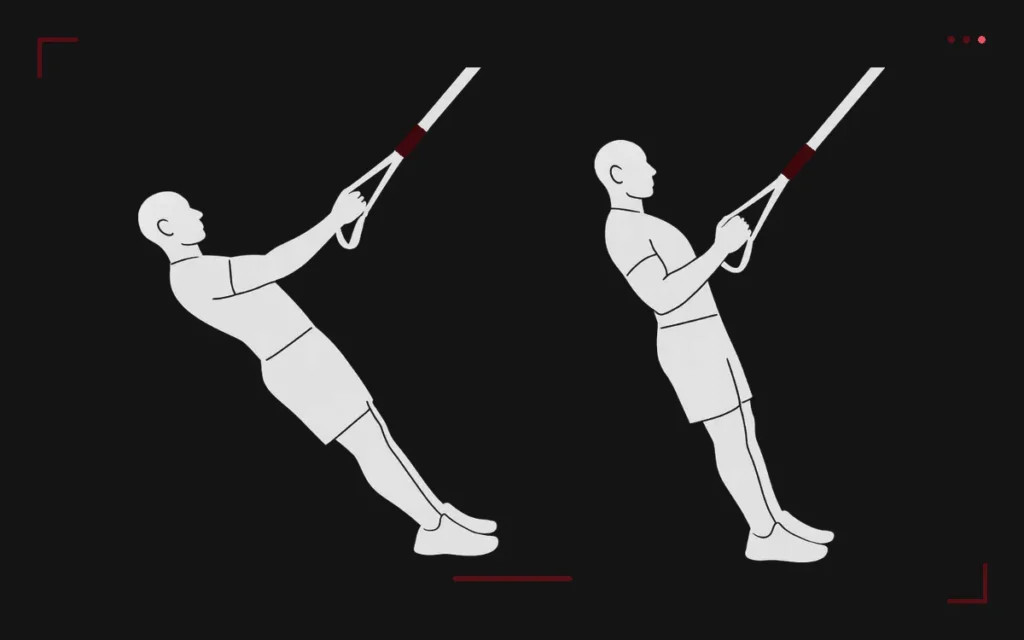
- The TRX row is a bodyweight horizontal pull: you hang from the straps with straight arms and row your chest up between your hands.
- It trains the lats, the mid and lower traps, the rhomboids, the rear delts and the biceps, with the abs and glutes braced the whole set.
- One cue carries the lift: retract your shoulder blades before the elbows bend, then drive your elbows back behind you instead of pulling the handles toward you.
- The big mistake is curling the wrist at the top, which dumps the load onto a tiny tendon on the inside of the elbow and invites tendinitis.
- You set the difficulty by walking your feet toward the anchor, which makes it useful from a total beginner to a lifter prepping weighted pull-ups.
The TRX row is the most honest horizontal pull there is: you row your own bodyweight, and you set the difficulty by walking your feet a few inches in or out. No bench, no machine, nowhere to hide a core that quits halfway through the set. It is also the back exercise with the lowest equipment bill: two straps and one solid anchor point.
You will also see it called a suspension row, a low row, or an Australian pull-up when it is done under a fixed bar. It does two very different jobs: it builds thickness through the upper back, and it builds the strength you need for pull-ups when you cannot do a single one yet. Here is the exact setup, the form cues, the mistakes that send people to a physical therapist, the variations worth your time, and how to program it week by week.
What the TRX Row Is and Why It Belongs in Your Week
TRX started as a brand of suspension straps and the name stuck to the whole category. The acronym stands for Total body Resistance eXercise. In practice it is two adjustable straps with handles and foot cradles, hung from a fixed point. All the resistance comes from your bodyweight and the angle you take relative to the floor.
The TRX row is the foundational pull on that tool. Grab the handles, walk your feet forward, hang with your arms straight, and row your chest up to your hands. It is a horizontal pull, so it builds the back in thickness, where pull-ups build it in width. The two are complements, not substitutes.
Why bother when you own barbells? Because the upper back and rear shoulders are still the most underdeveloped area on most lifters, a point strength coach Dan John has made for years and that coach Shane McLean repeats on Tony Gentilcore’s site. The TRX row fixes that gap with gear that fits in a gym bag.
On the equipment side, three things matter more than the logo on the strap:
- The anchor. A pull-up bar, a beam, a thick branch, or a door anchor if that is all you have. You want roughly 7 to 8 ft (2 to 2.5 m) of height so you can drop all the way to horizontal. Always load-test the anchor by hanging still on it before you row.
- Adjustable length. Handle height is what sets the difficulty. Fixed-length straps are useless for this exercise.
- The handles. Wide, padded, with a foot cradle built in. Budget straps row just fine; what you pay extra for is stitching quality and handle comfort on long sets.
Strap Setup and Locking In Your Start Position
Your start position is 80 percent of the result. A bad TRX row is decided before the first rep.
Handle height. For the full version, close to horizontal, set the straps so the handles sit just above your knee. Anthony Balduzzi, founder of the Fit Father Project, gives that exact benchmark: set the handles too low and you drag on the floor at the bottom, which costs you the end of the range. For the beginner version with a more upright torso, raise the handles to navel height.
The grip. Hands shoulder-width, pronated (palms down) for the standard version. Crush the handles. Grip is a switch: the harder you squeeze, the more back you recruit.
Three body anchors. Austin, coach and personal trainer behind the Training Tall channel, boils the setup down to a checklist you run every set: shoulders pulled back and down, abs locked, hips engaged by tucking the tailbone slightly without arching the low back. Let one of the three go and the body breaks in the middle.
Getting tight. Before you pull, push your chest out and drive your shoulders as far from your ears as you can. The coach behind the BmD Train With Me channel adds two cues almost nobody writes down: eyes on the anchor point, legs straight and squeezed together, glutes on, belly pulled in. One straight plank from head to heels.
Setting the load. Walk your feet toward the anchor and it gets heavier. Walk back and it gets lighter. Set it heavy enough that you have to adjust your position between sets, otherwise you never touch your actual threshold.
How to Do a TRX Row, Step by Step
- Take the tension with arms straight, elbows unlocked, body in one line, leaning back. The strap is already loaded; you are not hanging slack.
- Retract your shoulder blades before the elbows move at all. The rep starts in your back, not your arms.
- Drive your elbows back behind you, tight to your ribs. Think “elbows back,” not “handles to me.” Same path, but your brain recruits the back instead of the forearms.
- Bring your chest up between your hands, handles at chest level, right about nipple line. Not halfway. Not down at your belly.
- Pause at the top and squeeze the shoulder blades for half a second. That is where the work happens.
- Lower in 2 to 3 seconds, arms extending, shoulder blades opening, without ever letting the strap go slack.
For breathing, exhale as you pull and inhale on the way down. Some coaches teach the reverse to help you feel the deep back muscles; it is not where you lose reps. Range of motion is.
Muscles Worked by the TRX Row
The TRX row is a compound pull: it hits the whole upper-body pulling chain plus your trunk, which works isometrically from the first rep to the last.
| Muscle | Job in the movement | How to bias it |
|---|---|---|
| Lats | Drive the arm back and down, prime mover | Wider grip, elbows a little flared, row toward the lower chest |
| Mid and lower traps | Pull the shoulder blades together and down at the top | One-second pause with the chest against the handles |
| Rhomboids | Scapular retraction, upper-back thickness | Narrow grip, elbows straight back instead of out |
| Rear delts | Stabilize the shoulder and extend the arm | Face pull variation or a high-elbow row |
| Biceps and brachialis | Flex the elbow, loaded hard in a supinated grip | Underhand grip, palms up |
| Forearms and finger flexors | Hold your grip on a moving handle | Slow tempo, long sets |
| Abs and glutes | Lock the plank, stop the hips from sagging | Feet elevated, single-arm version |
The detail that changes everything: grip width steers the work. Go wide and you load the lats, building the back in width. Go narrow with the elbows tucked and you load the rhomboids and mid-back, building thickness. Rotate both across the month instead of picking a side.
Dialing the Difficulty: Five Levels of TRX Row
The TRX beats a fixed bar on one thing: you can progress an inch at a time. Here is how to structure that instead of guessing every session.
| Level | Position | Checkpoint | Target |
|---|---|---|---|
| 1. Intro | Handles at navel height, torso leaning back about 60 degrees, heels under the hips | You can hold the bottom position without shaking | 3 sets of 12 |
| 2. Beginner | Handles at mid-thigh, torso around 45 degrees | Shoulder blades move through the full range | 4 sets of 10 |
| 3. Intermediate | Handles just above the knee, feet walked far out, body close to horizontal | Chest touches the handles on every rep | 4 sets of 10 |
| 4. Advanced | Heels on a box or bench, body parallel to the floor | Zero hip sag across 10 reps | 4 sets of 8 to 10 |
| 5. Expert | Single-arm rows, or a 3-second-up, 3-second-down tempo | Your back fails before your grip does | 4 sets of 5 to 6 |
Expect a surprise on the slow tempo work. Stephanie Warick, a coach on the official TRX Training channel, warns that your forearms and grip burn out before your back does in that format, and that you sometimes have to let go and shake the hands out. That is not a flaw in the exercise, it is a diagnosis: grip is your weak link, and a little dead hang work will fix it faster than extra rowing volume.
Eight Mistakes That Ruin the TRX Row
- Breaking at the wrist at the top. This is the expensive one. Austin from Training Tall explains that when the wrist curls in, the load shifts onto the wrist flexors and pulls on a tiny tendon on the inside of the elbow, which sets you up for tendinitis that can take months to settle. The fix: relax the wrists, knuckles tipped slightly back the way they sit when you pick something up, and think “elbows back.”
- Stopping halfway. Hands arriving at your belly is a half rep. The chest has to come up between the hands.
- Hip sag. The butt drops and the row turns into a reverse good morning. Squeeze glutes and abs, and walk your feet back a step if you cannot hold the plank.
- Shrugging into your ears. If you start the rep by hiking the shoulders, your upper traps are doing the rhomboids’ job. Shoulders down before you pull, every time.
- Letting the strap go slack at the bottom. Tension stays on from the first rep to the last. One jolt in the strap at the bottom and your shoulder absorbs the catch.
- Elbows flaring out on a narrow grip. They should travel straight back along the ribs.
- Handles set too low. You drag the floor at the bottom and start cutting the range short to avoid banging into it.
- Feet sliding. On tile or hardwood the set becomes a fight with the floor. Wear shoes with grip, or jam your heels against a wall or a plate.
TRX Row Variations Worth Running
- Neutral grip (thumbs up): the friendliest option for cranky shoulders and a good starting point if the pronated row pinches. Same logic as a neutral-grip pull-up.
- Supinated grip (palms up): shifts a big share of the work onto the biceps. Useful at the end of a session to finish the arms without touching a dumbbell.
- Single-arm row. One hand on a handle, the other arm free. Your body wants to rotate and your obliques and glutes have to stop it. This is the variation strength coaches reach for to iron out left-to-right imbalances, and it carries over directly to the renegade row.
- Feet elevated. Heels on a box or bench, body parallel to the floor at the bottom. This is the next step once 4 sets of 10 on the floor feel easy.
- 3-1-3 tempo. Three seconds up, one-second hold, three seconds down. Fewer reps, far more tension, and a form you cannot fake.
- Power pull. One hand on the handle, the other reaching toward the floor then up to the ceiling as you rotate. Stephanie Warick flags one setup detail: take a wide stance for a strong base, otherwise the rotation stops happening at the hips and the move degrades into a bad ab exercise.
- Loaded reach row. Ebenezer Samuel, C.S.C.S., fitness director at Men’s Health, builds a version where you hold a light dumbbell in the free hand and reach it toward the ceiling as you row: even a 5 lb (2 kg) dumbbell makes it hard, run for 3 sets of 8 to 10 per side, best placed at the end of a workout.
- TRX face pull. Same straps, elbows high, handles to your forehead. For rear delts and shoulder health it is the direct complement to the row, and the logic matches the cable face pull.
Programming the TRX Row for Your Goal
Three goals, three formats. Do not blend them in the same session.
- Learn the movement and feel your back: 3 sets of 10 to 15 reps, 3 days a week, at a moderate angle. That is the format Anthony Balduzzi prescribes for beginners, and it is enough for your first several weeks.
- Add upper-back size: 2 to 4 sets of 12 to 20 reps, supersetted with a pressing movement. The TRX row handles long sets well because the load never crushes you.
- Build strength for pull-ups: 4 sets, 30 seconds of rest at most, targeting 10 full reps per set at the hardest angle you can hold. That is coach Arpad Halasz’s protocol on ArsCorpus, run 2 to 3 times a week with at least 48 hours between sessions.
Where it goes in the session: if you lift weights, the TRX row is a finisher after heavy barbell rows. If straps are all you own, it becomes your main pull and it goes first, with fresh grip and a fresh back. And to balance out all that pulling, give pressing equal billing: the weighted dip program is the logical counterweight to this much back work. Inside a full streetlifting program, the TRX row sits exactly there: back accessory, twice a week, never taken to failure.
A 4-week block that works, built on the protocol above:
- Week 1: find the angle where you get 6 to 7 clean reps. Run 4 sets there with 30 seconds of rest.
- Week 2: same angle, add one rep per set.
- Week 3: same angle, add one more rep per set. You should be closing in on 9 or 10.
- Week 4: as soon as 4 sets of 10 go up clean, walk your feet 4 in (10 cm) closer to the anchor and reset to 6 reps. The rep counter restarts; the strength does not.
From TRX Rows to Pull-Ups, Then to Weighted Pull-Ups
A TRX row is not a pull-up and never will be: the load vector is horizontal, not vertical. But it builds three things a pull-up needs: scapular control, elbow flexion strength, and the ability to hold a braced body under tension.
Call the TRX row handled when you can check every box, the mastery criteria from ArsCorpus:
- Full range on every rep: handles to the chest at the top, arms straight at the bottom.
- No hip break, legs straight, feet no wider than hip width.
- 10 clean reps on each of 4 sets, body parallel to the floor.
- 30 seconds of rest between sets is enough. If you need more, it does not count yet.
From there, move to vertical work. Assisted pull-ups take over the job of chasing that first strict rep, while you keep one TRX row session a week for volume. If you train outdoors, the Australian pull-up under a low bar does the same job with no straps at all.
After the first pull-up, the game changes again: you have to add load, structure your cycles, and manage recovery. The weighted pull-up asks only one thing of you to start: a single clean strict rep. From there the weighted pull-up program takes you to loaded sets, and the piece most people get wrong is how to attach the weight in the first place. If you want explosive strength instead, the weighted muscle up program uses the same horizontal pulling base to unlock the transition over the bar. Either way, the TRX row stays in your week as the thickness and prehab work that keeps your shoulders healthy while the loads climb.
TRX Row vs Barbell Row: Which One to Pick
The TRX has no monopoly on horizontal pulling. Here is where it sits against the alternatives, based on what you actually have access to.
| Exercise | Load | What it adds | When to pick it |
|---|---|---|---|
| TRX row | Bodyweight, adjustable by the inch | Free-moving handles, so a natural path and real stabilizer work | At home, as pull-up prep, as a finisher |
| Australian pull-up under a bar | Bodyweight, adjusted by bar height | Fixed path, easier to load hard single-arm | Outdoors, on a low bar or a rig |
| Barbell row | External load, unlimited progression | Top-end strength plus isometric posterior chain work | When raw strength is the goal and a bar is available |
| Ring row | Bodyweight, adjustable | Free wrist rotation, even more demanding on the stabilizers | If rings and the muscle up are on your list |
The real answer: none of them replaces the others. Barbell rows for load, TRX rows for movement quality and availability, and a rotation between them across the month. Two horizontal pulling sessions a week, in whatever form you can get, and your upper back stops being the weak link.
FAQ
Which muscles do TRX rows work?
The lats are the prime mover, backed by the mid and lower traps and the rhomboids that pull the shoulder blades together. Rear delts, biceps, brachialis and forearms contribute on every rep. Your abs and glutes work isometrically from the first rep to the last to hold the plank. A wide grip biases the lats, a narrow grip biases the mid-back.
What does TRX stand for?
Total body Resistance eXercise. TRX began as a brand of suspension straps and the name got attached to the whole category. The setup is two adjustable straps with handles and foot cradles hung from a high anchor, where all the resistance comes from your bodyweight and the angle you take to the floor.
Are TRX rows enough to build a big back?
They are, up to a point. Four sets of 10 with your body parallel to the floor and 30 seconds of rest is a real stimulus for the upper back. The ceiling is your bodyweight: once that gets easy, you progress by elevating your feet, going single-arm or slowing the tempo, and eventually by adding a barbell row for heavy loading.
How many TRX rows should I do?
To learn the movement, 3 sets of 10 to 15 reps, three days a week. For upper-back size, 2 to 4 sets of 12 to 20 reps. For pull-up strength, 4 sets aiming at 10 full reps with no more than 30 seconds of rest, at the hardest angle you can hold with clean form.
What is a good TRX row alternative?
An Australian pull-up under a low bar is the closest match and needs no straps at all. Ring rows give you the same free-handle feel with even more stabilizer work. If you want load rather than bodyweight, the barbell row is the direct swap, and a single-arm dumbbell row works if that is all your gym has.
Will TRX rows get me my first pull-up?
They build a big piece of it: scapular control, elbow flexion strength and the ability to stay braced under tension. They do not train the vertical pulling pattern itself, so pair them with assisted pull-ups or negatives. A good handoff point is 4 sets of 10 clean reps with your body parallel to the floor.

mathieu
Street workout athlete since 2019, I discovered streetlifting in 2023. Today I share my passion for the sport through streetliftings.com.