
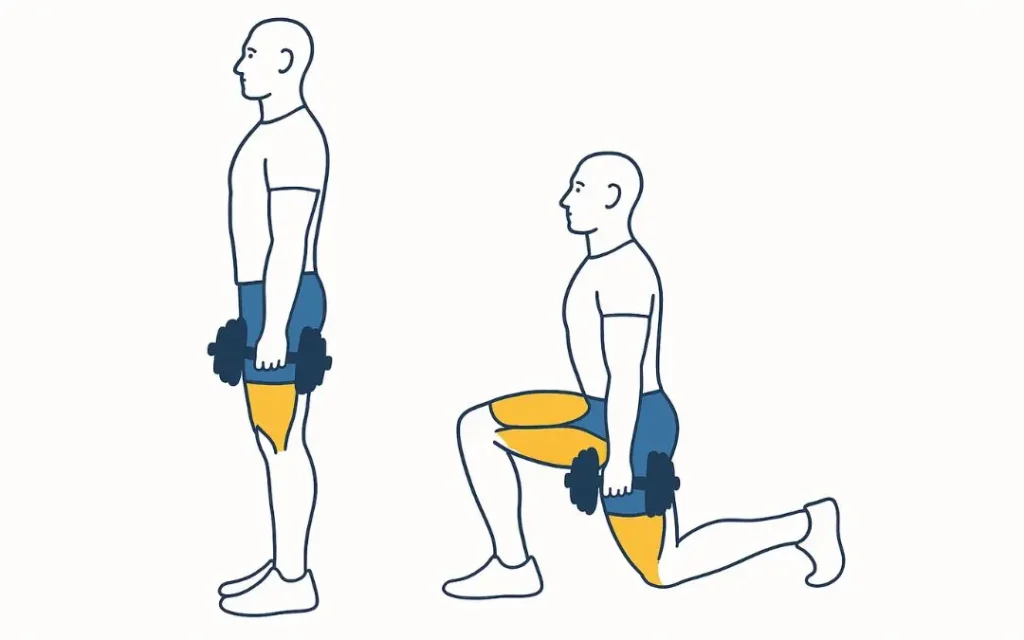
Walking lunges are a must-have exercise in strength training, whether in the gym or in street workout. They train the legs in a functional way while improving balance, coordination, and mobility. Here is everything you need to know to master this movement, progress effectively, and integrate it intelligently into your program.
How to Perform Walking Lunges
To execute walking lunges correctly, it is essential to follow a rigorous technique:
-
Starting position: Stand with feet hip-width apart, torso upright, gaze forward.
-
First step: Take a large step forward with one leg. The front foot should remain flat on the ground, while the rear heel may lift.
-
Descent: Lower your body until both knees form approximately a 90-degree angle. The rear knee should come close to the floor without touching it.
-
Rise and continuation: Push through the front heel to return to standing, then immediately step forward with the other leg.
Always keep the torso braced and core engaged, and avoid letting the knee travel past the toes to prevent injury.
Program or coaching?
Find your ideal format
Answer 4 questions and receive a personalized recommendation based on your level and goals.
Tailored result
Free
Muscles Worked
Walking lunges are a multi-joint exercise that recruits several major muscle groups:
-
Quadriceps: the primary driver of the movement, especially during the push phase.
-
Glutes (gluteus maximus): heavily loaded during hip extension.
-
Hamstrings: contribute to stability and movement control.
-
Adductors: activated to stabilize the pelvis.
-
Calves: for balance and propulsion.
-
Core muscles: abdominal and lower-back bracing to maintain alignment.
How to Progress
To progress with walking lunges, it is crucial to adapt the intensity to your level:
-
Beginner: start with bodyweight over a short distance (10-15 steps).
-
Intermediate: add load (dumbbells, kettlebells, or a sandbag) to increase resistance.
-
Advanced: work with a slow tempo, pauses at the bottom of the movement, or chain lunges with other exercises (squat, jump).
Also consider varying surfaces: training on grass, sand, or an unstable mat improves balance and proprioception.
Integrating Walking Lunges into Your Training Program
Walking lunges can be incorporated in many ways into a training program:
-
As a warm-up: unloaded, to activate the hips and legs.
-
In a full-body circuit: paired with pull-ups, push-ups, or dips.
-
At the end of a leg session: for a « finisher » effect that really burns.
-
As active mobility work: perfect for improving joint range of motion.
Variations
Here are some variations to prevent stagnation:
-
Dumbbell walking lunges: add a weight on each side to intensify the work.
-
Walking lunges with rotation: hold a plate and rotate your torso at each descent.
-
Alternating jump lunges: a plyometric version for explosive power work.
-
Bulgarian split-squat walks: alternate classic lunges with elevated rear-leg lunges.
-
Lateral walking lunges: to target the adductors more.
Each variation allows you to stimulate the muscles differently and bring freshness to your routine.
Coach’s Conclusion
Walking lunges are far more than a simple leg exercise: they develop strength, mobility, coordination, and muscular endurance. Whether you are a beginner or experienced, they deserve a prime spot in your training. Work with control, focus on movement quality, and scale the difficulty to keep progressing. A simple movement – but devastatingly effective.