
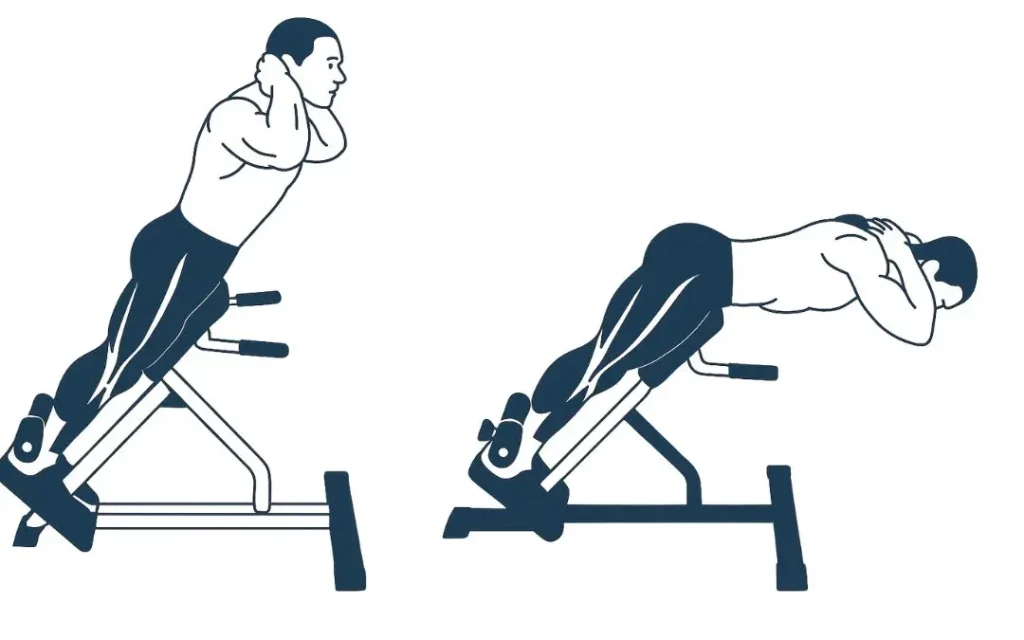
Back extensions on the hyperextension bench are a must-have exercise for strengthening the posterior chain – in particular the lower back muscles, glutes, and hamstrings. Practised in both weight training and street workout, this lower back extension on bench is essential for improving posture, preventing back pain, and boosting performance.
Start Here
- Streetlifting Program
- Weighted Muscle Up Program
- Weighted Pull-Up Program
- Weighted Dip Program
- Squat Program
How to perform the back extension on the hyperextension bench
Proper execution is crucial to effectively target the muscles while avoiding injury. Here are the steps to correctly perform a back extension on the hyperextension bench:
-
Setting up on the hyperextension bench:
- Adjust the bench so that your hips extend slightly beyond the pad.
- Lock your feet firmly under the foot rests.
- Cross your arms over your chest or place them behind your head to increase the difficulty.
-
The movement:
- From the bottom position (torso angled toward the floor), engage your glutes and lower back muscles to slowly raise your upper body until it is aligned with your legs.
- Do not aim to hyperextend: a neutral alignment is sufficient.
- Lower yourself back down in a controlled manner, without jerking.
-
Breathing:
- Inhale on the way down.
- Exhale on the way up, at the moment of effort.
In 1 minute
Program or coaching?
Find your ideal format
Answer 4 questions and receive a personalized recommendation based on your level and your goals.
1 min flat
Tailored result
Free
Muscles worked
The back extension on the hyperextension bench is a multi-joint exercise that recruits several muscle groups, including:
- Spinal erectors (lower back): the primary muscles targeted by the movement.
- Glutes (mainly the gluteus maximus): highly active during the raising phase.
- Hamstrings: contribute to hip extension.
- Core and deep abdominal muscles: for postural control and stability.
Benefits of the back extension
Regularly performing hyperextension bench exercises offers numerous benefits:
- Lower back strengthening: essential for preventing back pain and supporting the spine.
- Improved posture: by strengthening the postural muscles.
- Injury prevention: especially in sports involving heavy loads (weightlifting, streetlifting).
- Performance carry-over: useful for movements such as the squat, deadlift, or pull-ups.
- Corrective work: ideal for counterbalancing the effects of prolonged sitting.
Variations
There are several variations of the back extension on the hyperextension bench, allowing you to vary the muscular stimulus:
- Weighted back extension: holding a weight plate against your chest to increase resistance.
- Unilateral extension: raising one side of the body at a time for lateral core work.
- Floor extension (Superman): a no-equipment variation, effective for beginners.
- Swiss ball extension: allows a smoother execution with added core engagement.
- Reverse hyperextension: often performed on a dedicated machine, it targets the glutes and hamstrings more heavily.
Additional tips
To get the most out of your back extensions on the hyperextension bench, here are a few useful recommendations:
- Warm up: mobilize the spine and activate the glutes before you start.
- Control the tempo: favour a slow, controlled movement.
- Avoid hyperextension: do not aim to arch your back excessively.
- Progress gradually: 2 to 3 times per week at the end of a session is sufficient.
- Think about recovery: the lower back muscles also need rest to grow stronger.
See other exercises to strengthen your hamstrings