
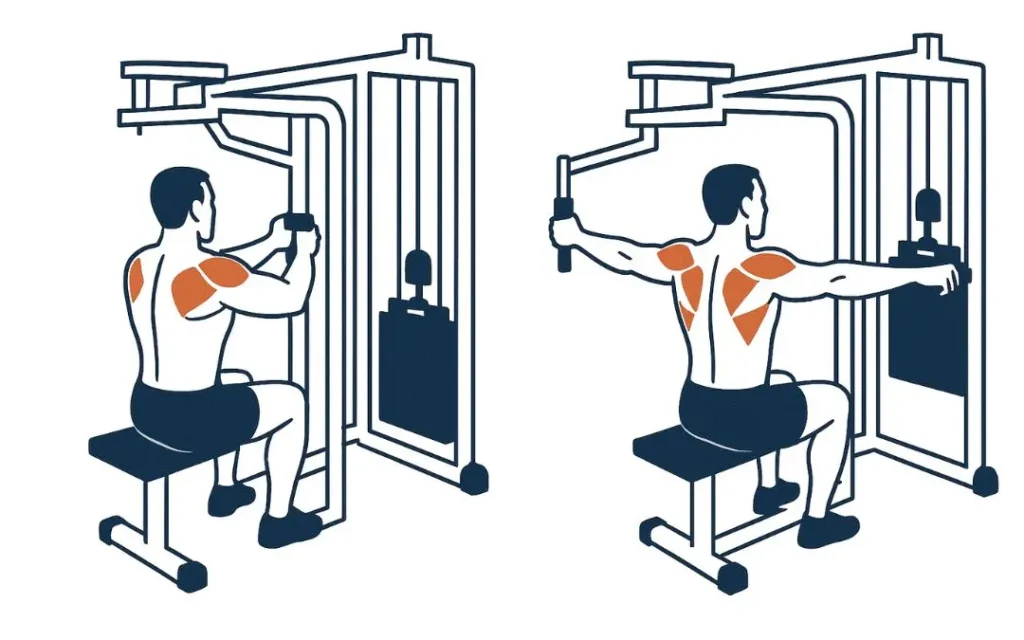
The reverse pec deck is an essential strength-training exercise for targeting the rear deltoids, a muscle group frequently overlooked in favor of the bench press or lateral raises. Yet for balanced shoulders and a strong upper body, this movement deserves your full attention. Easy to slot into any training program, it delivers targeted, effective, and joint-friendly work to reinforce the posterior muscles of the upper body.
How to perform the reverse pec deck
The reverse pec deck, also known as the reverse fly machine or the « butterfly » machine performed in reverse, is executed on a pec deck or butterfly machine in the reversed position.
Steps for perfect execution:
- Adjust the seat to the correct height: your arms should be horizontal, aligned with your shoulders.
- Sit facing the back pad, chest against the cushion, back straight, and feet flat on the floor.
- Grip the handles with a neutral grip (palms facing each other).
- Keep your elbows slightly bent, never locked out.
- Slowly open your arms backward, squeezing your shoulder blades together.
- Return to the starting position in a controlled manner.
Program or coaching?
Find your ideal format
Answer 4 questions and receive a personalized recommendation based on your level and goals.
Tailored result
Free
Targeted muscles
The reverse pec deck is an isolation exercise that primarily targets the posterior deltoids – those fibers so often neglected in standard programs.
Primary muscles worked:
- Posterior deltoids (rear shoulder)
- Middle and lower trapezius
- Rhomboids
These muscles play a key role in posture, scapular stability, and shoulder balance. Strengthening them not only improves the aesthetic of the upper back but also helps prevent injuries caused by muscular imbalances.
Benefits of the reverse pec deck
Adding the reverse pec deck to your routine offers numerous benefits, whether you are a beginner or an experienced lifter.
1. Strengthens the rear deltoids
One of the best exercises for developing the posterior portion of the deltoids, which is notoriously difficult to target with traditional movements.
2. Improves posture
By engaging the scapular muscles, it helps straighten the upper back – especially valuable if you spend long hours sitting or hunched forward.
3. Injury prevention
A proper balance between anterior and posterior deltoids reduces the risk of shoulder injuries, which are common in strength training.
4. Guided and safe execution
The machine controls the range of motion, minimizing the risk of technical error. Ideal for learning to feel the muscular contraction without cheating.
5. Perfect as a session finisher
Excellent for wrapping up a push/pull or shoulder session with targeted isolation work and no joint stress.
Common mistakes to avoid
Like any exercise, poor technique on the reverse pec deck can lead to pain or injury. Here are the traps to avoid:
X Pulling with the arms
The movement must originate from the shoulders, not the elbows. If you mainly feel your biceps or triceps, you are hitting the wrong target.
X Using too much weight
Overloading encourages compensations such as excessive upper trapezius engagement. A moderate weight with clean technique is always better.
X Skipping the eccentric phase
Returning slowly to the start position produces better muscle stimulus. Do not let the handles snap back uncontrolled.
X Locking out the arms
Fully extended elbows increase tension on the joints and reduce exercise effectiveness. Always maintain a slight bend.
X Neglecting machine setup
A seat that is too low or too high alters the working angle and shifts stress away from the posterior deltoids.
Variations
To keep things fresh or when a machine is not available, several reverse pec deck variations target the same muscle groups:
Dumbbell reverse fly
Lying on an incline bench or bent over while standing, this free-weight version engages more stabilizer muscles.
Cable reverse fly
By crossing the cables, you can vary the angle of tension while keeping constant resistance throughout the full range of motion.
Resistance band reverse fly
A practical option for home training or warm-up, with progressive tension. See our guide on resistance bands.
Prone rear delt raise
Lying face down on a bench, the prone rear delt raise prevents momentum cheating and effectively targets the rear shoulder.
Coach’s conclusion
The reverse pec deck is simple yet devastatingly effective for building complete shoulders and preventing imbalances. Too often overlooked, it deserves a regular place in your training programs – especially if you want to improve your posture, reinforce your upper back, or complete a well-rounded physique.
Focus on clean, controlled execution and concentrate on feeling the muscular contraction. Remember that progress comes not only from the weight lifted, but above all from the quality of each rep.
More shoulder exercises
- Face Pull
- Prone rear delt raise
- Seated dumbbell press
- Behind-the-neck press
- Pike push-up
- Military press