
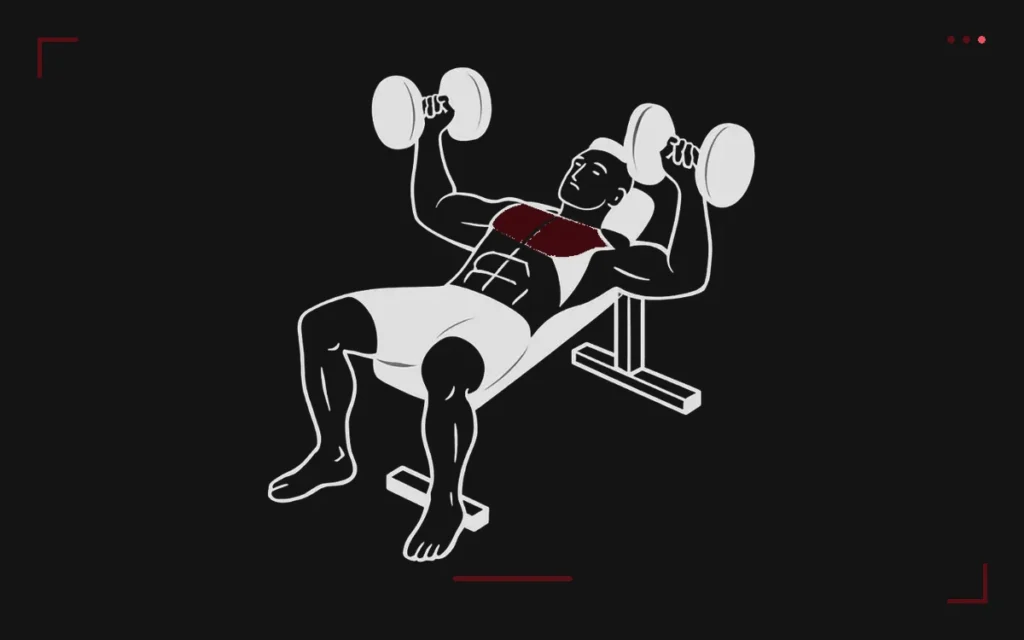
The dumbbell bench press is an essential exercise for building the chest and strengthening your weighted dips. Versatile, effective, and accessible, it delivers a more complete muscular workout than its barbell counterpart. That said, you need to execute it correctly. Poor posture, uncontrolled range of motion, or badly managed loads can limit your results — and even lead to injury. In this article, we explain how to perform the dumbbell bench press properly, which muscles it targets, why it is so effective, and which mistakes to avoid.
How to Do the Dumbbell Bench Press
Mastering the dumbbell bench press comes down to following proper technique to guarantee optimal muscle activation while staying injury-free.
Setup
Before lifting any weight, proper setup is essential:
-
Choose a weight suited to your level. Beginners should start light (6 to 10 kg) and progress gradually.
-
Set up on a flat bench with your feet flat on the floor.
-
Lie back with the dumbbells resting on your thighs. Use your thighs to help kick them up above your chest as you lie down fully.
-
Always keep your shoulder blades retracted and your shoulders depressed to protect the joint and better engage the chest.
Proper Execution of the Dumbbell Bench Press
Correct execution follows 5 key steps:
-
Starting position: Hold the dumbbells vertically above your chest with arms extended, palms facing forward.
-
Controlled descent: Slowly lower the dumbbells until they reach chest level, elbows bent to approximately 90 degrees, keeping your wrists straight.
-
Breathing: Inhale on the way down, exhale as you press up.
-
Explosive press: Drive the dumbbells back to the starting position while strongly contracting the chest muscles.
-
Stability control: Avoid jerky movements or imbalances. Working with controlled instability is one of the major advantages of dumbbells.
Targeted Muscles
The dumbbell bench press is a highly complete multi-joint exercise. It primarily works:
-
The pectoralis major, the primary target muscle.
-
The anterior deltoid (front of the shoulder), which stabilizes and assists the movement.
-
The triceps brachii, which contributes to elbow extension.
But there is more: by stabilizing the dumbbells, you also engage the stabilizer muscles, particularly the deep shoulder muscles and even the core, to maintain good posture.
Program or coaching?
Find your ideal format
Answer 4 questions and receive a personalized recommendation based on your level and your goals.
Tailored result
Free
The Advantages of Dumbbells Over the Barbell
Why choose dumbbells over a barbell for bench pressing? There are many reasons:
-
Greater range of motion: Dumbbells let you lower further and bring your arms closer together at the top, which promotes a fuller contraction of the chest.
-
Balanced unilateral work: Each arm works independently, which corrects muscular imbalances.
-
Less stress on the joints: The wrists and shoulders have more freedom of movement, reducing strain — particularly useful if you experience shoulder discomfort.
-
Better activation of stabilizer muscles: Dumbbells require more control and coordination, engaging the entire kinetic chain to a greater degree.
Mistakes to Avoid to Stay Injury-Free
Like any strength training exercise, the dumbbell bench press can become risky with poor execution. Here are the common mistakes to avoid at all costs:
-
Lowering the dumbbells too far: This can cause shoulder hyperextension. Stay within a controlled range of motion.
-
Excessive lower back arch: A slight natural arch is normal, but your lower back should not lift excessively off the bench.
-
Moving too fast: Prioritize slow, controlled movement to maximize muscle recruitment.
-
Ego lifting: Using weights that are too heavy compromises technique and increases injury risk.
-
Bent wrists: Keep your wrists aligned with your forearms to prevent pain.
Coach’s Takeaway
The dumbbell bench press is a prime tool for building powerful, balanced chest muscles. Accessible, safe, and effective, it suits beginners and advanced athletes alike. To get the most out of this exercise, it is essential to position yourself correctly, control every phase of the movement, and follow a suitable progression. Add it to your training program for complete upper-body development.
And above all, never forget: execution quality comes before the weight on the bar. Now get to work!
Other Exercises to Build Your Chest
- Assisted dips
- Weighted push-up program
- Build your chest with weighted dips
- Incline press: dumbbells or barbell
- Decline press
- Pec deck
- Chest press
- Cable crossover fly
- Archer push-up
- One-arm push-up

mathieu
Street workout athlete since 2019, I discovered streetlifting in 2023. Today I share my passion for the sport through streetliftings.com.