
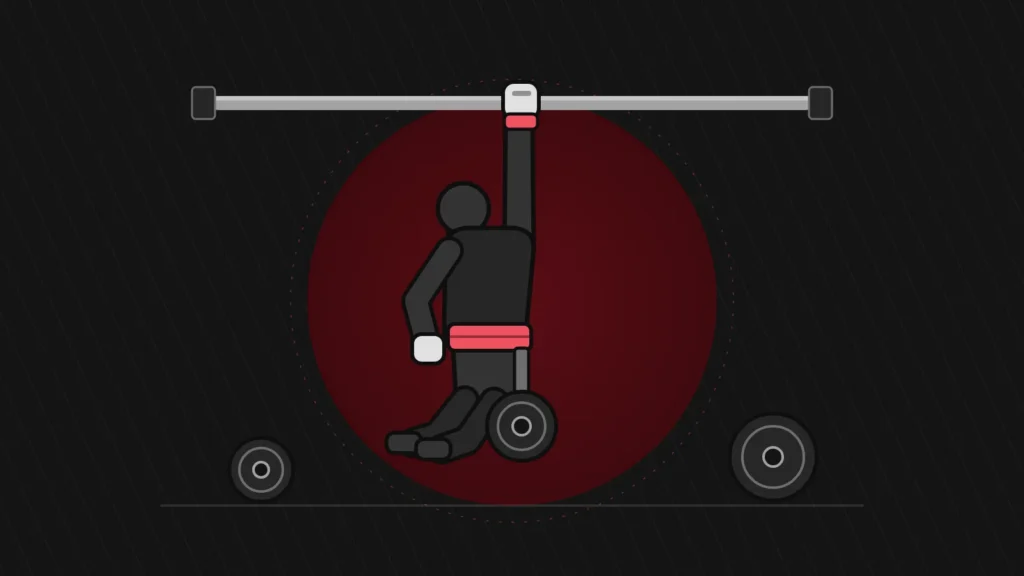
The one arm pull up is the most filmed pulling movement on the internet and the least prepared for in real gyms. You see a skill, it is a load problem first: a single arm has to move one hundred percent of your bodyweight, with no kip and no spotter. Until you have built that much strength with added load, you can grind unilateral drills for three years and never leave the bottom.
One arm pull up: the load math nobody runs
Run the numbers on yourself. On a standard pull-up, two arms split your bodyweight: at 180 lb (82 kg), each arm handles 90 lb (41 kg). Clip a dip belt with 90 lb (41 kg) on it and each arm is now moving 135 lb (61 kg). For one arm to handle the full 180 lb (82 kg), which is exactly what a one arm pull up asks, you need a weighted pull-up with +180 lb (82 kg) hanging off you, a full one hundred percent of bodyweight added. That is arithmetic, not opinion.
Real-world numbers land lower: your two-arm pull is never perfectly symmetrical, and a single-arm grip lets the torso rotate and steal a little leverage. Coaching standards converge on a floor: a weighted pull-up at 1.5 times bodyweight total, meaning roughly half your bodyweight added, plus 15 strict reps with your chest to the bar. At 180 lb, that is one clean rep with 270 lb (122 kg) on the system, so +90 lb (41 kg) on the belt.
Keep the hierarchy straight: the +50 percent floor buys you the right to try, the +100 percent arithmetic equivalence buys you the margin to succeed cleanly and repeat it. Between those two numbers, you train. All of it gets built with load on a belt, which is why the honest warnings in weighted pull-ups, dangerous or not matter more here than on any other goal.
The prerequisites to clear before your first attempt
Five tests, all passed inside the same month, before you take a hand off the bar. Miss one and you are not ready, and the thing that gives out first will be your elbow.
| Prerequisite | Standard to hit | What it proves |
|---|---|---|
| Strict pull-ups | 15 consecutive reps, chest to bar | Base strength and full range |
| Weighted pull-up, 1 rep | 1.5 times bodyweight, total load | The absolute strength floor |
| One-arm dead hang | 20 seconds per side | Grip and shoulder tolerance under traction |
| One-arm scapular pulls | 8 to 10 controlled reps per side | Scapular control under unilateral load |
| Elbows and shoulders | No pain on any pulling work | Connective tissue ready for what comes next |
The timeline depends on where you start, and it is long. Published progression standards put it at 4 to 8 months for a puller already at 1.7 times bodyweight, 10 to 18 months for an intermediate between 1.3 and 1.5 times, and 18 to 36 months if you currently do fewer than ten pull-ups. If those numbers kill your motivation, put the energy into added load instead: same road, faster payoff.
Muscles worked: why your elbow pays the bill
The muscles worked are the same ones a regular pull-up uses, except one side now supplies all of it: lats, teres major, lower traps and rhomboids to drive the shoulder blade down, biceps brachii and brachialis to bend the elbow, finger flexors and pronator to hold the bar. Your trunk joins in too, because something has to stop your body from spinning under the bar.
The bottleneck is not muscular, it is tendinous. Muscle adapts fast, tendon does not. The review by Mersmann, Bohm and Arampatzis shows that a marked rise in muscle strength precedes significant changes in tendon stiffness by 1 to 2 months, and that stiffness only moves with contractions at 85 to 90 percent of the isometric maximum, held around 3 seconds, repeated for at least 12 weeks (Frontiers in Physiology, 2017). That two-month gap is precisely the window where you feel strong and your elbow is not yet.
The spot that usually talks is the medial epicondyle, the bony bump on the inside of the elbow, where the pronator and the finger flexors attach. Climbing coach Eric Hörst names the cause bluntly: training too often, too hard, and above all with too little rest (Training For Climbing). His return protocol is short: pronator work for 15 to 20 reps with a slow lowering phase, 2 sets per hand every other day, and a minimum of two to four weeks before any cautious return. Sharp pain, swelling, pain that wakes you up, or grip strength that stays down more than 72 hours is not an article topic: see a doctor. Nothing written here is a diagnosis.
The one arm pull up progression, step by step
Five steps in this order, 4 to 6 weeks minimum per step. You move up only when the current step is clean on both sides, never because the calendar says so.
1. One-arm negatives
Get to the top with both arms or off a box, let one hand go, then lower for a full 5 seconds to a straight arm. 3 sets of 3 to 5 reps per side, twice a week at most. This step builds the most usable strength and beats you up the most, so never stack it with full attempts on the same day. The mechanics of a loaded lowering are broken down in the guide to negative pull-ups.
2. Towel assist, then band assist
Strong hand on the bar, weak hand gripping a towel hung over the bar, moving lower down the towel week by week so the help shrinks an inch at a time. 3 sets of 4 to 6 reps. Once the towel is too coarse an adjustment, switch to a band looped over the bar, which is easier to dial in. The logic is the same as any assisted pull-up, and the resistance picks follow the chart in resistance band pull-ups.
3. Archer pull-ups
Wide grip, pull toward one hand while the other arm stays straight and slides along the bar without pulling. 3 sets of 6 to 8 reps per side, tempo of 2 seconds up, 1 second at the top, 2 seconds down. The archer teaches you to pull off center without your torso twisting out of line. It is a position drill, not a max strength drill, so do not load it.
4. Top-position isometrics
Hold the top of a one-arm pull-up, chin at bar height, for 5 seconds or more. 3 sets of 3 holds per side. These high-intensity holds are exactly the stimulus the research ties to tendon stiffness, and they are the step almost everyone skips.
5. Partials by third
Work the range in slices: the top third first, then the middle third with the elbow near 90 degrees, which is the sticking point. 3 sets of 3 per side. When the middle third goes on both sides, the full rep is close.
Weekly volume that survives six months
Two to three sessions a week, no more, with 3 to 5 minutes of rest between sets. This is max strength work, not conditioning. Each session holds one unilateral step plus a block of heavy weighted pulling, in that order. Match set counts side to side, always starting with the weak arm and making the strong arm copy it.
The rest of your week has to balance all that pulling or your shoulders send the invoice. Two pressing sessions built off the weighted dip program are enough to hold the ratio. For the added load that underwrites the whole project, the weighted pull-up program lays out the week-by-week progression, and the weighted muscle up program trains the top of the range without piling on more unilateral stress.
Mistakes that cost you six months
- Trying too early. Mistake number one, and the bill is inner-elbow tendinopathy that takes you out of heavy pulling for weeks.
- Stacking the steps. Negatives, archers and full attempts in one session is the same tissue hit three times.
- Training one side. Always both, equal volume, equal tempo, weak arm first.
- Dropping weighted work. It stays the engine. Unilateral drills refine, they do not build absolute strength.
- Counting weeks instead of criteria. A step is cleared when it looks clean on both sides, not after six weeks on the calendar.
- Ignoring pain that keeps coming back. Two sessions in a row with the same elbow spot and you cut the unilateral work and ramp back in stages.
Your next test fits in one session: load a belt with half your bodyweight and pull one clean rep. If it goes up, you start negatives this week. If it does not, you just found your answer and your program for the next three months.

mathieu
Street workout athlete since 2019, I discovered streetlifting in 2023. Today I share my passion for the sport through streetliftings.com.