The Pallof Press is a core-strengthening exercise that should not be underestimated. Often overlooked in strength training programs, it is nonetheless essential for developing the stability and resistance of your core. This movement, named after its creator, physiotherapist John Pallof, is an anti-rotation exercise – meaning it strengthens the deep muscles of your abdomen by preventing your body from rotating under the effect of an external force. It is simple to perform, yet remarkably effective once properly mastered.
In this article, we will explore why you should include the Pallof Press in your training program, how to execute it correctly, common mistakes to avoid, and the benefits this exercise can bring to your routine.
Why Do Pallof Presses?
The Pallof Press is one of the best exercises for building core stability, alongside the hollow hold. Unlike classic ab exercises such as crunches, this exercise primarily targets the deep muscles of the abdomen: the transverse abdominis, the obliques, and the stabilizing muscles of the spine. It is an isometric exercise in which you resist an external rotational force, intensely engaging the stabilizing muscles of the trunk.
Core stability is essential for functional movements in daily life as well as for athletic performance. Whether you are an athlete, a runner, or a fitness enthusiast, a stable core allows you to generate more power, improve your posture, and prevent injuries.
Program or coaching?
Find your ideal format
Answer 4 questions and receive a personalized recommendation based on your level and goals.
Tailored result
Free
How to Do a Pallof Press: Step by Step
Now that you know why the Pallof Press is such a valuable exercise, let’s look at how to execute it correctly. While the movement may seem straightforward at first glance, following a few key steps is essential to getting the full benefit of the exercise while minimizing injury risk.
1. Setting Up the Band or Cable
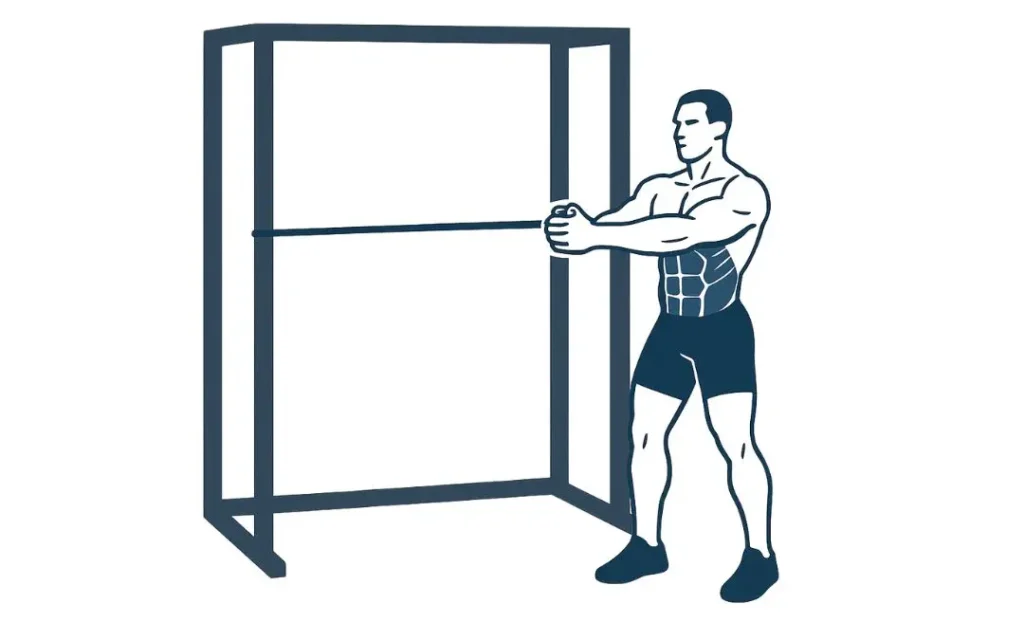
To begin, you need a cable machine or a resistance band anchored to a fixed point at chest height. If using a resistance band, make sure it is taut enough to create resistance when stretched. Stand perpendicular to the resistance source, feet hip-width apart.
2. Body Positioning
Grip the handle (or band) with both hands. Stand upright with knees slightly bent and feet firmly planted on the ground. Your hips, knees, and shoulders should be aligned, which will allow you to remain stable throughout the movement. Keep a neutral spine – avoid excessive arching in the lower back – and engage your core from the very start.
3. Executing the Movement
The Pallof Press movement itself is relatively simple: from the starting position, extend your arms straight in front of you, resisting the force that tries to rotate your body toward the resistance source. The key is not to let your trunk move or twist. Once your arms are fully extended, hold the position for a few seconds before slowly bringing your hands back to your chest.
4. Controlled Breathing
Breathing plays a key role in executing the Pallof Press. Inhale as you bring your hands back to your chest, and exhale as you extend your arms. This helps you maintain control of the movement and sustain continuous abdominal contraction.
5. Repetitions
Perform 10 to 15 repetitions per side. You can adjust the band tension or cable load according to your level. For maximum strength gains, aim for 3 to 4 sets, alternating sides between sets.
Common Pallof Press Mistakes to Avoid
Even though the Pallof Press looks simple, several mistakes can limit its effectiveness or increase injury risk, just as with a cable crunch. Here are the most frequent errors to avoid when performing this exercise.
1. Failing to Engage the Core
The first common mistake is not engaging the abdominal muscles sufficiently. If you release the tension in your core, you lose a large part of the exercise’s benefits and risk placing too much stress on the lower back. Make sure to contract your abs from the start of the movement and maintain that contraction throughout the exercise.
2. Rotating the Body
The goal of the Pallof Press is to resist rotation, not to allow it. If you let your hips or shoulders turn toward the resistance source, you are not performing the exercise correctly. Focus on maintaining a stable position with your shoulders and hips perfectly aligned.
3. Using Too Much Weight or Resistance
A frequent mistake is increasing the load or resistance too quickly. Start with a light load or a low-resistance band to properly master the movement. The goal is to train stability, not to lift heavy weights. If the resistance is too high, you risk recruiting other muscles such as the shoulders or back instead of the abs.
4. Poor Foot Position
Foot placement plays a crucial role in overall stability during this exercise. If your feet are too close together, you will struggle to stay balanced. Make sure your feet are hip-width apart for a solid base and better resistance to rotational forces.
Conclusion
The Pallof Press is far more than a simple ab exercise. It is a functional movement that strengthens the stability of your entire core, improves posture, and prevents injuries – especially in the lower back. By adding the Pallof Press to your training program, you will not only work your core musculature but also optimize your overall athletic performance.