
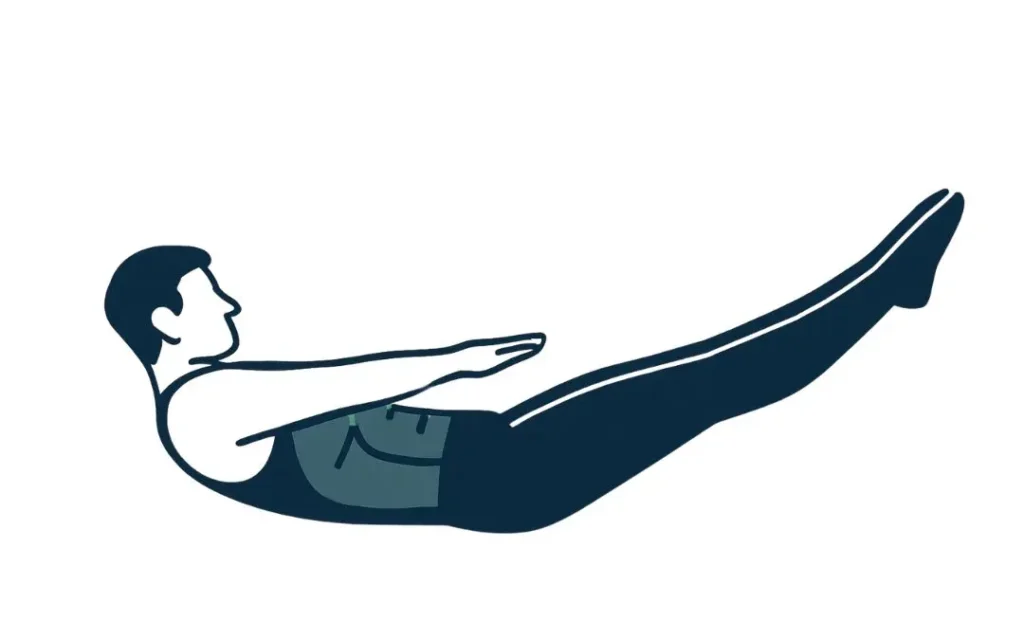
The hollow hold is one of those essential exercises for building powerful abs and developing core stability. Used by gymnasts and strength coaches alike, this bodyweight movement is remarkably effective for strengthening the trunk. In this article, we break down every aspect of the hollow hold so you can add it to your training routine and get the most out of it.
Exercise technique
The hollow hold is a core bracing exercise that, despite looking simple, demands precise technical execution to deliver optimal results. The position involves maintaining a hollow-body shape by balancing the contraction of all trunk muscles while avoiding lumbar extension.
To perform the hollow hold correctly, lie on your back with arms extended overhead and legs straight out in front of you. Then contract your abs, lift your legs and shoulders slightly off the floor, and create a gentle curve with your body – as if you were forming a hollow shell. The goal is to keep your lower back pressed against the floor, which ensures continuous tension on the abs.
You can also try the deadbug to strengthen your abs.
Program or coaching?
Find your ideal format
Answer 4 questions and receive a personalized recommendation based on your level and goals.
Tailored result
Free
Muscles targeted
Like the Pallof press, the hollow hold is a complete abdominal exercise – but it engages far more than just the abs. By holding the position, you work:
- Rectus abdominis: The most visible abdominal muscle and the primary target of the hollow hold.
- Internal and external obliques: Less heavily loaded than the rectus abdominis, but essential for stabilizing the posture.
- Deep trunk muscles: These are the stabilizer muscles – such as the transverse abdominis – that play a crucial role in holding the position.
- Hip flexors: Notably the psoas, which lifts the legs and keeps them extended.
- Shoulder stabilizers: Keeping the arms extended also engages the deltoids and rotator cuff muscles.
What are the benefits of the hollow hold?
Like the cable crunch, the benefits of the hollow hold go well beyond ab strengthening. Here are the main advantages of this core bracing exercise:
Improved core strength: Core strength is crucial for athletic performance and everyday movement. The hollow hold strengthens not only the abs but also the deep muscles, delivering gains in power and stability for movements like squats, deadlifts, and even running.
Better stability and coordination: The hollow hold demands perfect coordination between the upper and lower body. By holding the position, you learn to activate multiple muscle groups simultaneously, which improves neuromuscular connection and coordination. The stability you build here benefits every type of athletic movement.
Lower back pain prevention: By strengthening the trunk stabilizer muscles, the hollow hold reduces tension on the spine, lowering the risk of lower back pain. The deep abdominals play a protective role by taking load off the lumbar spine during carrying movements.
How to do a hollow hold?
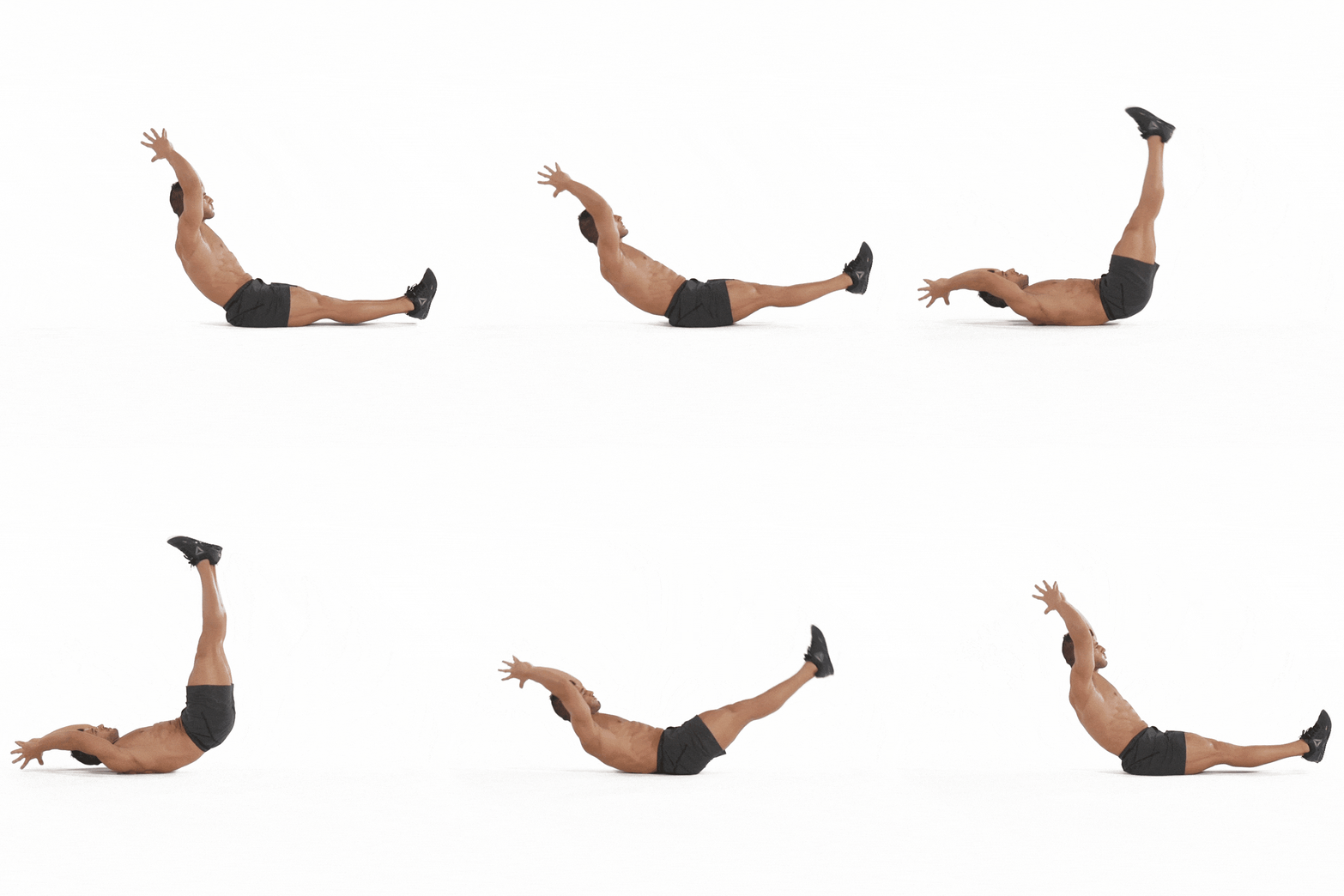
Now that you know the benefits and the muscles involved, let’s go through how to perform the hollow hold step by step.
- Lie on your back: Start by lying flat, arms extended overhead and legs straight on the floor.
- Brace your abs: Take a deep breath in, then contract your abs to press your lower back into the floor. This is essential for maintaining a stable position.
- Raise your legs and shoulders: Without arching your back, lift your legs slightly (roughly 30 degrees off the floor) and raise your shoulders. Your arms stay extended, following the line of your body.
- Hold the position: Maintain this position with your lower back glued to the floor. Your body should form a gentle curve.
- Control your breathing: Breathe in and out steadily to stay focused. Each breath should accompany the muscular contraction.
Beginners are advised to hold the position for 20 to 30 seconds, then progressively increase the duration. The longer you can sustain the hollow hold, the more your core endurance and abdominal strength will develop.
Common mistakes to avoid for better progress
Success with the hollow hold comes down to precise execution. Here are the most frequent errors to avoid so you don’t slow your progress.
Arching the lower back: Your lower back must stay pressed against the floor at all times. Excessive arching reduces the effectiveness of the exercise and can cause lower back pain. Always brace your abs first to prevent this mistake.
Raising the legs too high: For beginners, lifting the legs too high can feel easier, but it actually reduces tension on the abs. Keep your legs extended at roughly 30 degrees off the floor to maximize the contraction.
Forgetting to breathe: Many people hold their breath during the hollow hold, which is counterproductive. Breathing keeps your rhythm and helps you stay focused. Breathe in and out steadily to keep your muscles oxygenated.
Coach’s conclusion
The hollow hold is an essential exercise for developing solid abs and improving core stability. Its apparent simplicity should not fool you: it actually demands significant muscular control and discipline to produce real results. Whether you’re looking to improve your posture, strengthen your core, or simply boost your athletic performance, the hollow hold is an excellent addition to your training routine.