
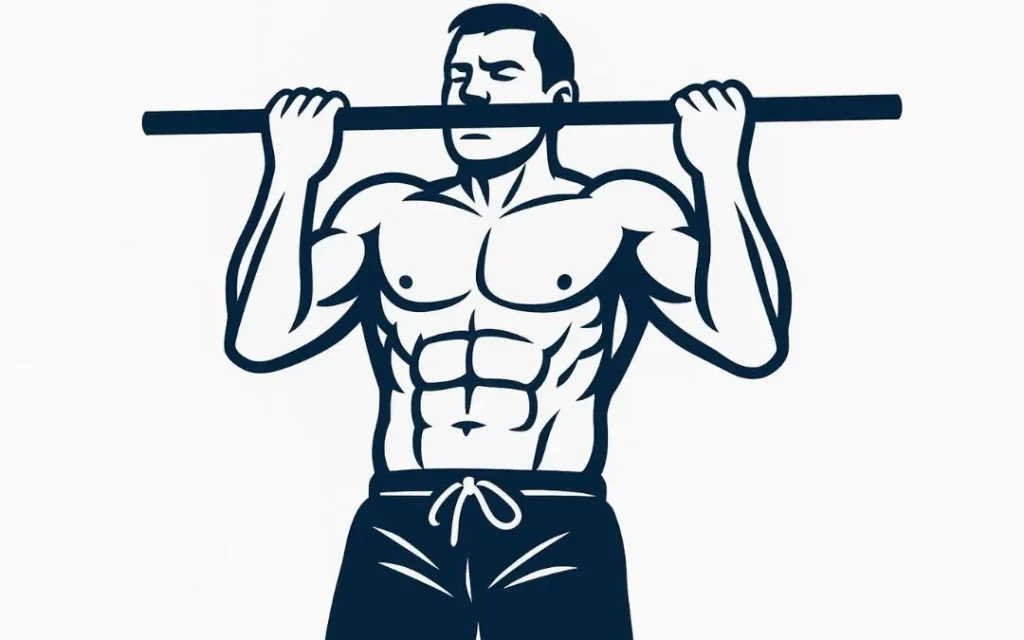
The chin-up biceps, also called the supinated pull-up, is one of the most effective exercises for developing both arm strength and arm size. A star movement in streetlifting and a cornerstone of bodyweight training, it places intense demand on the biceps while also strengthening the back and core. Whether you are a beginner or an experienced athlete, mastering this movement will allow you not only to build powerful arms but also to boost your overall pull-up performance. In this guide, discover the perfect technique, the muscles targeted, and a concrete program to progress fast.
What is the chin-up biceps?
The chin-up biceps is a pull-up variant performed with a supinated grip (palms facing you) that is particularly effective at targeting the biceps while also working the back. Unlike the classic pronated pull-up, this grip allows a greater range of elbow flexion, which increases recruitment of the biceps brachii and brachioradialis.
It is an essential movement in both strength training and streetlifting, valued equally for strength and aesthetics.
The difference between a pronated pull-up and a supinated pull-up
-
Pronated pull-up: palms facing forward, emphasis on the latissimus dorsi, trapezius, and rhomboids. Less direct biceps involvement.
-
Supinated pull-up (chin-up): palms facing you, arms slightly closer together, strong biceps activation while also working the back.
Tip: if your main goal is biceps development, prioritize a strict, controlled supinated grip with no momentum.
Program or coaching?
Find your ideal format
Answer 4 questions and get a personalized recommendation based on your level and goals.
Tailored result
Free
How to do chin-ups
-
Starting position: grip the bar with a supinated grip at shoulder width, palms facing you.
-
Core bracing: engage your abs and lock your lower back to prevent swinging.
-
Pull: rise by driving your elbows down and toward your chest, pulling your chest toward the bar.
-
Control: lower yourself slowly back to near-full arm extension.
-
Breathing: inhale at the bottom, exhale on the way up.
Muscles worked
-
Biceps brachii (short head and long head)
-
Brachialis
-
Brachioradialis
-
Latissimus dorsi
-
Trapezius and rhomboids
-
Core stabilizers
Tips to master the chin-up biceps
-
Work your grip strength: use a tighter grip for better muscle recruitment.
-
Bodyweight progression first: nail clean reps before adding weight.
-
Controlled tempo: 2 seconds up, 3 seconds down to maximize time under tension.
-
Full range of motion: avoid partial reps that limit progress.
-
Vary your grips: close supinated, neutral, or wide supinated to recruit muscle fibers differently.
Sample training plan to progress in chin-up biceps
| Exercise | Sets | Reps | Rest |
|---|---|---|---|
| Strict supinated chin-up | 4 | 6-8 | 2 min |
| Weighted chin-up | 4 | 4-6 | 3 min |
| Neutral-grip pull-up | 3 | 8-10 | 2 min |
| EZ-bar curl | 3 | 10-12 | 1 min 30 |
| Dead hang core hold | 3 | 30-40 sec | 1 min |
In streetlifting, the chin-up is a foundational movement practiced with added weight to build maximum strength. Progressively loading the bar (2.5 kg, 5 kg, then 10 kg and beyond) lets you move beyond pure muscular endurance and build massive biceps. The ideal training range is 4 to 8 reps with an appropriate load, following our streetlifting program or our weighted pull-up program.
Coach’s conclusion
The chin-up biceps is far more than a simple arm exercise: it is a complete movement that combines strength, hypertrophy, and aesthetics. Mastering the technique, progressing intelligently with added weight, and integrating this exercise into a structured program will allow you to push past your limits and blow up your performance.
As always, prioritize execution quality over quantity. In streetlifting as in classic strength training, consistency is what builds results.
Explore other exercises to build your biceps
- Seated dumbbell curl: for big arms
- Low-cable biceps curl
- Hammer curl
- Preacher curl
- Incline dumbbell curl
- Concentration curl
- Barbell curl
- Spider curl