
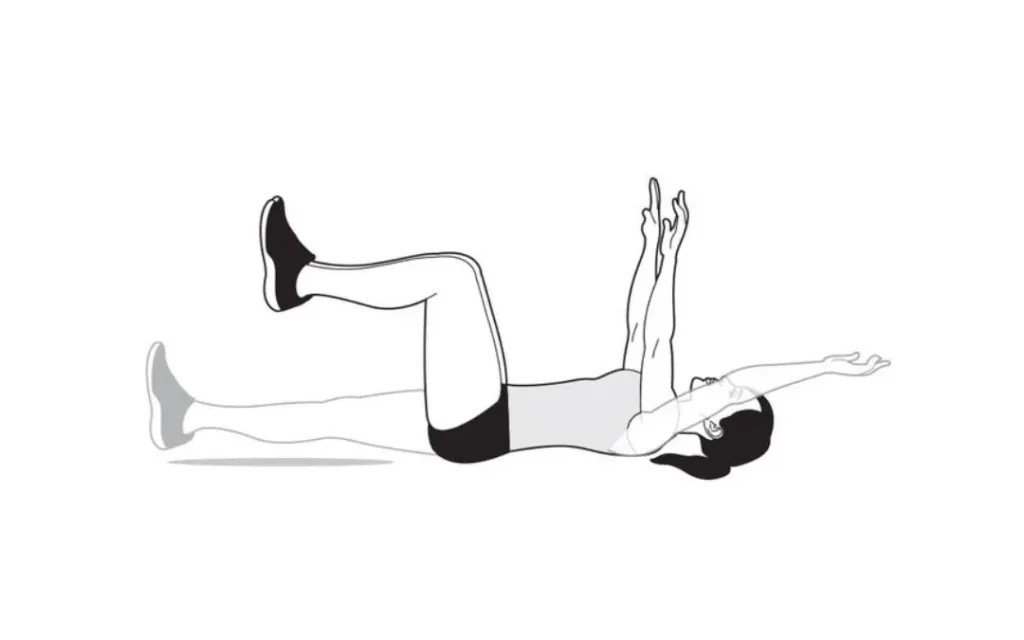
The Deadbug is a dynamic core exercise particularly effective for strengthening the abdominal muscles. Used in both rehabilitation and physical preparation, it trains the deep trunk muscles while improving overall body stability. Easy to perform, it adapts to all fitness levels and minimizes injury risk.
How to Perform the Deadbug
Here are the steps to correctly execute the Deadbug:
-
Starting position: Lie on your back with arms extended toward the ceiling and legs raised, knees bent at 90 degrees.
-
Core engagement: Contract your abdominals, pressing your lower back flat against the floor.
-
Controlled movement: Slowly lower one arm behind your head while extending the opposite leg forward, without letting either touch the floor.
-
Return to start: Bring both limbs back to the starting position in a controlled manner.
-
Repeat by alternating sides, without rushing.
For optimal results, perform 3 to 4 sets of 10 to 15 repetitions while maintaining good posture throughout.
Program or coaching?
Find your ideal format
Answer 4 questions and receive a personalized recommendation based on your level and goals.
Tailored result
Free
Muscles Targeted
The Deadbug engages several muscle groups, including:
-
Deep abdominals: The transverse abdominis and obliques, which stabilize the trunk.
-
Rectus abdominis: Known as the « six-pack » muscle.
-
Hip flexors: Involved in the leg movement.
-
Back stabilizers: Essential for preventing lower-back pain.
Why Do the Deadbug to Strengthen Your Abs?
The Deadbug is a foundational exercise for core strengthening, offering several key benefits:
-
Improved core stability: It promotes deep abdominal strengthening without placing excessive stress on the spine.
-
Lower-back pain prevention: By training the back stabilizer muscles, it helps protect the lumbar region.
-
Better posture: A solid abdominal belt contributes to overall better body alignment.
-
Functional training: The alternating arm-leg pattern mirrors natural movement patterns essential for coordination and balance.
Easy to integrate into any training program, it can be used both as a warm-up and as a main exercise.
Common Mistakes to Avoid
Although the Deadbug is accessible to most people, some common errors can reduce its effectiveness or cause discomfort:
-
Arching the lower back: If your lower back lifts off the floor, the exercise loses effectiveness and can create unnecessary tension.
-
Moving too fast: A poorly controlled Deadbug limits muscle engagement and can lead to imbalances.
-
Incorrect breathing: Holding your breath reduces trunk stability. Remember to inhale as you lower and exhale as you return.
-
Excessive range of motion: It is better to limit the movement than to lose abdominal tension.
Coach’s Conclusion
The Deadbug is a must-have exercise for anyone looking to strengthen their core effectively and safely. Suitable for all levels, it integrates easily into a training program and makes an excellent complement to other core stability exercises. For best results, pair it with proper breathing and controlled execution. Ready to try this movement and improve your stability?