
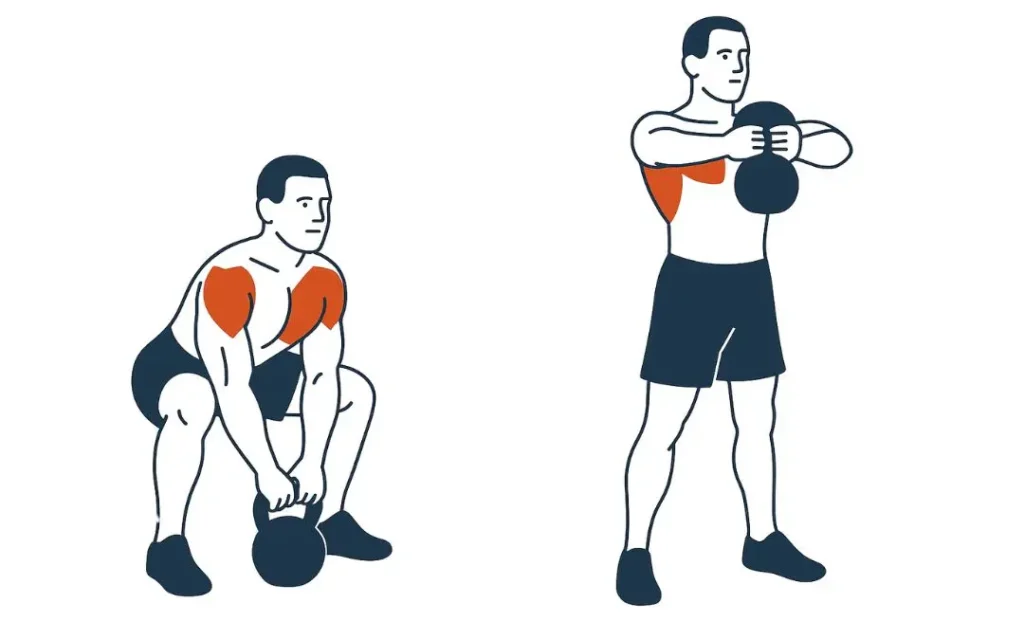
The kettlebell sumo squat is an essential exercise for fitness enthusiasts, athletes, and anyone looking to strengthen their body comprehensively. This movement combines strength, balance, and mobility for an intense and complete muscular workout. If you want to optimize your training sessions while minimizing the risk of injury, this move is for you. But how do you perform it correctly? Which muscles does it work, and what benefits does it offer? Here is everything you need to know to master the sumo squat with a kettlebell.
How to perform the kettlebell sumo squat
To execute a kettlebell sumo squat correctly, follow these precise steps:
-
Starting position:
-
Hold a kettlebell with both hands, handles pointing down, between your legs.
-
Place your feet wider than shoulder-width apart, toes turned slightly outward.
-
-
Execution:
-
Engage your core to protect your lower back.
-
Slowly descend by bending your knees and pushing your hips back, as if you were sitting down on an imaginary chair.
-
Keep the kettlebell close to your body and your knees aligned with your toes.
-
Drive through your heels to return to the standing position.
-
-
Breathing:
-
Inhale on the way down, exhale on the way up to stabilize your body.
-
Coach tip: Focus on a smooth, controlled movement – the same quality you bring to a classic squat or a belt squat.
Program or coaching?
Find your ideal format
Answer 4 questions and receive a personalized recommendation based on your level and goals.
Tailored result
Free
Muscles targeted
The kettlebell sumo squat is a multi-joint exercise that engages many muscles, including:
-
Quadriceps: Located at the front of the thighs, these are the primary drivers during the push phase.
-
Glutes: The gluteus maximus is strongly activated to propel the hips forward.
-
Adductors: The sumo stance increases engagement of the inner thigh muscles.
-
Hamstrings: Located at the back of the thighs, they help stabilize the movement.
What are the benefits of using a kettlebell in a sumo squat?
Using a kettlebell for a sumo squat offers many benefits:
Its ergonomic shape allows a natural grip and promotes a greater range of motion, which improves technique and limits injuries – especially for beginners.
This exercise not only strengthens the muscles used in everyday movements, but also engages the trunk stabilizers for better balance, just like an air squat.
Easily adaptable to all levels thanks to varied weights, the kettlebell also allows you to combine different exercises.
Mistakes to avoid to prevent injury
Poor alignment or inadequate posture can turn a beneficial exercise into a source of pain. Here are the most common mistakes and how to correct them:
Knee position:
-
Mistake: Knees caving inward during the descent.
-
Fix: Make sure they always follow the alignment of your toes. Engage the adductors to stabilize the position.
Rounded back:
-
Mistake: Allowing the back to round.
-
Fix: Maintain a neutral spine by contracting your core and keeping your chest proud.
Poor kettlebell grip:
-
Mistake: Gripping the kettlebell too loosely or too low.
-
Fix: Use a firm, stable grip to prevent slipping.
Insufficient range of motion:
-
Mistake: Only descending halfway.
-
Fix: Work on your flexibility to achieve a deep, effective descent.
Wrong load:
-
Mistake: Choosing a weight that is too heavy or too light.
-
Fix: Start with a moderate load and increase it progressively over your sessions.
Coach’s conclusion
The kettlebell sumo squat is a versatile and powerful exercise, ideal for strengthening the lower body and core. By practicing it regularly, you will develop strength, stability, and mobility, while preventing injuries through correct posture.
Start Here
- Streetlifting Program
- Weighted Muscle Up Program
- Weighted Pull-Up Program
- Weighted Dip Program
- Squat Program