
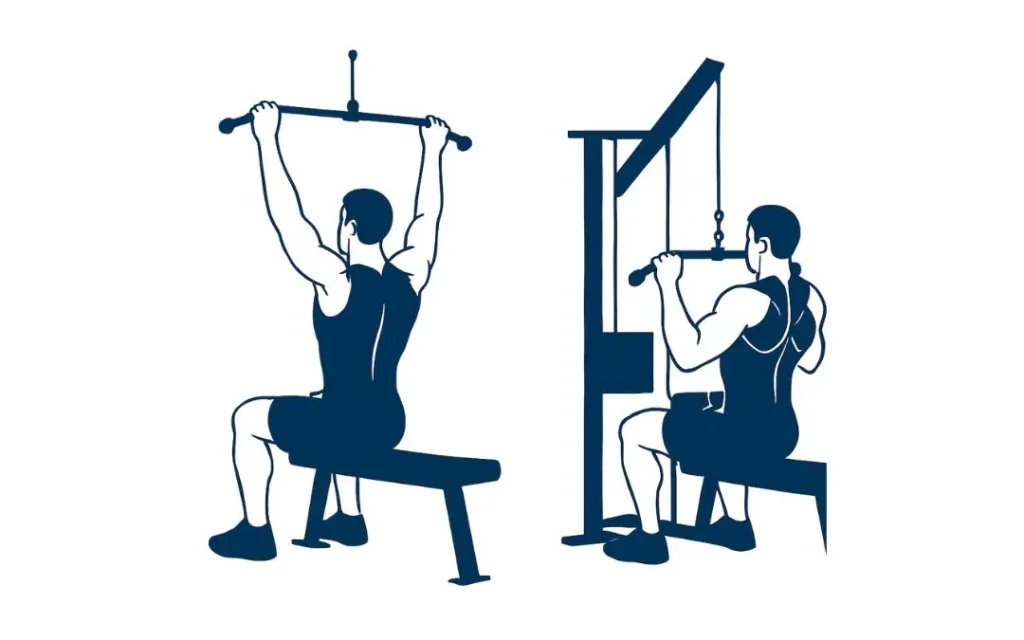
What is the lat pulldown?
The lat pulldown is a strength-training exercise used primarily to build back muscles. It is typically performed on a cable machine with a high pulley, where the user pulls a bar downward from a seated position – arms extended overhead – until the bar reaches chest or neck height. The movement mimics the pull-up pattern but offers more control and adjustable resistance.
The lat pulldown is a compound, multi-joint exercise, meaning it recruits several muscle groups at the same time. It is an excellent way to develop back thickness and width while improving functional strength and posture. Because it is performed seated, it is also more accessible than pull-ups for beginners or anyone who struggles to lift their own bodyweight.
Which muscles does the lat pulldown work?

The lat pulldown is especially effective at targeting the entire posterior muscle chain, and in particular the back muscles. Here are the primary muscles activated during this exercise:
Latissimus dorsi
This is the primary muscle worked in the lat pulldown. It is responsible for the width of the back and plays a key role in shoulder adduction, extension, and internal rotation.
Trapezius
The trapezius – especially the lower and middle fibers – stabilizes the shoulders throughout the movement and assists in pulling the bar downward.
Rhomboids
Located between the shoulder blades, the rhomboids are activated to retract and stabilize the scapulae during the exercise.
Biceps
Although the lat pulldown is primarily a back exercise, the biceps are also heavily recruited during elbow flexion as the bar is pulled down.
Teres major
This muscle assists in arm adduction and extension, working in synergy with the latissimus dorsi.
What are the benefits of the lat pulldown?
This exercise offers numerous benefits for both beginners and experienced athletes, which is why it appears in most back-training programs. One of its primary advantages is its contribution to back width development. By heavily loading the latissimus dorsi, it helps build the V-taper silhouette that athletes prize. Additionally, by strengthening back muscles – particularly the trapezius and rhomboids – the lat pulldown helps correct muscular imbalances, significantly improving posture and reducing the risk of back pain often caused by poor alignment.
Another major strength of the lat pulldown is its scalability. Unlike pull-ups, which require you to lift your own bodyweight, this exercise lets you adjust the load to match your current level, making it accessible to everyone, including beginners. Furthermore, by reinforcing the back muscles and improving shoulder stability, it plays a key role in injury prevention, particularly for issues related to the lower back or shoulders.
Finally, the lat pulldown is not limited to back work alone. It also recruits the biceps, making it an excellent complementary exercise for anyone looking to strengthen their arms while optimizing overall physique and functional strength.
Lat pulldown variations

There are several variations of the lat pulldown, each targeting the back and arm muscles from a slightly different angle. Here are the main variations you can incorporate into your training program to vary the stimulus and prevent monotony.
Front lat pulldown (to the chest)
The front lat pulldown is the most common form of this exercise. It involves pulling the bar down to the upper chest while keeping the back straight and the shoulder blades squeezed together. This variation emphasizes the latissimus dorsi and allows for optimal muscle contraction.
- Technique: Sit on the machine with your thighs locked under the support pads. Grip the bar wide with your palms facing forward. Keeping your back straight, pull the bar down to your upper chest while contracting your back muscles. Pause at the bottom of the movement, then return slowly to the starting position.
Behind-the-neck pulldown
The behind-the-neck pulldown is a variation where the bar is pulled behind the head to neck level. Although it also works the latissimus dorsi, this version is often criticized for the stress it places on the shoulders and cervical spine.
- Benefits: This variation can more intensely recruit certain areas of the back, particularly the trapezius and rhomboids.
- Risks: However, it carries a higher risk of injury to the shoulders and cervical spine. It is therefore not recommended for anyone with limited mobility or shoulder pain.
Close-grip lat pulldown
The close-grip lat pulldown involves bringing your hands closer together on the bar, which changes the pulling angle and places greater emphasis on the lower lats and arms.
- Technique: Grip the bar with a narrow grip, hands shoulder-width apart or closer. Pull the bar to your chest while keeping your back straight. This variation places more emphasis on the biceps and lower back, offering an interesting alternative to the standard pulldown.
Underhand (supinated) grip lat pulldown
The underhand lat pulldown involves placing the hands in a supinated position (palms facing you). This variation recruits the biceps more heavily while still effectively engaging the latissimus dorsi.
- Technique: Sit on the machine and grip the bar underhand with your palms facing you and hands shoulder-width apart. As you pull the bar to your chest, make sure to contract both your back and arm muscles fully.
Single-arm lat pulldown
The single-arm lat pulldown is performed with a handle attachment, allowing you to work one side of the body at a time. This makes it possible to correct muscular imbalances and focus more precisely on muscle contraction.
- Benefits: This variation is ideal for anyone wanting to isolate one side of the back or strengthen a weaker muscle group, improving overall muscular symmetry.
How to program the lat pulldown
The lat pulldown is a versatile exercise that fits easily into various training programs – including a streetlifting program – whether you are a beginner or an advanced athlete. Here are some tips for incorporating it effectively into your routine:
- Frequency: For best results, perform the lat pulldown 1-2 times per week, pairing it with other back exercises such as weighted pull-ups, rows, or deadlifts.
- Sets and reps: For muscle hypertrophy, do 3-4 sets of 8-12 reps with a moderate-to-heavy load. If your goal is strength, opt for shorter sets (4-6 reps) with a heavier load.
- Combining with other exercises: The lat pulldown pairs well with horizontal pulling exercises (such as rows or face pulls) for a comprehensive back workout.
Common mistakes to avoid
To avoid injury during the lat pulldown, it is crucial to engage your back muscles rather than pulling with your arms, making sure to properly retract your shoulder blades. You should also maintain an upright posture without rounding your back, keeping your chest up and out. Using a load appropriate to your level is essential to preserve good technique. In addition, control the eccentric (negative) phase of the movement and avoid pulling the bar too high or too low to prevent incorrect loading of the muscles and joints.
Conclusion
The lat pulldown is an essential exercise for anyone looking to develop their back effectively. By recruiting a variety of muscles – notably the latissimus dorsi, trapezius, and biceps – it improves not only strength and posture but also overall muscular balance. With its many variations, the lat pulldown can be adapted to different levels and goals, whether for hypertrophy, strength development, or correcting imbalances.
Program or coaching?
Find your ideal format
Answer 4 questions and receive a personalized recommendation based on your level and goals.
Tailored result
Free
More exercises to train your back