The standing leg curl is a highly effective isolation exercise for the hamstrings. Less well-known than its lying or seated counterparts, it offers real advantages for strengthening the back of the thighs, improving muscular balance, and preventing injuries. Whether you train in the gym or compete in streetlifting, adding the standing leg curl to your program can make a genuine difference.
Start Here
- Streetlifting Program
- Weighted Muscle Up Program
- Weighted Pull-Up Program
- Weighted Dip Program
- Squat Program
How to Do the Standing Leg Curl Correctly
Mastering the technique of the standing leg curl is essential to get all its benefits and avoid common mistakes. Here is what you need to know for optimal execution.
The Standing Leg Curl Machine
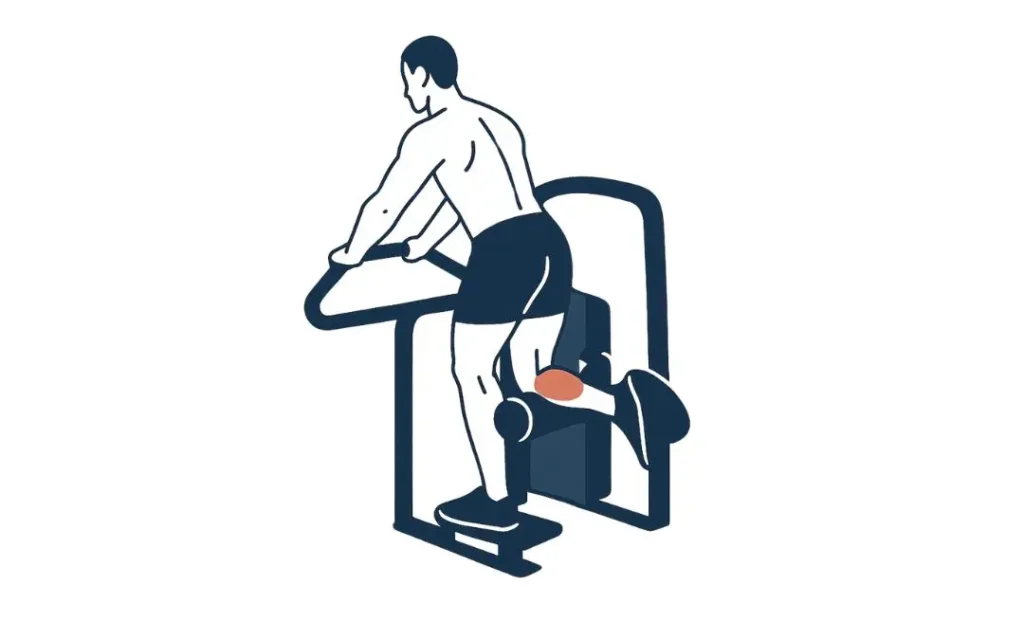
The standing leg curl is performed on a dedicated machine found in most gyms. This machine is designed to isolate one leg at a time, enabling very effective unilateral work.
It consists of a vertical support with a pad to brace the torso and an ankle strap for the working leg. The free leg performs the flexion movement while the rest of the body stays completely stable.
Coach tip: start with a moderate load, then increase it progressively to maintain good movement quality.
Standing Leg Curl Execution
Executing the standing leg curl requires control and concentration:
- Starting position: Stand facing the machine with your torso slightly leaning forward, one leg anchored behind the roller.
- Flexion: Bend the knee by contracting the hamstring until you reach roughly a 90-degree angle.
- Return: Slowly lower back to the starting position, controlling the descent.
Keep your hips stable throughout the movement.
Avoid jerky movements or unnecessary momentum.
Program or coaching?
Find your ideal format
Answer 4 questions and receive a personalized recommendation based on your level and goals.
Tailored result
Free
Muscles Worked
The standing leg curl primarily targets the hamstrings, a muscle group located at the back of the thigh, made up of:
- Biceps femoris (long and short heads)
- Semitendinosus
- Semimembranosus
Secondarily, the exercise also activates:
- Calves (gastrocnemius) to stabilize the movement
- Glutes, particularly at the peak of the contraction
Difference Between Standing Leg Curl and Other Leg Curl Variations
There are several leg curl variations, each with its own characteristics. Here is how they compare:
| Variation | Position | Main characteristic |
|---|---|---|
| Standing leg curl | Standing, unilateral | Better unilateral control and more functional engagement |
| Seated leg curl | Seated, bilateral | More pronounced hamstring stretch, comfortable |
| Lying leg curl | Prone on a bench | Constant tension but more stress on the lower back |
| Swiss ball leg curl | Lying on the floor, no machine | Bodyweight variation, excellent for stability |
Adding the Standing Leg Curl to Your Training Program
The standing leg curl can be integrated into many programs, whether the goal is muscle gain, cutting, or injury prevention.
Programming examples by goal:
- Strength and performance: 4 sets of 6-8 reps, heavy load, slow tempo.
- Hypertrophy: 3-4 sets of 10-12 reps, moderate load, maximum contraction.
- Rehabilitation or imbalance correction: 2-3 sets of 15-20 reps, light load, strict unilateral work.
Prioritize this exercise at the end of a leg session, after compound movements such as squat or hip thrust, to fully isolate the hamstrings.
Bonus tip: regularly rotate between leg curl variations to avoid plateaus and stimulate muscle fibers from different angles.
Coach’s Conclusion
The standing leg curl is an often underestimated exercise, but extremely effective for strengthening the back of the thighs. Its unilateral nature makes it a valuable tool for correcting asymmetries and preventing injuries. Performed correctly and intelligently placed in your routine, it will help you build powerful, balanced, and well-defined hamstrings.
Do not overlook the importance of these muscles in your overall program: they play a key role in athletic performance, posture, and injury prevention.