
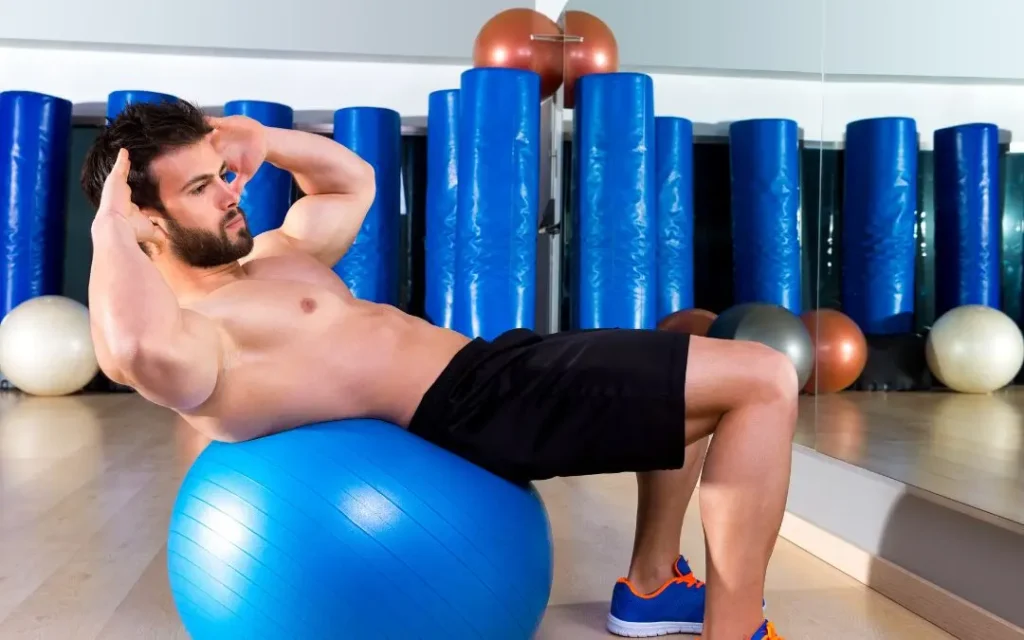
The Swiss Ball Crunch is an excellent exercise for working the abdominals in depth while engaging the trunk stabilizer muscles. Thanks to the instability of the ball, this movement is more effective than a classic crunch performed on the floor. In this article, we will look in detail at how to correctly perform this strength exercise, the muscles targeted, its benefits, and the mistakes to avoid.
How to Do Swiss Ball Crunches
The Swiss Ball Crunch is accessible to everyone, as long as you follow the correct technique. It requires only a Swiss ball – an essential piece of equipment for bodyweight strength training.
Exercise Technique
Here are the steps to perform a Swiss Ball Crunch safely:
-
Starting position:
- Sit on the ball and slowly walk your feet forward, letting your back extend over the ball.
- Feet flat on the ground, hip-width apart, knees bent at 90 degrees.
- The lower back rests on the ball, shoulder blades slightly behind the top of the ball.
-
Movement execution:
- Place your hands behind your head or cross them on your chest.
- Engage your abs by drawing in your navel and lift your torso upward.
- Do not pull on your neck with your hands. The movement must originate from the rectus abdominis.
- Lower back down slowly while maintaining control, without fully releasing the tension in your back.
-
Breathing:
- Exhale as you rise.
- Inhale as you lower back down.
Program or coaching?
Find your ideal format
Answer 4 questions and get a personalized recommendation based on your level and goals.
Tailored result
Free
Targeted Muscles
The Swiss Ball Crunch is a targeted exercise that activates several muscle groups, in particular:
- Rectus abdominis: the primary abdominal muscle, responsible for trunk flexion.
- Obliques: stabilize the movement and can be further engaged by adding a rotation.
- Transverse abdominis: a deep muscle that acts as a natural abdominal belt.
- Trunk stabilizers: notably the lower back and glutes, which maintain balance on the ball.
What Are the Benefits of Swiss Ball Crunches?
Doing crunches on a Swiss Ball offers many advantages for improving your fitness and building a strong core:
- Greater range of motion: compared to floor crunches, the back can extend further, allowing for a deeper stretch and better abdominal contraction.
- Core strengthening: the instability of the ball forces the deep muscles to work to maintain balance.
- Lower back pain prevention: when performed correctly, this exercise places less stress on the spine than a traditional crunch.
- Accessibility and simplicity: all you need is a ball and a little space. Suitable for beginners and advanced athletes alike.
- Easy progression: you can increase the difficulty by adding weight, adjusting the tempo, or incorporating rotations.
Mistakes to Avoid to Prevent Injury
As with any strength exercise, poor execution can lead to pain or injury. Here are the main mistakes to avoid:
- Pulling on the neck: this is one of the most common mistakes. Keep your elbows open and use your abs to rise, not your arms.
- Using momentum: the movement must be slow and controlled, maintaining constant muscular tension.
- Placing the ball too low or too high: it should sit under the lower back, not under the glutes or shoulder blades.
- Arching the back on the way down: keep the lower back in contact with the ball and do not let the rib cage flare open excessively.
- Forgetting to breathe: breathing is essential for supporting the effort and avoiding unnecessary tension.
Coach’s Conclusion
The Swiss Ball Crunch is one of the best exercises for strengthening the abs in a functional way. It not only improves core tone but also trunk stability and overall posture. Whether you are a beginner or an advanced athlete, this exercise should be part of your training routine.
Take the time to master the technique, stay consistent, and listen to your body. Remember that strong abdominals are the foundation of every powerful movement, whether that’s streetlifting, CrossFit, or calisthenics.