
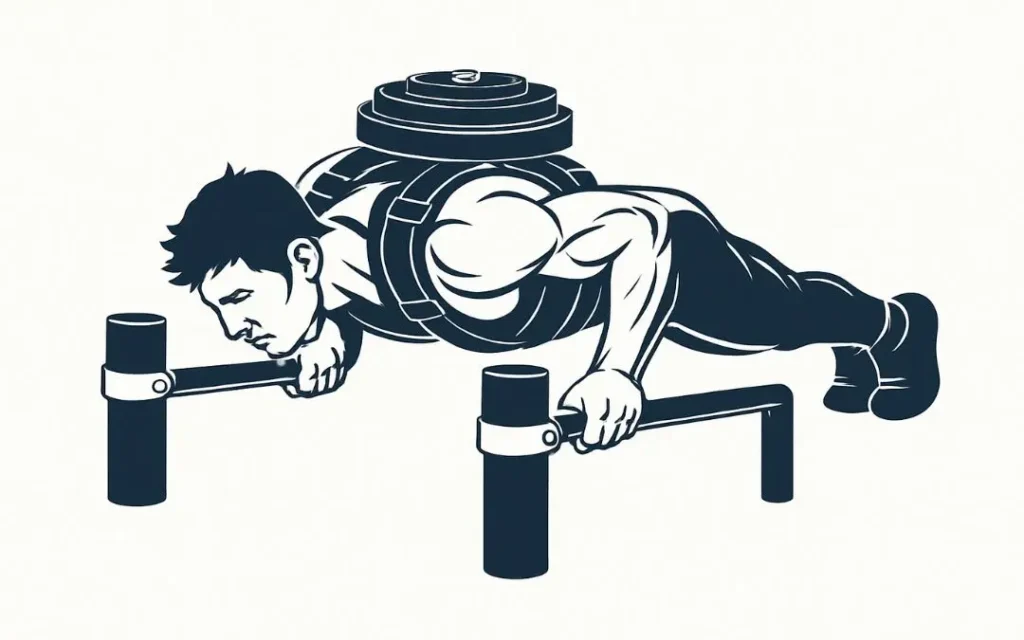
Looking for a new way to build strength? A weighted push-up program might be exactly what you need. Simple yet effective, this method helps you progress faster by adding load to a movement you already know. Adding weight forces new muscles into action, session after session boosting your power and endurance.
That said, this training is accessible to all levels but must follow a progressive approach to prevent injuries and lock in lasting gains.
Why Add Weighted Push-Ups to Your Training?
Classic push-ups are an excellent exercise, but their effectiveness quickly plateaus. After many repetitions, the body adapts and progress slows down. Adding weight restarts muscle stimulation and breaks through that ceiling.
The benefits are numerous: increased strength and muscle volume, better endurance, improved core stability, and better posture.
Weighted push-ups also efficiently prepare the body for more demanding disciplines by building greater overall resistance.
For athletes who want to progress quickly and avoid technical errors, working with a sports coach can be very valuable. An outside perspective helps adapt the load, correct posture, and structure an effective, safe program.
Program or coaching?
Find your ideal format
Answer 4 questions and get a personalized recommendation based on your level and goals.
Tailored result
Free
Weighted Push-Up Program: Equipment Preparation and Safety
Before you start, you need to prepare your space and equipment properly. First and foremost, use a stable, non-slip surface to minimize the risk of slipping during the movement. Also have a comfortable mat on hand to protect your hands and knees.
A weighted vest is ideal and offers the best weight distribution across your torso. You can also use a backpack loaded with weight plates or water bottles. Check your equipment regularly to prevent accidents.
For safety, warm up before every session. A few minutes of light cardio and joint mobilization exercises are enough to prepare your muscles and joints for the effort.
During your first sessions, use a very light load. Observe your technique and make adjustments. Concretely, hands should be placed at shoulder width, body straight without arching the lower back.
If you feel unusual pain, stop immediately. Small warning signals matter, especially discomfort in the wrists or shoulders. Also make sure you have mastered the movement before adding weight – it is better to be able to do twenty clean push-ups with perfect form before loading your body.
If possible, have a training partner monitor your form. Stay well hydrated throughout the session, as hydration supports recovery and reduces the risk of cramps or injuries.
How to Organize a Weighted Push-Up Program

Setting up a structured program allows you to progress quickly while protecting your body. A good program must always start with an honest assessment of your current abilities.
Assessment and Frequency
Start with a simple test. Attempt five repetitions with your target load. If you complete them without difficulty, you can increase the weight next session. On the other hand, if the movement becomes too hard, reduce the load immediately.
Organize your week with two to three sessions spaced at least 48 hours apart. This rhythm gives your muscles time to recover without accumulating fatigue. For beginners, two sessions per week is more than enough to get started. More advanced athletes can aim for three sessions while staying attentive to fatigue signals.
Choosing Volume and Sets
Adapting your training volume is essential for progress. The goal is not to exhaust yourself completely each session, but to stimulate strength and endurance progressively. Three to four sets of eight to twelve repetitions is a solid starting point, with the exact choice depending on your level and the intensity of the load.
The last repetition of each set should be challenging but still executed with perfect technique – if your form breaks down, the weight is too heavy and must be adjusted. Between each set, take the time to recover fully, generally one to two minutes. Progressively, you can increase the weight or the number of repetitions, always respecting how you feel and without rushing.
Session Structure: Execution, Recovery, and Tips

For each weighted push-up session, start with a general warm-up. Then perform three warm-up sets with the lightest possible load. Move to your main sets and hit the planned rep count. Keep a slow tempo: lower yourself over two seconds and push back up in one second.
This rhythm maximizes muscle pump and improves movement quality. After each set, shake out your arms and do small shoulder circles to encourage active recovery. Breathe throughout every rep – inhale on the way down, exhale on the way up. If you feel discomfort, stop and analyze your technique.
End the session with a cool-down: stretch your chest, triceps, and shoulders. This limits soreness and prepares your body for the next session.
Weighted Push-Up Program: Variations and Common Mistakes
If you want to boost your results, weighted push-ups offer a wide range of variations to work all upper body muscles and avoid plateaus. For best results, vary your hand position (narrow grip for triceps, wide grip for chest).
Also try decline push-ups (feet elevated) to target the upper chest. To make your session more demanding, try slow reps or explosive push-ups, which recruit fast-twitch muscle fibers.
However, certain common mistakes can hinder your progress and expose you to injuries:
- Excessive overload: adding too much weight leads to a breakdown in technique and a higher risk of injury.
- Incorrect posture: a sagging lower back, hips too high, or incomplete range of motion reduces the exercise’s effectiveness and unnecessarily stresses the joints.
- Lack of consistency: every repetition must be performed with the same precision, even at the end of a set, to avoid muscle imbalances.
Finally, warming up remains non-negotiable. Wrists, shoulders, and core must be prepared before every session to protect your joints and optimize performance.
Integrating Weighted Push-Ups into a Full Training Cycle
Adding weighted push-ups to your strength training routine is a genuine upgrade to your workouts. This movement specifically reinforces the chest, triceps, and core, effectively complementing other compound exercises. To get the full benefit, place them strategically and combine them with other movements.
Place them at the start of your session when your energy is at its peak. Pair this work with exercises like rows, weighted pull-ups, or weighted dips. The goal is to train the full muscle chain and drive strength gains. Alternate weighted sessions with bodyweight sessions to maintain flexibility and endurance.
To track your progress and adjust your sessions, a training log is very useful. You can record:
- the number of sets and reps performed,
- the load used each session,
- how you felt (ease, fatigue, any pain).
This approach lets you visualize the evolution of your performance and helps maintain motivation.
More Chest Exercises
- Assisted dips
- Build your chest with weighted dips
- Incline press: dumbbells or barbell
- Decline press
- Dumbbell bench press
- Pec deck
- Chest press
- Cable crossover fly
- Archer push-ups
- One-arm push-ups