
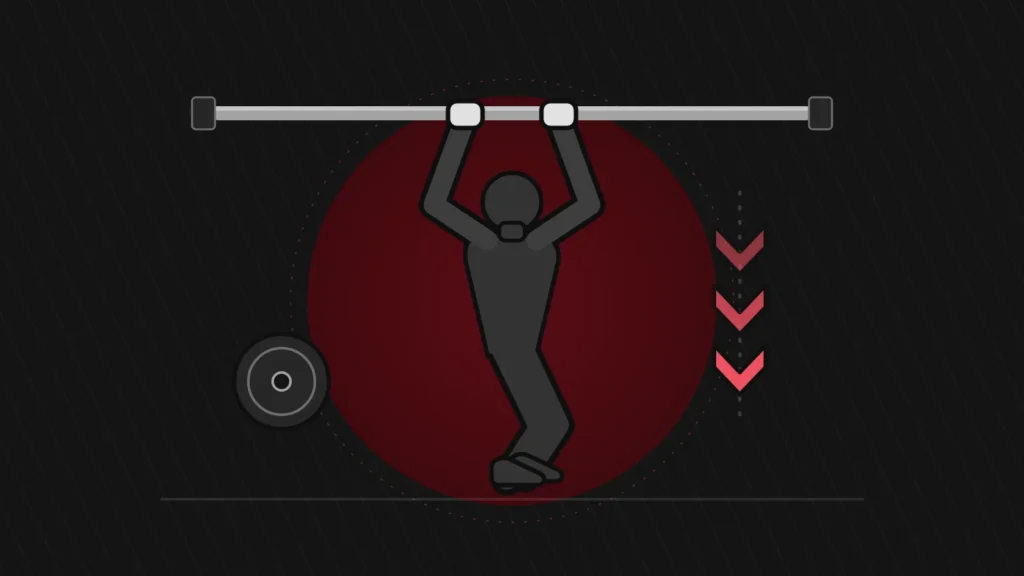
Negative pull ups keep only half the movement, the half you are strongest in: the lowering. You get your chin over the bar with a box, a bench or a jump, then you fight gravity all the way down to straight arms. Two very different lifters live on this exercise: the one who cannot do a single rep yet, building the strength they are missing, and the one already pulling with a 45 lb plate (20 kg) on a belt, chasing an overload no other drill provides. Same movement, two completely different prescriptions.
Negative Pull-Ups: Why Lowering Builds Pulling Strength
A muscle under tension while it lengthens produces more force than the same muscle shortening. In isolated fiber, maximal eccentric force reaches roughly 1.8 times maximal isometric force. In a whole human, neural inhibition pulls that ratio down to about 1.2 times, but it still beats what you can produce concentrically, as laid out in a review published in Frontiers in Physiology in 2017. In gym terms: you can control a descent you have no chance of reversing. That gap is the entire reason the negative pull-up works.
The same review covers the second half of the story, energy cost. At a matched movement speed, positive work costs about six times more energy than negative work, with fewer motor units recruited and a lower discharge rate. Huge mechanical tension, very little metabolic bill. That is why three sets of negatives leave you shaky without leaving you winded.
What Eccentric Training Actually Buys You
The systematic review by Douglas and colleagues in Sports Medicine, 2017, concluded that eccentric training produces greater strength gains, though largely specific to the contraction mode, and increases muscle cross-sectional area at least as much as other methods, with a preferential growth of type II fibers. A more recent meta-analysis in Sports, pooling 8 randomized controlled trials and 441 participants, found an effect size of 0.95 for strength and 0.60 for hypertrophy favoring eccentric work, with a wide gap in rate of force development.
Pay attention to the word “specific,” because that is where lifters get burned. Negatives alone will not hand you a full pull-up. They build the strength reserve; the attempt at the concentric is what converts it into a rep that counts. Keep real pulling in your week alongside them, bands or assisted reps, the way the guide to progressing at pull-ups lays it out.
Muscles Worked in a Negative Pull-Up
The same ones as a standard pull-up, loaded while lengthening and for far longer under tension. Lats and teres major resist the arm traveling away from your torso through the whole descent. Lower traps and rhomboids control the shoulder blade as it rides back up your ribcage, and that is where beginners break first: the shoulder rides up toward the ear and the rep turns into a drop. Biceps brachii and brachialis brake elbow extension, and your finger flexors hold the bar from start to finish, so grip often quits before your back does. Your abs and glutes keep the pelvis from swinging forward and turning the negative into a pendulum.
Electromyography work on pull-up variations, including Dickie and colleagues in 2017, shows more biceps activity with a close supinated grip and more lat activity with a wide pronated grip. For negatives, stay with a pronated, shoulder-width grip. It is the grip you actually want to own, and it keeps the elbow in a comfortable angle across a long descent.
How to Do a Negative Pull-Up, Step by Step
- Get to the top without spending energy: a box, a bench, or a jump off the floor. You are not training the way up.
- Set the top position properly. Chin over the bar, chest tall, shoulder blades down and squeezed, elbows pointing at the floor.
- Legs slightly in front, pelvis locked, abs braced. No arch, no swing.
- Lower at a constant speed, no dead time at the top: the same pace from chin to straight arms.
- Finish with arms fully extended and shoulders still engaged. Full range is half the benefit.
- Step down, reset at the top, go again. The reset is part of the set, so do not rush it.
The Right Tempo, Not the Longest One
Three to five seconds of real control beats ten seconds where the last four are a free fall. The thing that drives adaptation is tension held across the whole range. When you can no longer hit your target tempo, the set is over, even if you had reps left on paper.
Getting Your First Pull-Up With Negatives
The protocol that works is deliberately small: 3 to 5 sets of 3 to 5 negatives, 3 to 5 seconds down, 2 to 3 minutes of rest between sets, twice a week. No more than that. Negatives are expensive both neurally and mechanically, and unaccustomed eccentric work is exactly what produces the most muscle damage and soreness. The good news is that the damage drops sharply after the first few sessions thanks to the repeated bout effect. The bad news is that if you start at six sessions a week, you will spend a month sore and gain nothing.
Progress in this order: tempo quality on 3 reps first, then rep count, then descent length. Once you own 5 clean negatives at 5 seconds, you are physically ready for the full rep, and the method for your first pull-up walks through how to set that attempt up. Once you clear 8 bodyweight reps, roll straight into the weighted pull-up program.
Weighted Negatives: Eccentric Overload for the Weighted Pull-Up
Once you can pull, the problem flips. Your concentric caps the load you can handle, while your descent could absorb considerably more. Weighted negatives remove that cap: you get to the top with help from your legs, you come down with the weight.
The numbers come from the research. Testing eccentric-only bench press, Moir and colleagues in 2013 loaded 9 resistance-trained men at 110, 120 and 130 percent of their concentric 1RM, who completed 14.2, 11.4 and 9.4 reps respectively, and projected an eccentric max near 165 percent of the concentric max. On the payoff side, a study published in Frontiers in Physiology in 2023 compared 10 weeks of accentuated eccentric loading at 90 percent versus 120 percent of 1RM in 27 active men: 6.3 percent strength gain in the submaximal group, not statistically significant, against 16.3 percent in the supramaximal group. That is the case for loading the descent, provided you keep the volume honest.
| Variable | Negatives for your first rep | Weighted negatives |
|---|---|---|
| Load | Bodyweight only | 105 to 115 percent of total load, bodyweight included |
| Descent | 3 to 5 seconds | 3 to 4 seconds, never longer |
| Sets and reps | 3 to 5 sets of 3 to 5 | 3 to 4 sets of 2 to 3 |
| Frequency | Twice a week | Once a week, in a 3 to 4 week block |
| Spot in the session | Early, after a full warm-up | After your heavy pull-up sets |
| Purpose | Build strength you do not have | Break through your concentric ceiling |
Run the math carefully, because in a pull-up your body is part of the load. A 175 lb (79 kg) lifter whose best single is plus 60 lb (27 kg) is moving 235 lb (107 kg) total. Targeting 110 percent of that total, 258 lb (117 kg), means hanging about 83 lb (38 kg) off the belt, not 66. The jump is bigger than it looks, so climb in 10 lb (5 kg) steps. Use the same belt or vest you already train with, and have a partner help you reach the top. Setup and progression details live in the weighted pull-up guide. The same logic transfers directly to dips, where loading the descent is even easier, and the weighted dip program already builds it in. For the weighted muscle up program, the negative is there to teach a controlled transition, not to pile on plates.
Mistakes That Cancel the Benefit
- Dropping at the end. Two-thirds controlled and one-third free fall is a joint exercise, not a strength exercise. Shorten your target tempo until you can own the full range.
- Stopping at half-extended elbows. You are cutting out the position where you are weakest, which is the one that needs the work most. Finish straight, shoulders engaged.
- Doing them every day. Eccentric work generates more muscle damage than concentric work. Two sessions a week is plenty for a beginner, one for weighted negatives.
- Muscling your way to the top. Burn yourself out getting up there and nothing is left for the part that matters. Box, bench, or jump, every single rep.
- Running negatives only. Eccentric gains are mode-specific. Without a full-rep attempt every week, you will get strong at lowering and still not pull.
- Adding weight too early. Weighted negatives assume a clean full-range pull-up. Before that, bodyweight is already giving you all the stimulus you can use.

mathieu
Street workout athlete since 2019, I discovered streetlifting in 2023. Today I share my passion for the sport through streetliftings.com.