Key takeaways
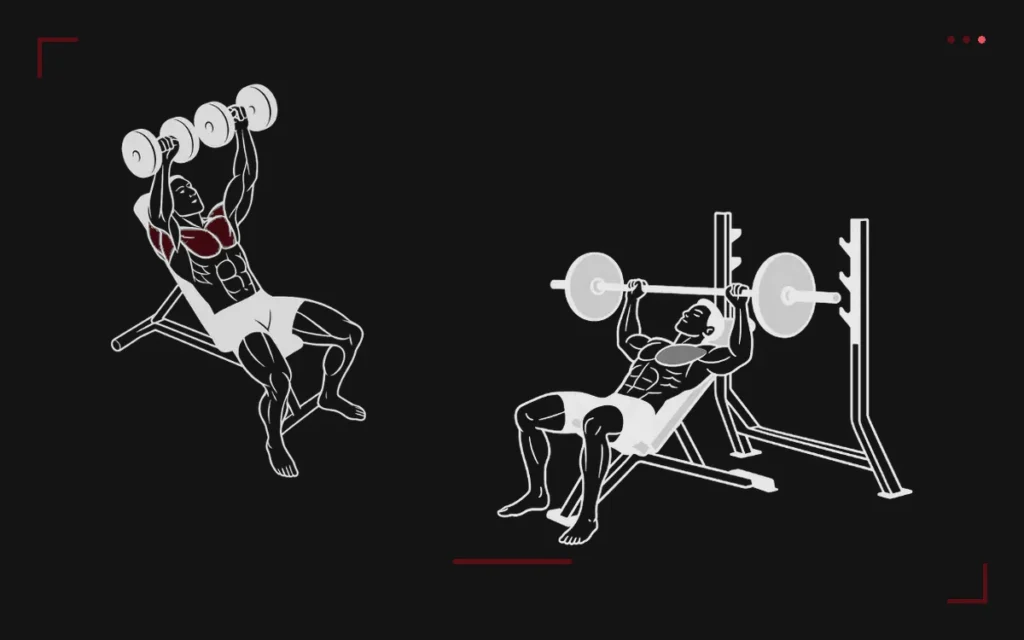
- The incline press is a pressing movement on an angled bench that biases the clavicular head of the pec major, the upper chest.
- It also loads the anterior deltoid and triceps heavily, and their share grows as the bench gets steeper.
- Upper chest activation peaks around a 30-degree incline: past 45 degrees the lift turns into a seated shoulder press.
- The number one mistake is setting the bench too steep, followed by flaring the elbows to 90 degrees, which strains the shoulder and empties the movement.
- The barbell is for heavy loading, dumbbells are for range of motion and fixing left-right imbalances: run both across the week.
The incline press is the go-to lift for filling out the upper chest, that shelf under the collarbones that makes a torso look finished from the front. Barbell or dumbbells, it is also one of the most badly set up lifts in any gym: raise the bench two notches too high and the work walks straight into your front delts. Here is the technique, the bench angle that actually matters, the loads to expect, the mistakes to fix, and where the lift belongs in a push day, including when your real goal is stronger weighted dips.
Muscles Worked by the Incline Press
The incline press is a compound push. It does not shut off part of your chest and switch on another: it changes the press line so the clavicular head of the pec major, the portion that attaches to the collarbone, contributes more than it does on a flat bench.
- Pec major, clavicular head: the main target, the upper slab of chest near the collarbone.
- Pec major, sternal heads: still working hard, the incline does not turn them off.
- Anterior deltoid: heavily involved, and its share climbs as the bench gets steeper.
- Triceps brachii: drives elbow extension through the top half of the press.
- Serratus anterior, traps and cuff: hold the shoulder blade in place for the whole set.
It helps to know why that clavicular head responds to an incline at all. According to Frédéric Delavier, anatomist and strength training author, the specific job of the clavicular head is frontal elevation, raising the arm forward, where the sternal heads only pull the arm across the body. The practical fallout, walked through in this breakdown of the incline press: keep your elbows slightly tucked and traveling forward under the bar and you drive the elbow up and forward, which is exactly what that head does. Flare the elbows out to the sides and you are back to a mid chest press, whatever the bench says.
The second takeaway is less comfortable: what you feel depends on your build, your humeral torsion and your arm length. Delavier’s advice is to test the lift over several weeks on yourself instead of copying someone else’s verdict. If after four to six weeks you have never once felt your upper chest, that is a signal worth acting on.
Bench Angle: The Setting That Decides Everything
This is your first technical decision, before you even pick a weight. The more upright the backrest, the closer the path gets to a seated shoulder press and the more the front delt takes over.
| Bench angle | What works hardest | When to use it |
|---|---|---|
| 0 to 15 degrees | Mid chest, close to a flat bench | Incline effect is marginal, little reason to bother |
| 15 to 30 degrees | Upper chest, shoulders still quiet | Best trade-off for most lifters |
| 30 to 45 degrees | Upper chest with a clearly loaded front delt | Standard setting if your shoulders are comfortable |
| Above 45 degrees | Anterior deltoid dominant | That is a seated shoulder press, not a chest press |
A 2020 study in the International Journal of Environmental Research and Public Health, reported by Peloton, compared muscle activation on the barbell bench press across angles: upper chest activation peaked with the bench at 30 degrees, and every extra degree past that fed more work to the front delt and triceps. That lines up with Jeremy Ethier, kinesiology-trained coach and founder of Built With Science, who recommends a slight incline of 15 to 30 degrees, usually one or two notches up from the bottom setting on a commercial bench.
The in-set cue: if your front delts are burning and your upper chest is not, drop the bench one notch. On a bench with no markings, aim for a backrest at roughly a third of vertical, not half.
Barbell or Dumbbells: The Honest Trade-Off
Both work. They just solve different problems. The barbell is the load tool, the dumbbells are the range-of-motion and symmetry tool.
| Criteria | Barbell incline press | Dumbbell incline press |
|---|---|---|
| Load you can handle | Highest, and you can add 5 lb at a time | Lower, stabilizing caps the weight |
| Range of motion | Stops the moment the bar hits your upper chest | Goes deeper, bigger stretch at the bottom |
| Bar path | Fixed, reassuring but rigid | Free, lets you bring your hands together at the top |
| Left-right imbalance | Your strong side covers for the weak one | Each arm carries its own load, gaps close |
| Shoulder comfort | Wrists and shoulders locked in by the bar | Semi-neutral grip available, usually kinder |
| If you fail a rep | You need a spotter or safety pins | You dump the dumbbells to the sides |
| Weak point | Unracking from hooks set too high | Getting the dumbbells into and out of position |
In practice: training alone with no safeties, take the dumbbells. Chasing pure strength with a clean progression log, keep the barbell as your first movement. The best long-term answer is to rotate, one barbell session and one dumbbell session, the same way you would with the flat dumbbell press.
Step-by-Step Execution
Your setup matters as much as the press itself. Flat back on the pad, shoulder blades wandering, glutes lifting off, and you have given away half your strength before rep one.
The Setup, Both Versions
- Set the backrest between 15 and 30 degrees to prioritize the upper chest, up to 45 if your shoulders feel better there and you get a stronger chest contraction.
- Pull your shoulder blades back and down into the pad, chest proud. This is what stabilizes the shoulder and sends tension into the pec.
- Keep your glutes pinned to the seat, feet planted hard, knees pushed out.
- Brace: breathe in through the nose, squeeze abs and glutes. A small arch is normal and useful, your butt does not leave the bench.
Barbell
- Grip just outside shoulder width. A very wide grip kills the squeeze at the top and cuts chest recruitment.
- Unrack without shoving the bar off the hooks with your shoulders, which unpacks everything you just set. Get a lift-off or lower the hooks.
- Lower with elbows under your wrists and slightly tucked, bar tracking to just below the collarbones. Control it, never bounce it off your chest.
- Press by driving your feet into the floor, elbows staying under the wrists, no hard lockout at the top.
- Breathe: inhale on the way down, exhale as you press.
Dumbbells
- Get into position with the dumbbells resting on your thighs, then kick them back as you lie down. Never curl them up off the floor with straight arms.
- Start with the dumbbells over your upper chest, arms extended but not locked, wrists stacked over elbows.
- Lower with elbows 45 to 60 degrees from your torso, never flared to 90. Go down to a real stretch, not past what your shoulders allow.
- Press and bring the dumbbells slightly together at the top without clanking them, and stop once your arms are straight over your shoulders.
- Finish the set by bringing the dumbbells onto your chest and sitting up with them, rather than dropping them out to the sides.
Mistakes That Waste the Lift
Four faults account for most unproductive sets and most sore shoulders on this exercise.
| Mistake | What happens | Fix |
|---|---|---|
| Bench set too steep | Front delt takes the press, chest checks out | Drop one or two notches, stay under 45 degrees |
| Elbows flared to 90 degrees | Shoulder in a vulnerable spot, clavicular head barely used | Elbows 45 to 60 degrees, tucked under the wrists |
| Forearms angled inward | Shorter lever, load leaves the chest | Forearms vertical over the elbow on every rep |
| Shoulders rounding forward | Delts absorb the work and the growth | Blades retracted and depressed from first rep to last |
| Glutes lifting, slippery bench | Lost base, soft brace, bar path drifts | Feet down, glutes pinned, lighten the load |
| Bouncing off the chest | Brutal load on ribs and shoulder | Controlled eccentric, one-count pause at the bottom |
The forearm mistake deserves more than a table row. According to Jeremy Ethier, the habit of letting your forearms cant inward as the weight climbs shortens the lever and hands work to the triceps. Ethier runs the numbers in this video on five dumbbell press mistakes: if the dumbbells end up halfway between your shoulder and your elbow, the load actually reaching the chest can be cut roughly in half. You press more weight and stimulate less muscle. Check it by filming a set from the side, the forearm should stay vertical over the elbow the whole way down.
One more gym-floor detail that gets ignored: a slick bench pad slides your hips up set after set, your brace goes soft and you lose your foot drive in the middle of a heavy set. A couple of bungee cords wrapped around the seat give your shorts something to grip and stop the slide.
How Much Weight and How Many Reps
Expect to press less than you do on a flat bench: the leverage is worse and the delt takes a bigger share. Coaching benchmarks, to be adjusted against your own sets.
- Barbell: figure on roughly 70 to 85 percent of your flat bench for the same rep count. If you flat bench 225 lb (102 kg) for 5, expect 155 to 190 lb (70 to 86 kg) for 5 on the incline.
- Dumbbells: total load across both dumbbells usually lands another 10 to 20 percent below the barbell version because of the stabilizing demand.
- First session: build up over three ramp-up sets before your first working set, with the shoulders properly warm.
| Goal | Sets and reps | Rest | Preferred version |
|---|---|---|---|
| Strength | 4 to 5 x 3 to 5 | 2 to 3 min | Barbell, first exercise of the day |
| Mass | 3 to 4 x 6 to 10 | 90 to 120 s | Barbell or dumbbells |
| Volume and feel | 3 x 10 to 15 | 60 to 90 s | Dumbbells, 3-1-1 tempo |
| Return from shoulder pain | 3 x 12 to 15 | 60 s | Neutral-grip dumbbells, shortened range |
Progress through progressive overload: the moment you hit the top of your rep range on every set with clean form, move up. Dumbbell jumps are chunky (often 5 lb per hand), so lean on reps, a pause at the bottom and a slower eccentric before you jump. Leave at least 48 hours between heavy pressing sessions.
Where It Belongs in Your Session
The classic move is to run the incline press right after flat bench. That is not always the smart call. According to Nico Dalam, a coach known for translating training research, the two lifts are too similar for the second one to add much: after heavy flat sets, you no longer have the output to make incline sets productive. In this video on stacking incline after flat bench, Dalam argues for making the incline the main press of a second chest session in the week, and finishing sessions with a constant-tension movement, cable or machine, instead of a second barbell press.
Two layouts that work, depending on whether you press once or twice a week:
- One push day per week: incline barbell press 4 x 6-8 first, weighted dips 3 x 6-8, flat dumbbell press 3 x 8-10, cable crossover 3 x 12-15.
- Two sessions per week: session A opens with flat bench and finishes on the chest press or a cable. Session B opens with the incline press, then pec deck and triceps.
Either way, the incline goes in while you are fresh, never last behind two other presses. Session-by-session progression is laid out in the streetlifting training program.
Variations and Alternatives
Changing the tool restarts progress without changing the goal. Each variation answers a specific problem.
- Smith machine incline: fixed path, useful for learning the setup or pressing heavy alone with safeties, at the cost of stabilizer work.
- Neutral-grip dumbbells: palms facing each other, the kindest version for cranky shoulders and worth trying before you drop the lift.
- Single-arm press: one dumbbell at a time, your core has to fight the offset load and each side progresses on its own.
- Low cable press: constant tension and the option to cross your hands at the top, the best fallback if you never feel your chest on a barbell press.
- Incline flye: isolation at the same angle, as a finisher and never as a replacement for a press.
- Decline press: the opposite angle for the lower chest, cycled against the incline (see the decline press).
Incline Press and Weighted Dips: The Carryover
In streetlifting the incline press is not a physique lift, it is a strength accessory. The upper chest and the front delt work together coming out of the bottom of a weighted dip, which is exactly where most lifters stall. Loading that portion with external weight buys you margin at the weak point.
Three ways to use it when your dips stop moving:
- Slow tempo: 3 seconds down, a 1 second pause at the bottom, normal press up. That builds tolerance to tension in the stretched position, which is what runs out at the bottom of a dip.
- Light pre-fatigue: two sets of dumbbell incline press for 12 to 15 reps before dips, only on a volume day, never before a heavy session.
- Separate session: heavy barbell incline on a day with no dips programmed, so you add pressing volume without eating into dip performance.
The rest of the progression, belt loading and how to cycle it, is covered in the weighted dip program. Train your back and external rotators too: a balanced shoulder girdle is what lets you press heavy for years without breaking down.
To balance all that pressing with pulling, the weighted pull-up program is the natural pairing. And if the muscle-up is your goal, the weighted muscle-up program puts that same pressing strength to work in the lockout over the bar.
FAQ
What muscles does the incline press work?
The main target is the clavicular head of the pec major, the upper chest just under the collarbone. The sternal heads of the chest still work, and the anterior deltoid and triceps contribute heavily to the press. Serratus anterior and traps hold the shoulder blade in place throughout the set.
Is incline press 30 or 45 degrees?
Aim for 15 to 30 degrees if your goal is the upper chest, and up to 45 degrees if that angle feels better on your shoulders. A 2020 study reported by Peloton found upper chest activation peaked at 30 degrees, with each additional degree feeding more work to the front delt and triceps. Above 45 degrees you are doing a seated shoulder press.
How much should you incline press?
Expect roughly 70 to 85 percent of your flat bench for the same rep count. A 225 lb (102 kg) flat bench for 5 reps usually translates to somewhere around 155 to 190 lb (70 to 86 kg) for 5 on the incline. With dumbbells, the combined load typically lands another 10 to 20 percent lower because of the stabilizing demand.
Barbell or dumbbells for the incline press?
The barbell lets you load the most weight and track progression in 5 lb jumps, which makes it the logical first lift of a session. Dumbbells give you a deeper stretch at the bottom and force each arm to carry its own load, which closes left-right gaps. If you train alone with no safety pins, take the dumbbells.
Should you do incline press after flat bench?
Not necessarily. The two lifts overlap heavily, and after heavy flat sets you no longer have the output to make incline sets productive. A better setup is to make the incline the main press of a second chest session in the week, and finish your sessions with a constant-tension cable or machine movement instead.
What is the difference between incline press and shoulder press?
The bench angle is what separates them. Up to about 45 degrees, the chest stays the prime mover and the front delt assists. Past that, the press line runs close to vertical, the anterior deltoid takes over, and the movement is effectively a seated shoulder press with back support.

mathieu
Street workout athlete since 2019, I discovered streetlifting in 2023. Today I share my passion for the sport through streetliftings.com.