Start Here
- Streetlifting Program
- Weighted Muscle Up Program
- Weighted Pull-Up Program
- Weighted Dip Program
- Squat Program
The Planche Row is an essential exercise for anyone who wants to build a powerful back and improve their strength training performance. Highly valued in muscle-building programs, this movement deeply targets the upper-body muscles while reinforcing posture. When performed correctly, it becomes a key asset in any training routine – especially for street workout and streetlifting athletes. Let’s break down how to master this technical exercise.
How to Do the Planche Row
Mastering the Planche Row requires discipline, good posture, and developed body awareness. Understanding each phase of the movement is essential to avoid injury and maximize your gains.
Exercise Technique
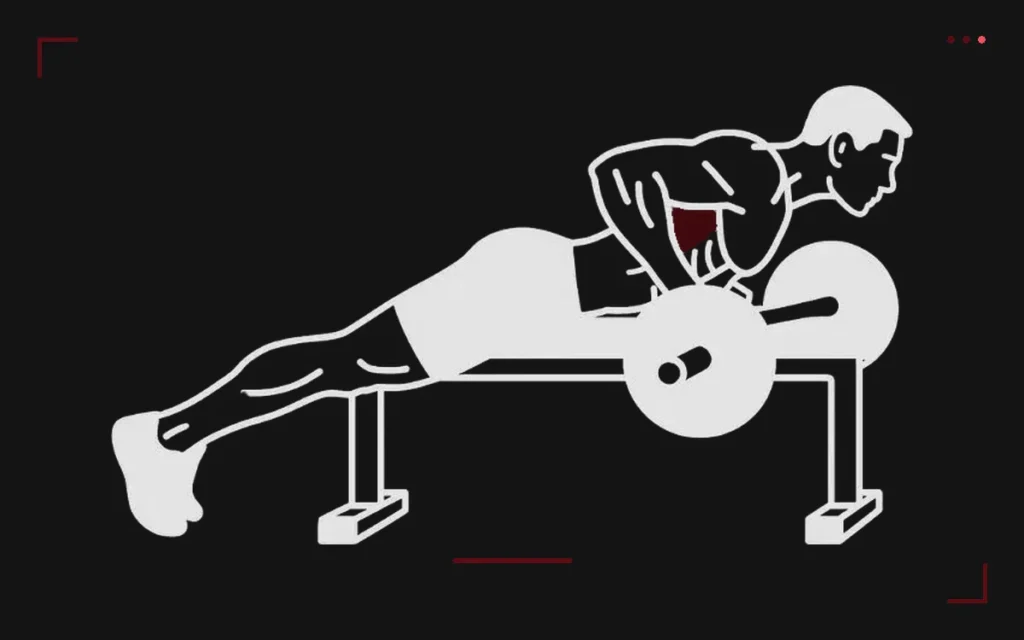
Here is a step-by-step execution guide to perform a Planche Row correctly:
-
Starting position:
Lie face down with your chest a few centimeters off the floor.
Keep your legs extended and feet resting on the floor.
Extend your arms forward, palms facing down. -
The pull:
Contract your glutes, lower back, and abs to stabilize your trunk.
Drive your elbows backward, keeping your arms close to your body.
Squeeze your shoulder blades as hard as possible at the top of the movement, as if you were trying to “pinch a pen” between them. -
Return to starting position:
Release the movement slowly and control the descent.
Program or coaching?
Find your ideal format
Answer 4 questions and receive a personalized recommendation based on your level and your goals.
Tailored result
Free
Targeted Muscles
The Planche Row is a multi-joint exercise that intensely works several muscle groups. It ranks among the best back exercises for strength training.
Here are the main muscles targeted:
-
Latissimus dorsi: the primary driver of the pull.
-
Middle and lower trapezius: involved in scapular movement.
-
Rhomboids: responsible for scapular retraction.
-
Posterior deltoids: stabilize and assist the movement.
-
Spinal erectors: maintain a braced, rigid torso throughout.
What Are the Benefits of the Planche Row?
The Planche Row offers numerous advantages, whether you are a beginner or an experienced athlete.
Functional Strength Gains
This movement builds strength in the posterior muscles, which are crucial for pulling movements such as pull-ups, muscle ups, and horizontal rows.
Better Posture
By strengthening the upper back, this exercise helps correct postural imbalances caused by long hours of sitting or unbalanced training programs.
Accessibility
No equipment required: the Planche Row is a bodyweight exercise, making it accessible to everyone – at home or in the gym.
Streetlifting Preparation
It is also an excellent assistance exercise for streetlifting athletes, strengthening the muscles used in weighted pull-ups and static holds such as the planche.
Common Errors to Avoid to Prevent Injury
Like any strength exercise, the Planche Row requires correct execution to be effective and safe. Here are the most common mistakes to avoid:
❌ Lifting your head: this causes unnecessary tension in the neck. Keep your head aligned with your spine.
❌ Performing fast, uncontrolled reps: favor a slow, controlled execution to effectively engage the back muscles.
❌ Pulling with your arms only: the goal is to mobilize your shoulder blades, not just bend your elbows.
❌ Excessively arching the lower back: active bracing is essential to protect the lumbar spine.
❌ Insufficient range of motion: aim to squeeze your shoulder blades as hard as possible on every rep.
Coach’s Conclusion
The Planche Row is a devastatingly effective exercise for building back strength, improving scapular stability, and boosting your overall performance. Easy to integrate into a street workout or bodyweight training program, it will help you build a solid back – essential for muscular balance and athletic performance.
Add it 2 to 3 times per week to your routine alongside other pulling exercises, and you will quickly see results in your posture, strength, and physique.
Other Back Exercises to Explore
- Assisted Pull-Up
- Dead Hang
- Pull-Ups with Resistance Bands: the first step toward pull-up progress
- How to Do Chin-Ups and Build Your Biceps
- Ring Muscle Up
- TRX Row
- Close-Grip Lat Pulldown
- Barbell Row: Techniques and Tips
- Neutral Grip Pull-Up
- Renegade Row

mathieu
Street workout athlete since 2019, I discovered streetlifting in 2023. Today I share my passion for the sport through streetliftings.com.